How many minutes is the Peak Tram ride?
The Peak Tram ride takes about 6 minutes one way over 1,278 metres of track. Here is what that time buys, what the ride is like, and why the length of the ride is not the same thing as how long the whole visit takes.
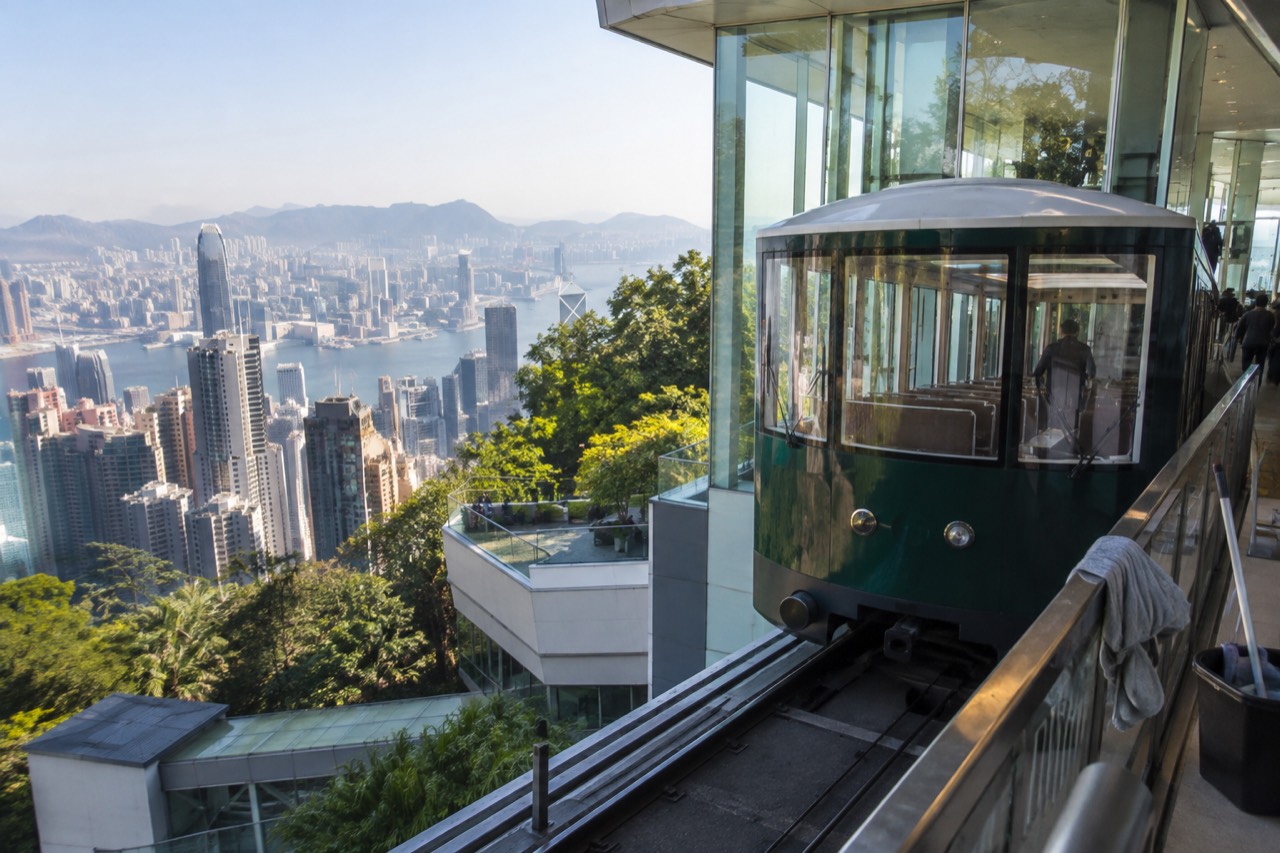
How many minutes is the Peak Tram ride?
The Peak Tram ride takes approximately 6 minutes one way, according to the operator's own published history of the line. The tram covers 1,278 metres of track between the Central Terminus at 33 metres above sea level and the Peak Terminus at 396 metres. Six minutes is the ride alone: it does not include getting to the terminus, boarding, or anything you do once you step off at the top.
Six minutes is a short number for one of the most famous railway rides in Asia, and it surprises people who have read longer estimates elsewhere. The figure comes straight from the operator, which publishes it on its history page alongside the track length and both terminus heights. It is a funicular, not a conventional tram: a double reversible system where two cars are hauled along the same track by cables, with haulage ropes of 50.5 mm diameter holding a 55-tonne tramcar, at a published safety factor of 8.
The ride has run on its original alignment since service commenced on 30 May 1888, when it was the first cable funicular in Asia. The line was raised over the years to give headroom over Kennedy Road, but the route you ride today follows the 1888 alignment. On the first day the tram carried 600 passengers, and about 150,000 in its first year, the only ridership figures that are genuinely sourced from the operator's own record.
If you are planning around that six minutes, the practical point is that the ride time is fixed and the rest of the day is not. Boarding depends on how many visitors turn up, and the operator says plainly that queueing time depends on the number of visitors on the day. The full picture of waiting at the terminus is covered in how long the tram queue is, while this article sticks to the ride itself.
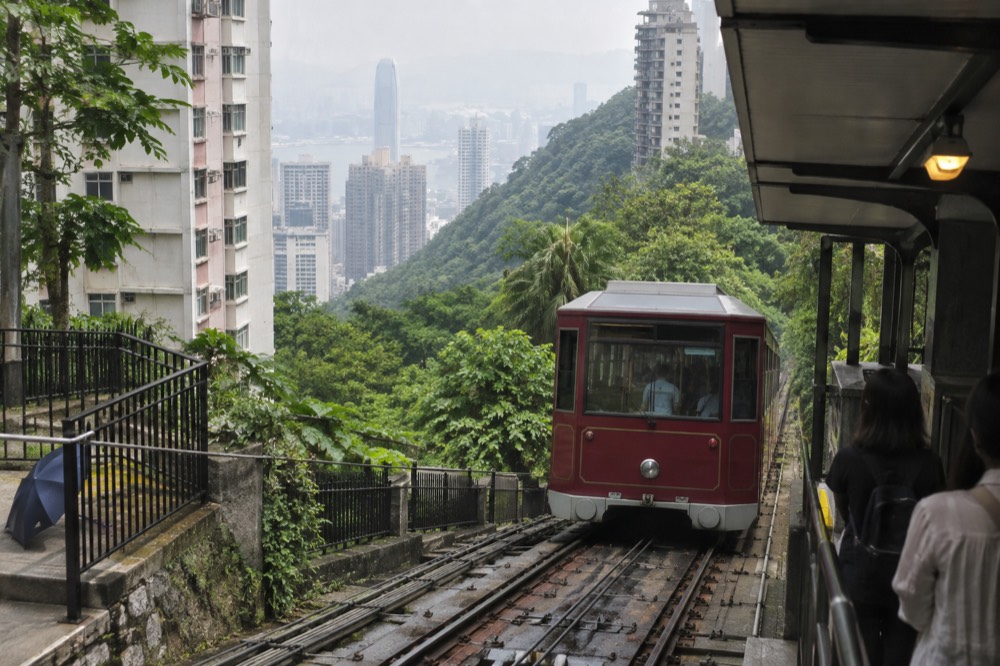
What does the ride actually feel like?
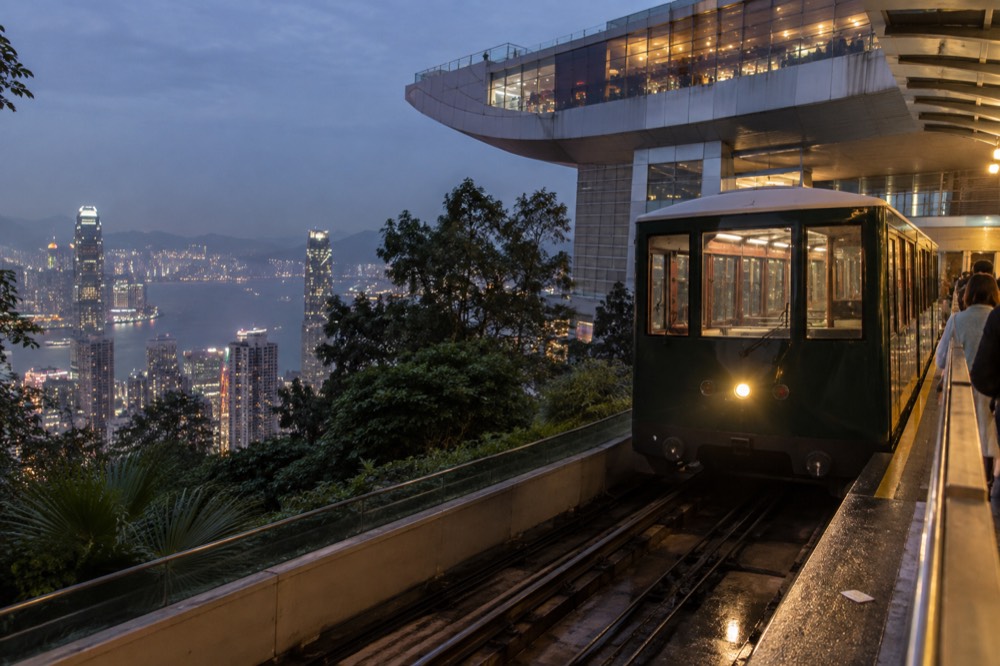
The ride feels like a slow, steep climb through apartment blocks and trees, reaching a maximum gradient of 25.7 degrees where the tracks pass below May Road, the steepest part of the line. Going uphill, many passengers notice that the high-rise buildings to the right appear to lean toward the Peak, a visual illusion documented in a 2013 Psychological Science study and cited by the operator. The current cars seat 167 passengers with room for 43 standing.
That leaning-buildings effect is the detail everybody mentions afterwards and almost nobody can explain. The operator's page attributes it to a study by The University of Hong Kong, published in 2013 in Psychological Science, a journal of the Association for Psychological Science. The buildings are not moving: the combination of the tilted cabin and the surrounding verticals tricks the eye, and the effect is strongest on the steepest parts of the climb.
The steepness is real even where it is not at its maximum. The gradient runs from 4 degrees at the gentlest to 25.7 degrees at the hardest, and the steepest stretch has a named location: the tracks pass below May Road at 25.7 degrees to the horizontal. A car weighing 55 tonnes holds on that slope, and the tram carries four braking systems: Normal Stop, Service Stop, Emergency Stop, and a fourth fitted on the tramcars themselves, in the operator's own naming. For a nervous reader, that is the honest answer, from the operator rather than from reassurance invented by a travel writer.
The floor of the standing area carries a waveform design for standing passengers, one of the small published touches of the 2022 rebuild. The windows are panoramic and larger than the previous generation's, the doors are wider, and the operator added step-free access for persons with a disability in the same project, which is the one verified accessibility fact about this trip. The livery is a bespoke colour the operator calls Peak Tram Green, a nod to the third and fourth generation cars, which is why every photograph taken since 2022 shows green rather than the old red.
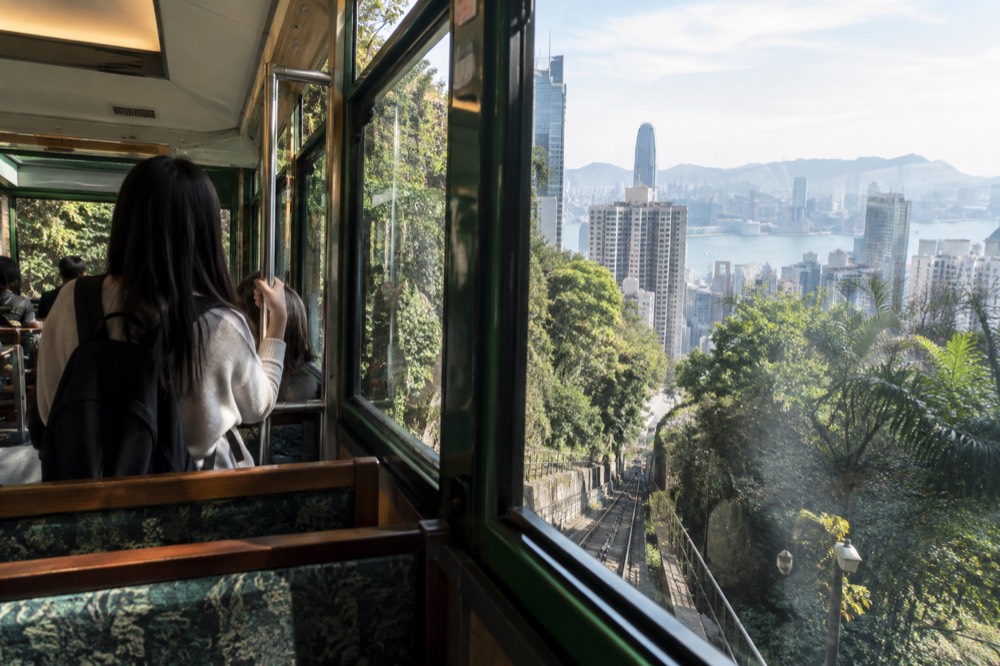
Why do so many articles describe the ride wrongly?
Because the entire system was rebuilt in August 2022, and anything written before that date describes a tram that no longer exists. The sixth generation replaced all haulage, control and signalling systems, installed new tramcars and track rails, strengthened the foundations and refurbished both termini with enhanced queuing capacity. Capacity rose 75 per cent, from 120 passengers to 210. Most competing articles still carry the retired numbers.
The fifth generation arrived in 1989 after a HK$60-million overhaul, carried 120 passengers, and was reopened by Governor Sir David Wilson on 20 September 1989. That 120 figure is the one that keeps resurfacing, sometimes stated as current fact on pages that have not been rewritten in years. It has been out of service since 2021, and the sixth generation that replaced it carries 210: 167 seated and 43 standing.
The new tramcars are manufactured in Switzerland by Garaventa, CWA and Frey, three named makers from the operator's own page rather than the vague "new Swiss trams" that most write-ups offer. The rebuild is also why the termini look the way they do: the same project significantly refurbished both ends of the line with enhanced queuing capacity, so any description of the Central Terminus layout from before August 2022 is describing a building that has since changed.
The dating problem runs through the whole subject. Between 1908 and 1949, a brass plaque on the back of the first two seats read "This seat is reserved for His Excellency, the Governor", and those seats could not be occupied until two minutes before departure. In 1926 electric haulage replaced the coal-fired steam boilers and that generation's car carried 52 passengers. On 11 December 1941 the engine room was damaged in an attack, and service resumed on Christmas Day 1945 with part of a Japanese shell still lodged under the main base plate of the haulage drums. Those are the operator's own recorded details, and they are the reason a page that can date its facts, like this one, reads differently from a page recycling a 2019 description.
The full story of the line, from Alexander Findlay Smith's 1881 petition to the 2022 rebuild, is told in the Peak Tram history guide, and the ride experience itself is covered in detail in the Peak Tram ride guide.
How does six minutes fit into a whole visit?
The tram runs from 7:30 am to 11 pm every day, but the ride is only the transfer: the hours that shape your day are the deck's. Sky Terrace 428 opens at 8:30 am and closes at 10 pm, an hour later and an hour earlier than the tram, so a first-tram arrival cannot use a combo ticket in full on arrival. Most of a Peak visit happens after the six-minute ride, not during it.
This is the hours trap that catches early risers and night owls at opposite ends of the day. The Peak Tower is open 7 am to 11 pm, the tram runs 7:30 am to 11 pm, and the paid deck on its roof keeps the shorter window. A visitor who rides the first tram of the day with a tram-and-deck combo arrives an hour before the deck opens. A visitor aiming for the deck's closing hour has to remember the deck shuts while the tram is still running, so the ride down stays available but the paid view does not. The full index of guides sits on Victoria Peak Hong Kong.
The operator's only published crowd-timing guidance is one sentence: "During public holidays or festive seasons, crowd control management will be implemented. Visitors are encouraged to purchase tickets in advance and come before 3pm during non-peak hours." That is the whole of the official advice on timing, and everything else on the subject is invention. The operator also sells tickets online for same-day visits and up to 30 days ahead, with a maximum of 10 tickets per ticket type per transaction, which bounds how far ahead a booking can be made.
Here is how the moving parts of a day line up:
| Part of the visit | Published hours or figure | Source |
|---|---|---|
| Peak Tram, both termini | 7:30 am to 11 pm, daily | Operator hours panel |
| The Peak Tower building | 7 am to 11 pm, daily | Operator hours panel |
| Sky Terrace 428 deck | 8:30 am to 10 pm, daily | Operator hours panel |
| The ride itself | Approximately 6 minutes one way | Operator history page |
| Track length | 1,278 metres | Operator history page |
| Height gain | 33 m to 396 m above sea level | Operator history page |
One weather rule sits on top of the hours: when a tropical cyclone warning signal no. 8 or above, or a special inclement weather warning, is hoisted, the Peak Tram and Sky Terrace 428 close. The operator recommends checking the Hong Kong Observatory's two Victoria Peak webcams before travelling, one looking east and one looking north-northeast, and both feeds resolve live.
Is a six-minute ride worth the fare?
At the gate the operator publishes HK$82 for an adult single tram ride and HK$116 for a return, tram only, with no Sky Terrace 428 admission in either. The cheapest bookable option on the live listing is $10.59, and it buys exactly that one-way tram ride for one adult, nothing more. Whether that is worth it depends on treating the ride as part of the visit rather than the whole of it.
The from-price trap is worth stating plainly, because most pages get it wrong. The $10.59 starting price on the operator's live listing is a one-way Peak Tram ride, adult, tram only, with no deck admission and no ride back down. The combo that most visitors actually want costs more at the gate: HK$146 for an adult single tram ride plus one Sky Terrace 428 admission, or HK$182 with a return ride. The operator also states that you cannot assemble the combo saving by buying the parts separately: "you must select the Peak Tram Special Combo tickets to enjoy the best price."
The honest way to frame the decision is a three-way split, each part separately sourced. The tram ticket buys the ride, six minutes of it, on a funicular that has run since 1888. The Sky Terrace 428 ticket buys the extra height, the deck on the tower roof at 428 metres above sea level, which the operator describes as "the highest observation deck in Hong Kong", a claim that belongs to the operator rather than to this page. And the view from the top of the hill costs nothing at all: the Peak Galleria rooftop viewing deck is free, in the tourism board's own words, and so are Lugard Road, Harlech Road and Victoria Peak Garden, which the operator publishes at 554 metres, higher than the paid deck.
| Ticket, adult, at the gate | Single | Return | Deck included |
|---|---|---|---|
| Peak Tram only | HK$82 | HK$116 | No |
| Special Combo, tram + Sky Terrace 428 | HK$146 | HK$182 | One admission |
| Sky Terrace 428 admission alone | HK$80 | n/a | Yes, deck only |
| Peak Tram Ruby Special, priority access | HK$342 | n/a | Yes |
Those HK$ figures are the operator's own published gate fares, not booking-page prices, and they stay in the currency they are published in. Concession fares exist for a child aged 3 to 11, a senior 65 or above, or a holder of the HKSAR Registration Card for people with Disabilities, and that last one is not a tourist discount: it is available only when buying on arrival. Hong Kong has no VAT or GST, and the operator charges no online handling fee, so the number you see is the number you pay. The full fare ladder, including the child and senior bands, is on the operator's published price list.
Does the ride take longer at busy times?
The ride time does not change with crowds: the operator publishes approximately 6 minutes one way and no source states a longer journey under load. What changes is everything around the ride. The operator states its timed tickets "do not provide priority boarding" and that queueing time depends on the number of visitors on the day, so a busy day stretches the boarding wait, not the six minutes in the car.
That distinction matters because the featured ticket is a standard ticket, not a fast-track product. Buying ahead puts you in the "Pre-purchased Ticket Holder" queue, which removes the ticket-buying line, not the boarding line. The operator makes the same point independently and bluntly: timed tickets are designed to help manage the flow of visitors, but they do not provide priority boarding, and the queueing time depends on the number of visitors on the day. No published figure exists for any wait, at any hour, in any season, and any page printing one has invented it.
Priority access does exist, but it is a different and dearer product. The operator's Peak Tram Ruby Special is published at HK$342 for an adult and described as "Priority Exclusive Access, Daily Limited Quota", and the equivalent option on the live listing carries its own redemption route at Ruby Pass access points. That is the honest answer to whether you can pay to move up the line: yes, at a specific published price, in a specific product, and not in the cheap one. The comparison is worked through in the is a Ruby Pass worth it post.
One practical note on boarding itself: baby strollers must be folded before entering the tram and must not exceed 26 inches, or 66 cm, in width when folded. Pets are not allowed on the tram except qualified guide dogs, though pets in a stroller or on a leash are allowed inside The Peak Tower. There is no luggage storage at either tram station or in the tower, which matters to anyone routing the Peak between a hotel checkout and a flight.
What should you actually plan around the ride?
Plan the day, not the ride: six minutes is fixed, so the variables worth controlling are when you arrive, which ticket you hold, and what you do at the top. Arrive before 3 pm outside peak hours if you follow the operator's own advice, check the Observatory's Peak webcams on the morning, and decide in advance whether the paid deck is worth it against the free viewpoints. The ride will take care of itself.
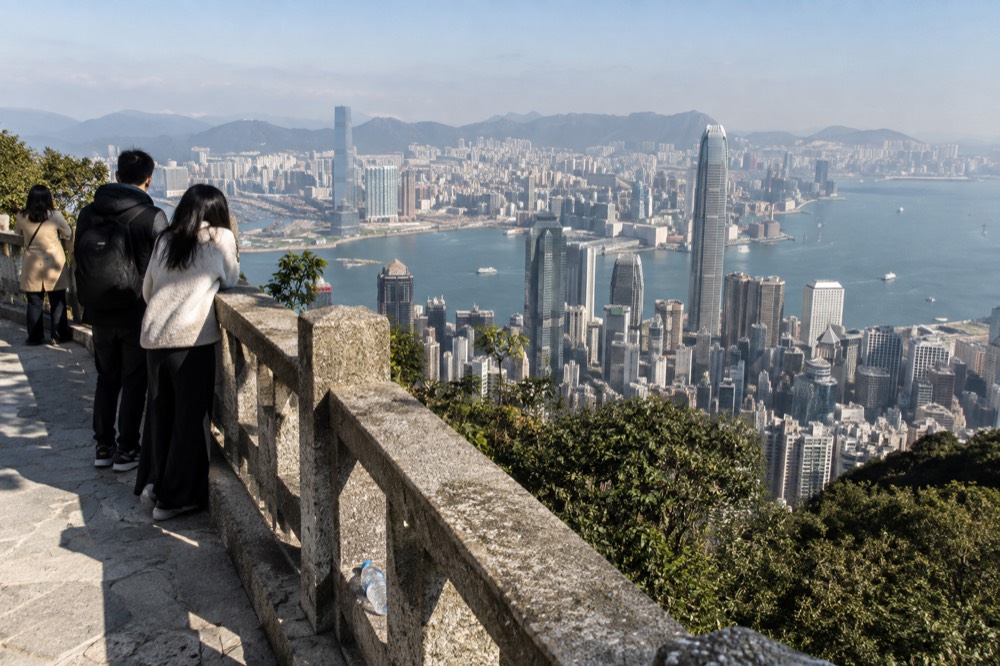
At the top, the tram deposits you at the Peak Terminus in Victoria Gap, and it is worth being precise about where that is. The Peak Tower does not stand on the summit: the operator states it "does not sit atop Victoria Peak but is situated in Victoria Gap, a dip along the line of the hills at an elevation of 396 metres". Victoria Peak itself is 552 metres, the highest point on Hong Kong Island, and the summit is closed to visitors, occupied by a radio installation. Victoria Peak Garden, at 554 metres in the operator's figures, is the highest ground a visitor can freely stand on, and it is free.
The free walking options are real and published with timings by the operator and the tourism board. The Hong Kong Trail loop, out along Lugard Road and back via Harlech Road, takes 40 to 60 minutes in the operator's own walk list. Victoria Peak Garden is a 30 to 40 minute uphill walk along Mount Austin Road, with a car park and a light refreshment kiosk at the top, and sits approximately 1.2 km from The Peak Tower. The Peak Circle Walk is 3.5 km and, in the tourism board's own words, "can be completed in an hour". None of those figures includes the ride up, which is the point: the ride is six minutes and the hill is the rest of the day.
Photographers should note the operator's own rules: tripods and lighting equipment are not allowed in the Peak Tram, The Peak Tower or Sky Terrace 428, and drones are prohibited on Peak Tram and Peak Tower property without management permission. Free Wi-Fi is available at the tram termini, in The Peak Tower and on Sky Terrace 428, which answers the practical question of uploading photographs from the top. The West Deck of Sky Terrace 428 can be hired as a private venue, which is why part of the deck is sometimes roped off for reasons that are not a fault.
For the ride itself, the operator's published FAQ is the source of record for boarding rules, Octopus card use and the weather closure rule. One detail worth knowing before you tap anything: an Octopus card cannot be used for direct entry at the admission gate, though it can be used to buy a ticket at the counter and to pay on board at the intermediate stations. The forum advice that says "just tap your Octopus" is wrong at the gate and right on board, and the split is published on the operator's own page. More on planning the whole outing is in how long you need up there, and the wider question of whether the day justifies itself is tackled in is the Peak worth going.
Common questions about the Peak Tram ride
How many minutes is the Peak Tram ride?
Approximately 6 minutes one way, in the operator's own published figure. The tram covers 1,278 metres of track and climbs from 33 metres above sea level at the Central Terminus to 396 metres at the Peak Terminus.
Is the Peak Tram ride the same as the Hong Kong street tram?
No. The Peak Tram is a funicular running on cables between Garden Road and Victoria Gap. The double-decker "ding ding" tram runs on flat ground along the north of Hong Kong Island and does not go up to the Peak.
Does the ride take longer when it is busy?
No published source says so. The operator states the journey takes approximately 6 minutes one way, and says queueing time, not ride time, depends on the number of visitors on the day.
Does the $10.59 ticket include the viewing deck?
No. The $10.59 starting price buys a one-way Peak Tram ride for one adult, tram only, with no Sky Terrace 428 admission. Deck admission is a separate, dearer option, and the operator's gate price for the tram-plus-deck combo is HK$146 single.
Can you ride the first tram of the day and go straight to the deck?
Not with a combo ticket used in full. The tram starts at 7:30 am but Sky Terrace 428 opens at 8:30 am, so an early arrival waits an hour before the deck admits visitors.
Is the ride steep enough to notice?
Yes. The gradient runs from 4 degrees to 25.7 degrees, with the steepest section where the tracks pass below May Road. Passengers riding uphill commonly see the buildings appear to lean, an effect documented in a 2013 study published in Psychological Science and cited by the operator.