Best Time to Visit Victoria Peak: Months, Weather and Views
October, November and December give the Peak its clearest air on the 30-year record, while February and March carry the most fog. Here is what the published data actually says, month by month.
Short answer
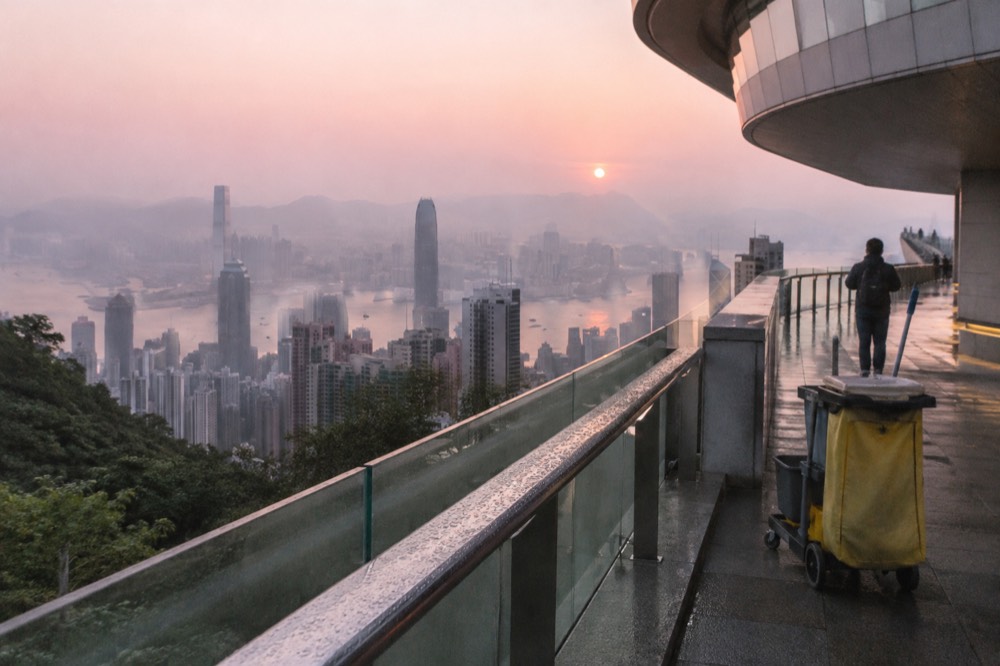
October is the clearest month on the Hong Kong Observatory's 1991 to 2020 record, with 55 per cent of possible bright sunshine, followed closely by November and December. February and March are the foggiest. The tram runs from 7:30 am but Sky Terrace 428 only opens at 8:30 am, so time the day around both.
Hong Kong's government weather record is unusually good at answering the question most seasonal guides guess at. The Hong Kong Observatory publishes 30-year monthly normals for the whole territory, and those numbers, read against the Peak Tram's own published hours, tell you which month to book and which hour to arrive far more reliably than any "October to December is best" line copied from another blog. This guide works through the data month by month, then covers the hours trap that catches early risers, the fog months nobody warns you about, and how the ticket options fit the season you choose.
One thing to be clear about at the start: the Observatory's figures are Hong Kong-wide normals recorded at the Observatory's own station, not measurements taken on Victoria Peak itself. No visibility statistic specific to the Peak is published anywhere. What the territory-wide record still tells you, honestly, is which months the air over the harbour is most likely to be clear, and that is the best available signal for planning a visit.
Which months give the clearest view from the Peak?
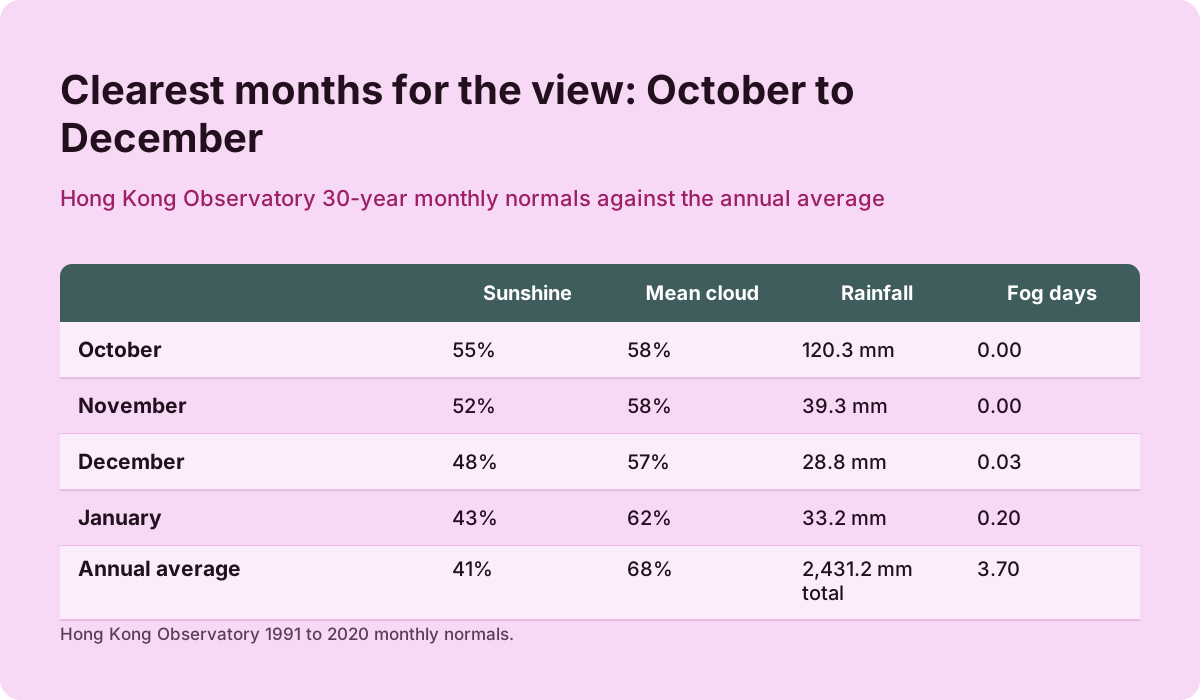
October, November and December are the three clearest months on the 30-year record, with October the sunniest of all at 55 per cent of possible bright sunshine and December the least cloudy at 57 per cent mean cloud. November combines 52 per cent sunshine with only 39.3 mm of rain. All three carry essentially no normal fog days. If your dates are flexible, these are the months to aim for.
October's advantage is the sunshine share. The Observatory's 1991 to 2020 normals give October 55 per cent of possible bright sunshine against an annual average of 41 per cent, with mean cloud at 58 per cent and 120.3 mm of rain across the month. That combination, high sun, moderate cloud and drying weather, is what produces the long-distance views across Victoria Harbour that the Peak is famous for.
November is the quieter answer. It holds 52 per cent sunshine, the same 58 per cent mean cloud as October, and rainfall drops to 39.3 mm. December then completes the run with the year's lowest mean cloud amount at 57 per cent, the year's lowest rainfall at 28.8 mm, and 48 per cent of possible sunshine. The common assumption that winter is a poor season for the view is simply wrong on this record: December is the driest and least cloudy month of the year.
January extends the good-weather window further than most guides admit. It carries 43 per cent sunshine, 62 per cent cloud, 33.2 mm of rain and 0.20 fog days, which makes it a genuinely solid month, just a step behind the October-to-December trio. Temperatures are mild rather than cold, with a mean daily maximum of 18.7 C and a minimum of 14.6 C on the normals.
| Month | Possible bright sunshine | Mean cloud | Rainfall | Fog days (visibility under 1,000 m) |
|---|---|---|---|---|
| October | 55% | 58% | 120.3 mm | 0.00 |
| November | 52% | 58% | 39.3 mm | 0.00 |
| December | 48% | 57% | 28.8 mm | 0.03 |
| January | 43% | 62% | 33.2 mm | 0.20 |
| Annual average | 41% | 68% | 2,431.2 mm total | 3.70 |
The whole year averages 2,431.2 mm of rain over 139.90 days with 0.1 mm or more, 68 per cent mean cloud and just 3.70 fog days, so every figure above is being measured against a fairly cloudy baseline. Four of those 3.70 fog days are spread across the year's other months, and two of them cluster in a pair of months covered further down this page.
What does the weather actually do month by month?
The Observatory's normals split the year into a clear, dry October-to-January run, a fog-prone February-to-April stretch, a hot wet May-to-September summer, and a recovering September. High summer is sunnier than spring on this record, which contradicts most seasonal advice. The numbers below are Hong Kong-wide, not Peak-specific.
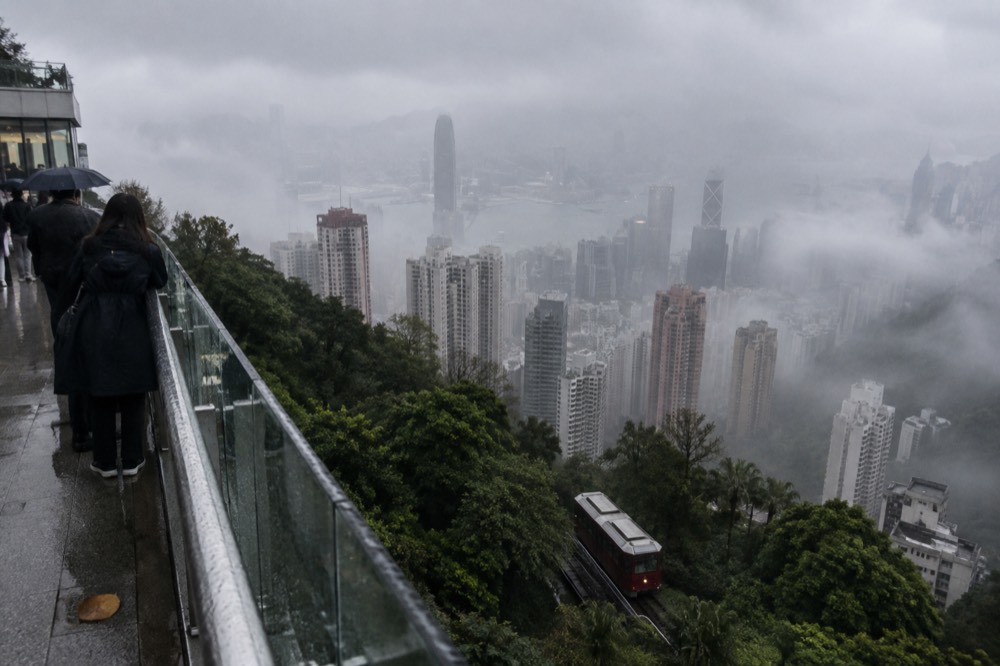
The spring months are the record's weak point, and the reason is fog rather than rain. March is the murkiest month of the year: 27 per cent of possible bright sunshine, the lowest of any month, 77 per cent cloud, 75.3 mm of rain and 1.47 mean days with visibility under 1,000 metres. February is close behind at 32 per cent sunshine, 72 per cent cloud and 1.10 fog days. April keeps cloud at 77 per cent with 30 per cent sunshine and still carries 0.83 fog days.
A "fog day" in this dataset means a day with visibility below 1,000 metres, and the whole year averages 3.70 of them. February and March alone hold 2.57 between them, which is the single most useful thing a seasonal guide can tell you: nearly seven in ten of the year's genuinely greyed-out days fall in those two months. Rain-based advice misses this entirely, because February is dry at 38.9 mm.
Summer flips the trade-off. May brings 34 per cent sunshine and 290.6 mm of rain across 15.37 wet days, but fog has all but gone at 0.07 days. June is the wettest month at 491.5 mm across 19.33 wet days, with 77 per cent cloud and 36 per cent sunshine. July carries 48 per cent sunshine with 385.8 mm of rain, August 46 per cent with 453.2 mm, and September 47 per cent with 321.4 mm as cloud falls back to 66 per cent.
The counterintuitive result is that July and August, at 48 and 46 per cent sunshine, are clearer months than March or April on this record. High summer is wet but bright between showers. Spring is dry but grey. If you are choosing between a March trip and an August trip for the view alone, the data points at August, typhoon risk aside.
Whichever month you pick, the ticket itself is a menu rather than a single product, and the option you choose changes the price considerably.
The cheapest option on the listing is a one-way adult tram ride at $10.59, tram only, with no Sky Terrace 428 admission and no ride back down. The operator's own published gate fares put a round-trip tram ticket at HK$116, Sky Terrace 428 admission alone at HK$80, and the round-trip tram plus deck combination at HK$182. Those are the operator's gate prices, not booking-page prices, and they are the honest comparison for what each option buys.
Should you go up in the morning or the afternoon?
The Peak Tram runs from 7:30 am to 11 pm but Sky Terrace 428 only opens at 8:30 am and closes at 10 pm, so the first tram of the day arrives an hour before the paid deck opens. The operator's only published timing advice is to come before 3pm during non-peak hours. Time your visit around both opening hours, not just the tram's.
| What | Opens | Closes | Days |
|---|---|---|---|
| Peak Tram | 7:30 am | 11 pm | Monday to Sunday and public holidays |
| The Peak Tower | 7 am | 11 pm | Monday to Sunday and public holidays |
| Sky Terrace 428 | 8:30 am | 10 pm | Monday to Sunday and public holidays |
On timing and crowds, exactly one sentence of official guidance exists anywhere, and it comes from the operator's own FAQ: "During public holidays or festive seasons, crowd control management will be implemented. Visitors are encouraged to purchase tickets in advance and come before 3pm during non-peak hours." That is the whole of the published advice. No queue time or wait duration is published for any hour, day or season, and the operator states plainly that queueing time depends on the number of visitors on the day, so nothing more precise may honestly be claimed.
Buying ahead does have one specific effect: it removes the ticket-counter line, because pre-purchased ticket holders present their e-voucher QR code at the admission gate rather than buying on arrival. It does not provide priority boarding, a point the operator makes itself. The tram ride itself takes approximately 6 minutes one way on 1,278 metres of track between the Central Terminus at 33 metres above sea level and the Peak Terminus at 396 metres.
If the morning-versus-afternoon question is really a light question for you, the night and day comparison at the Peak works through what the view gives at each end, and the guide to Peak Tram hours and the timetable covers the full schedule in one place.
Which months bring fog, rain and typhoons?
February and March carry the fog risk, holding 2.57 of the year's 3.70 mean fog days between them, with March the murkiest month at 27 per cent sunshine. June is the wettest month at 491.5 mm of rain. Typhoon signal 8 days cluster in August and September, averaging 0.80 and 0.67 days a year respectively, and a signal 8 closes the tram and the deck.
The typhoon numbers deserve more attention than the vague "typhoon season runs May to October" line most guides print. The Observatory's 1991 to 2020 normals give the mean number of days a year with a tropical cyclone warning signal no. 8 or above as: August 0.80, September 0.67, July 0.53, June 0.27, October 0.13, May 0.03, and nil for November through April. In other words, the clearest months for the view are also the months with effectively zero signal 8 risk.
The closure rule is published and specific: when a tropical cyclone warning signal no. 8 or above, or a special inclement weather warning, is hoisted, the Peak Tram and Sky Terrace 428 close. The road services keep running, so the hill itself is not cut off, but the ticketed attractions are. If you are booking a summer trip, it is worth knowing that the operator recommends checking the Hong Kong Observatory's two Victoria Peak webcams, one looking east and one looking north-northeast, before travelling; the operator's own FAQ points visitors at them as a live visibility check.
| Month | Mean days a year with signal 8 or above | Mean fog days | Rainfall |
|---|---|---|---|
| February | 0.00 | 1.10 | 38.9 mm |
| March | 0.00 | 1.47 | 75.3 mm |
| June | 0.27 | 0.00 | 491.5 mm |
| July | 0.53 | 0.00 | 385.8 mm |
| August | 0.80 | 0.00 | 453.2 mm |
| September | 0.67 | 0.00 | 321.4 mm |
| October | 0.13 | 0.00 | 120.3 mm |
| November | 0.00 | 0.00 | 39.3 mm |
September is the interesting transitional case. It still carries 321.4 mm of rain and a 0.67 mean of signal 8 days, but cloud falls to 66 per cent and sunshine rises to 47 per cent, so a late-September visit after a typhoon has passed can deliver excellent air. The risk profile, not the averages, is what should drive a summer booking.
For the fog months, the practical mitigation is the webcam check the operator recommends, plus a flexible itinerary. The Peak's free viewpoints cost nothing, so a grey morning can be written off without having wasted a deck ticket, which is one reason the free things at the top are worth knowing about before you go.
How does humidity change the view?
Humidity expresses itself at the Peak as haze and cloud, not as rain. The months with high mean cloud, 77 per cent in March, April and June, are the months when the skyline softens into grey, while the 57 to 58 per cent cloud of October to December is what produces sharp, long-distance views. Sunshine share, not rainfall, is the number that predicts what you will see.
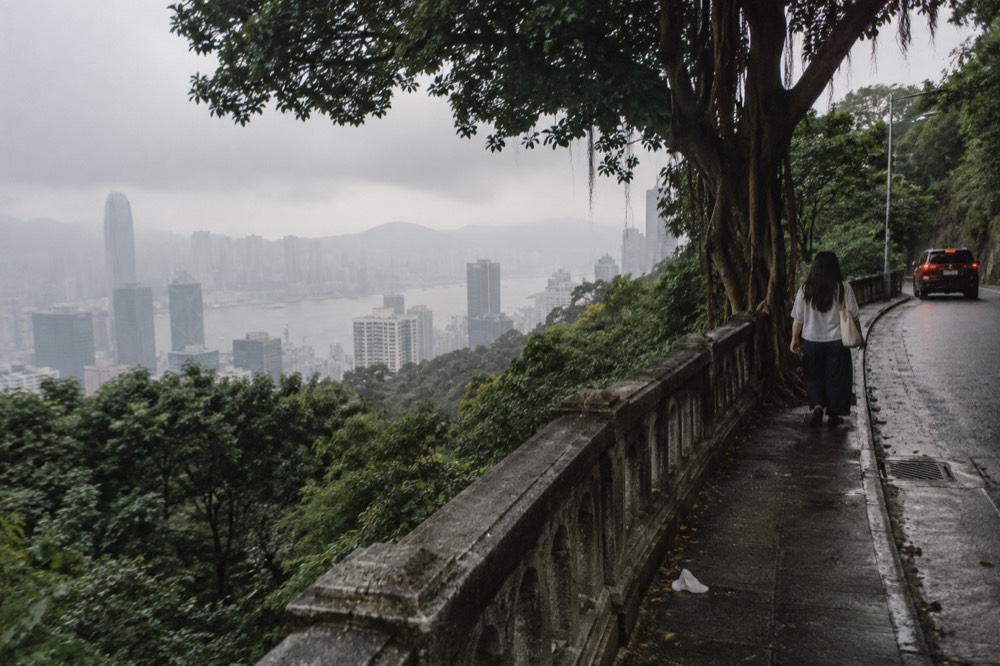
The distinction matters because rain and visibility are different problems. A wet June day can clear dramatically between showers, and the 36 per cent sunshine figure says some June hours are genuinely bright. A foggy March morning at 27 per cent sunshine may stay grey all day, because the moisture is suspended in the air rather than falling out of it. Visitors who plan around rain forecasts alone get this backwards.
The height you view from also changes how humidity reads. The Peak Tower sits in Victoria Gap at 396 metres, with Sky Terrace 428 on its roof at 428 metres above sea level, and the operator describes the deck as offering a 360-degree panoramic view across Victoria Harbour. At that height you are looking at cloud from inside the weather rather than beneath it. On a high-cloud day the deck can be inside the grey; on a clear winter day the same height is what makes the view reach the New Territories.
The operator describes Sky Terrace 428 as "the highest observation deck in Hong Kong", a claim worth attributing rather than asserting, and the deck's standalone admission is HK$80 for an adult on the operator's published price list. That standalone price matters to the timing question, because it means a visitor who arrives by bus or on foot on a clear evening can buy just the deck, and a visitor facing a grey afternoon can skip it and use the free alternatives instead.
The listing's aggregate rating is 4.6 across 41,347 reviews, and its full observed price range runs from $10.59 up to $38.79 in US dollars, a spread wide enough to show it is a menu of options rather than one ticket. The deck-only option exists precisely for the visitor whose timing is decided by the sky.
Is winter a good time to visit the Peak?
Yes, and the data says it is the best time. December has the year's lowest mean cloud at 57 per cent and lowest rainfall at 28.8 mm, and January follows at 62 per cent cloud and 33.2 mm. Mean daily maxima run 18.7 C in January and 14.6 C overnight, so it is mild. The only winter caution is that February, the last month of the season, is one of the two fog months.
Temperatures on the Observatory's normals run from a January mean daily maximum of 18.7 C and minimum of 14.6 C to a July maximum of 31.6 C and minimum of 26.9 C. Winter at the Peak is therefore a light-jacket experience, not a cold one, and the annual mean daily maximum of 26.0 C puts the whole year in warm-visit territory. The operator's own seasonal page gives softer ranges, including winter minima of 5 to 13 C for December and January, and where the two sources disagree the Observatory's 30-year dataset is the one to trust, as this guide does throughout.
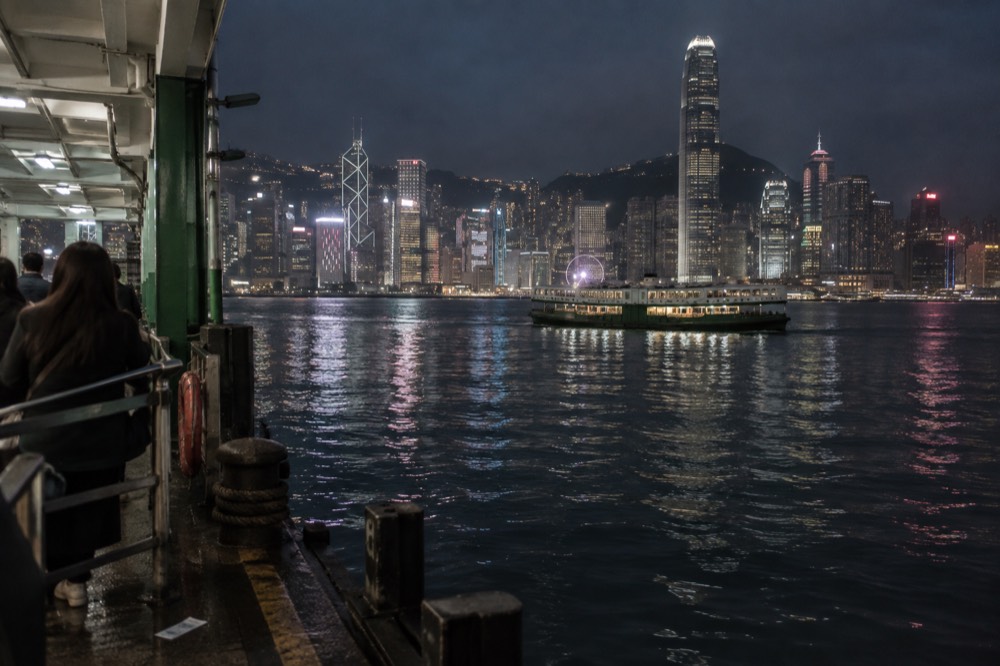
Winter also carries the year's best evening conditions. With fog days near zero and cloud at its annual minimum, the night skyline is at its sharpest, and the free viewing spots, the Peak Galleria rooftop deck, Lugard Road and the Lugard Road Lookout, cost nothing to check before you commit to a paid deck ticket. The Hong Kong Tourism Board calls Lugard Road "a great spot to enjoy sunset and night views of Victoria Harbour".
The one winter month to treat with care is February. It is dry at 38.9 mm, which makes it look good on a rain forecast, but it holds 1.10 mean fog days and 72 per cent cloud, second worst on the record. The fog-day column, not the rainfall column, is the honest signal for that month.
How should the season change what you buy?
In the clear October-to-January window, the round-trip tram plus Sky Terrace 428 combination at HK$182 as the operator's gate fare is the option most visitors want, because the view justifies the deck. In the fog months, a tram-only or deck-only option keeps your exposure low, and the free viewpoints at the top mean a grey day costs you nothing. Match the ticket to the forecast, not the brochure.
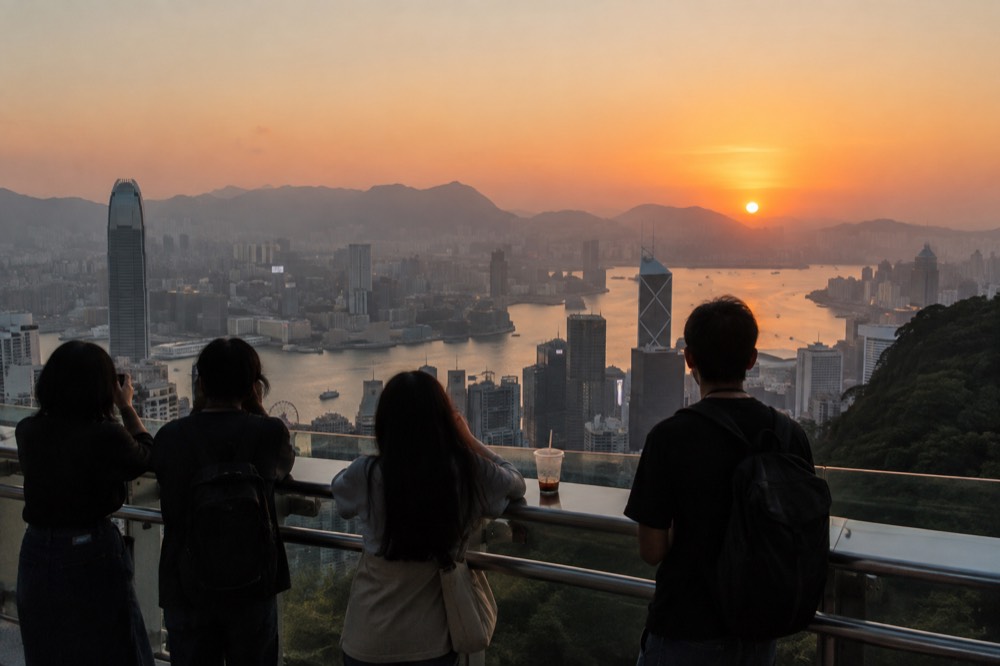
The operator's published gate ladder makes the comparison straightforward. An adult round-trip on the tram alone is HK$116, a single is HK$82, Sky Terrace 428 admission alone is HK$80, the single-ride combination is HK$146, and the round-trip combination is HK$182. Concession rates, for a child aged 3 to 11, a senior 65 or above, or a holder of the HKSAR Registration Card for people with Disabilities, run lower across the board, at HK$75 return tram-only, HK$118 return combo and HK$50 deck-only. The operator also states that you cannot assemble the combination saving by buying the parts separately: "you must select the Peak Tram Special Combo tickets to enjoy the best price".
| Ticket (adult, operator gate fares) | Single | Return |
|---|---|---|
| Peak Tram only | HK$82 | HK$116 |
| Peak Tram + Sky Terrace 428 combo | HK$146 | HK$182 |
| Sky Terrace 428 admission alone | HK$80 | not applicable |
| Peak Tram Ruby Special (priority access) | not applicable | HK$342 |
Two timing notes sit inside that ladder. First, the hours trap from earlier in this guide: a combination ticket used on the first tram of the day cannot be used in full until the deck opens at 8:30 am. Second, the operator sells tickets online for same-day visits and up to 30 days ahead, with a maximum of 10 tickets per ticket type per transaction, which bounds how far ahead a seasonal plan needs to commit. Hong Kong has no VAT or GST, and the operator charges no online handling fee.
The genuinely priority-access product is a different one: the Peak Tram Ruby Special, published at HK$342 adult and described by the operator as "Priority Exclusive Access, Daily Limited Quota". The standard ticket is not that product. Pre-purchase removes the ticket-counter line only, and the operator states its timed tickets "do not provide priority boarding", so the Ruby Pass value question is worth reading before paying the difference.
What should you check before you set the date?
Check the Observatory's two Victoria Peak webcams the operator recommends, confirm the tram and deck hours against your arrival time, and remember the signal 8 closure rule. Book within the operator's 30-day window if you want a dated ticket, and use the free viewpoints as your no-cost fallback if the sky turns. That is the whole checklist, and every part of it is published.
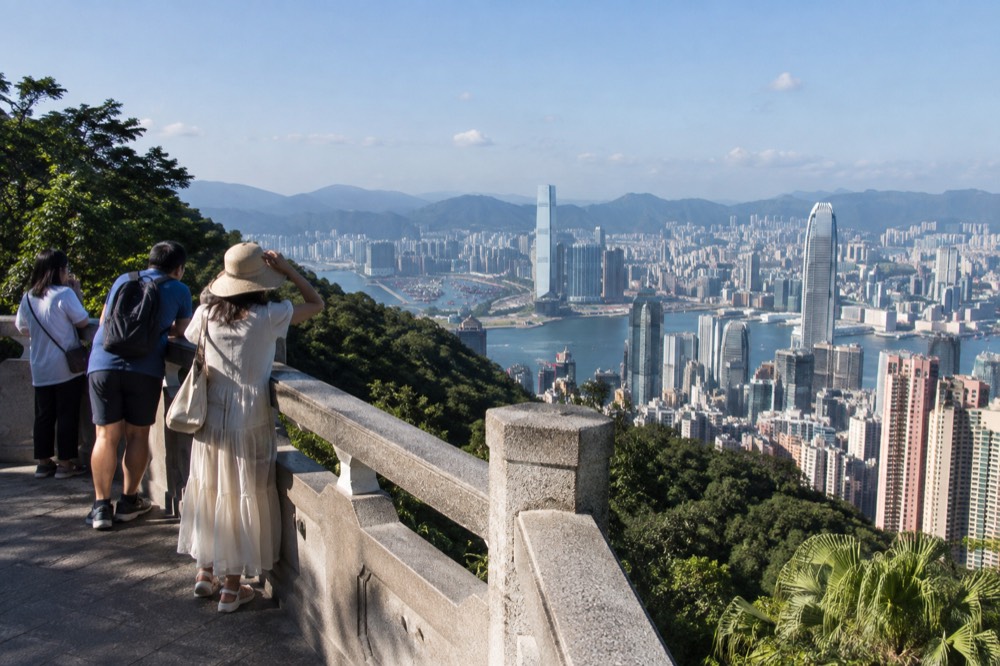
The webcam check is the most under-used tool in the whole plan. The operator's FAQ points visitors to the Hong Kong Observatory's two Peak webcams, one looking east and one looking north-northeast, as a live read on visibility before you travel. Checking the feed on the morning of your visit tells you more about the day's view than any monthly average can, because the averages pick the month and the webcam picks the day.
Beyond that, the planning sequence is short. Pick a month from the clear October-to-January window if your dates allow, and pick a day with the webcam if they allow less. Arrive with the hours trap in mind: the tram from 7:30 am, the deck from 8:30 am, the deck closing at 10 pm and everything else at 11 pm. Follow the operator's one published timing sentence and come before 3pm during non-peak hours if crowd management is in force over a holiday. Then choose the ticket option that matches the sky you actually have, which is exactly the decision the Victoria Peak Hong Kong ticket comparison is built to help with.
Weather aside, a few practical rules decide the day more than the season does. Tripods and lighting equipment are not allowed on the tram, in The Peak Tower or on Sky Terrace 428, and drones are prohibited on the property without management permission, so plan handheld night shots. There is no luggage storage at the tram stations or in the tower, which matters for anyone routing the Peak between a hotel checkout and a flight. Free Wi-Fi is available at the tram termini, in The Peak Tower and on Sky Terrace 428, which is the published answer to the photo-upload question.
Common questions about the best time to visit Victoria Peak
What is the best month to visit Victoria Peak?
October, on the Observatory's 1991 to 2020 normals: 55 per cent of possible bright sunshine, 58 per cent mean cloud, 120.3 mm of rain and no normal fog days. November and December are close behind, with December the least cloudy and driest month of the year.
What is the worst month for the view?
March, which has the year's lowest sunshine share at 27 per cent, 77 per cent mean cloud and 1.47 mean fog days. February is the other weak month, with 1.10 fog days. Together they hold 2.57 of the year's 3.70 mean fog days.
Is winter too cold at the Peak?
No. The Observatory's normals give January a mean daily maximum of 18.7 C and minimum of 14.6 C. Winter is the clearest season on the record, with December the least cloudy month of the year.
Does the Peak close for typhoons?
Yes. When a tropical cyclone warning signal no. 8 or above, or a special inclement weather warning, is hoisted, the Peak Tram and Sky Terrace 428 close. Signal 8 days cluster in August and September, averaging 0.80 and 0.67 days a year, and are effectively nil from November to April.
What time of day is best, morning or afternoon?
The operator's only published advice is to come before 3pm during non-peak hours. Note the hours: the tram starts at 7:30 am but Sky Terrace 428 does not open until 8:30 am, and the deck closes at 10 pm while the tram runs to 11 pm.
Can I check the visibility at the Peak before I go?
Yes. The operator recommends checking the Hong Kong Observatory's two Victoria Peak webcams, one looking east and one looking north-northeast, before travelling. They give a live read on the day's view.