Peak Tram history: from 1888 coal funicular to the 2022 rebuild
The Peak Tram opened on 30 May 1888 as Asia's first cable funicular, built to carry hill-station residents up to Victoria Gap. Six generations of tramcars later, the line still follows its original alignment, and the 1888 first-class fare was thirty cents. Today the adult single is HK$82 at the gate.
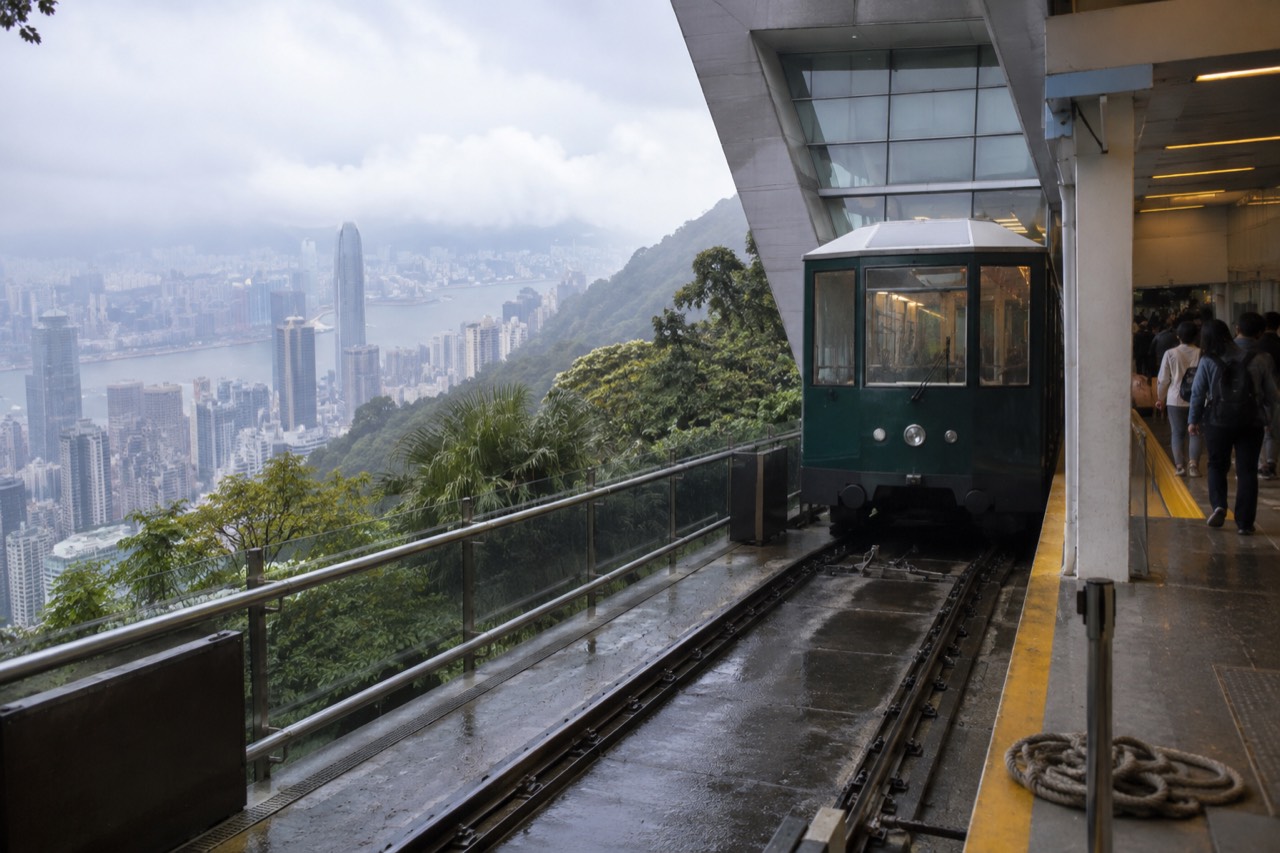
Short answer
The Peak Tram began service on 30 May 1888, the first cable funicular in Asia, after Alexander Findlay Smith petitioned the Governor in 1881. It originally ran 1,350 metres to five stations and charged 30 cents first class. The August 2022 rebuild raised capacity from 120 to 210 passengers, and the line still uses its 1888 alignment.
The Peak Tram has been climbing the same hill since 30 May 1888, when Sir William Des Voeux, then Governor of Hong Kong, officially opened Asia's first cable funicular. The line was not built for tourists. It was built because a Scotsman who had worked on Scotland's Highland Railway wanted a quicker way between Murray Barracks and Victoria Gap, and he spent seven years persuading the colonial government to let him build it.
Almost everything popularly written about the tram dates from before August 2022, when the sixth-generation rebuild replaced the haulage, the control and signalling systems, the track rails and the tramcars, and raised capacity from 120 to 210 passengers. A page describing the tram as a 120-seat ride is describing the fifth generation, retired in 2021. This guide tells the whole story from the operator's own records, and separates what has changed from what has not: the alignment, remarkably, is the original one.
Who built the Peak Tram, and when did it open?
Alexander Findlay Smith, a Scotsman with a background on Scotland's Highland Railway, petitioned Governor Sir John Pope-Hennessy in May 1881 for permission to run tram routes, one connecting Murray Barracks to Victoria Gap. Approval came in 1882, the Hong Kong High Level Tramways Company was formed, and service commenced on 30 May 1888, officially opened by Governor Sir William Des Voeux. It was the first cable funicular in Asia.
Findlay Smith's petition is the founding document of the line, and the operator's own history page preserves the detail that most retellings drop: he had worked for the Highland Railway before coming to Hong Kong. This was a railway man's project, not a property speculator's. The route he proposed ran from Murray Barracks, in the heart of what is now Central, up to Victoria Gap, the dip in the hills where The Peak Tower stands today.
The tram that opened in 1888 was a different machine from the one riding the hill now. It extended 1,350 metres, longer than today's 1,278-metre track, and connected five intermediate stations along the way. Coal-fired steam boilers drove the haulage. The line carried 600 passengers on its first day and about 150,000 in its first year, the only ridership figures in the whole subject that are genuinely sourced from a primary record.
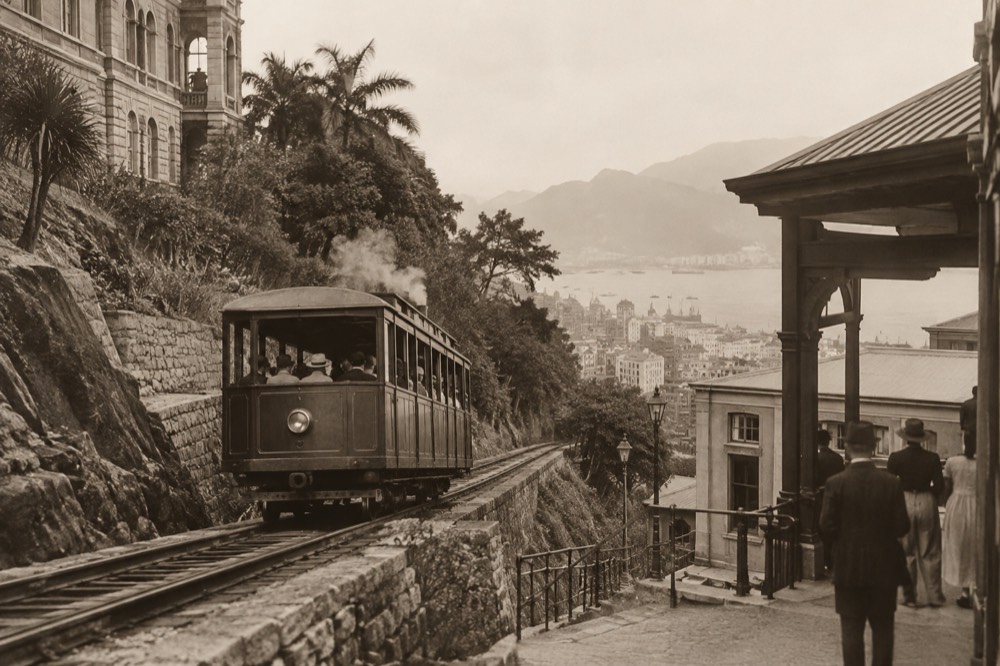
The original fare structure had three classes, and the return trip cost half price:
| 1888 class | Single fare to the Peak | Return fare |
|---|---|---|
| First class | 30 cents | 15 cents |
| Second class | 20 cents | 10 cents |
| Third class | 10 cents | 5 cents |
A century and a half later the class system is gone, but the single-versus-return split survives in the operator's fare ladder, which now runs from HK$82 for an adult single tram ride to HK$116 for the return. The full modern ladder is covered at the end of this guide.
Why was a funicular built to Victoria Gap?
The tram was built for the residents of the hill, not for sightseers. At the time of the petition the Peak was a hill station for wealthy colonists and the garrison, and the climb from Central on foot or by sedan chair was the daily obstacle. Findlay Smith's route from Murray Barracks to Victoria Gap solved exactly that problem, and the five intermediate stations existed to serve houses along the line.
The Peak in the late nineteenth century was a residential district with a transport problem. The homes above Mid-Levels were desirable precisely because they sat above the summer heat of the harbour, but reaching them meant a long climb. The tram turned that climb into a few minutes of seated travel, and the settlement pattern of the hill followed the line.
Victoria Gap, the destination, matters to this day and is one of the most misunderstood facts about the Peak. The operator states plainly that The Peak Tower "does not sit atop Victoria Peak but is situated in Victoria Gap, a dip along the line of the hills at an elevation of 396 metres". The tram has never taken anyone to the summit. It takes passengers to the gap, at 396 metres above sea level, where the upper terminus stands. The true summit of Victoria Peak, at 552 metres, is closed to the public and occupied by a radio installation.
That is why the modern ticket menu looks the way it does. The tram ride ends at Victoria Gap, and the paid viewing deck, Sky Terrace 428, sits on the roof of The Peak Tower at 428 metres, a separate admission on top of the ride. Readers deciding what to buy can compare the options directly:
The cheapest of those, the one-way tram option, is the $10.59 from-price, and it buys the ride only, no deck admission and no ride back down. The combo that pairs the tram with Sky Terrace 428 is a materially dearer option, and the operator publishes its own gate version at HK$146 single and HK$182 return for an adult.
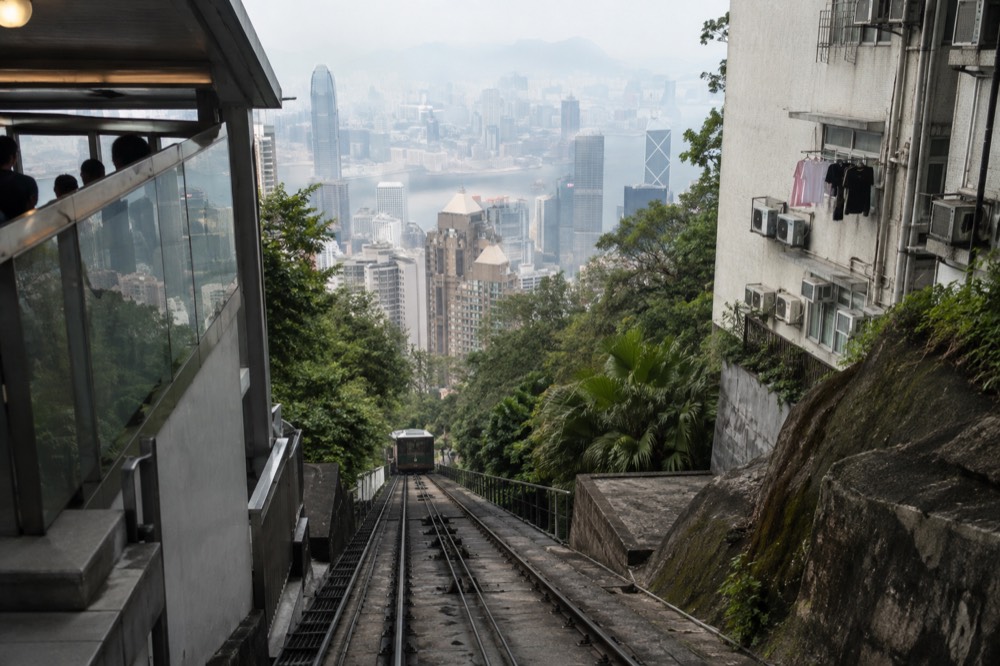
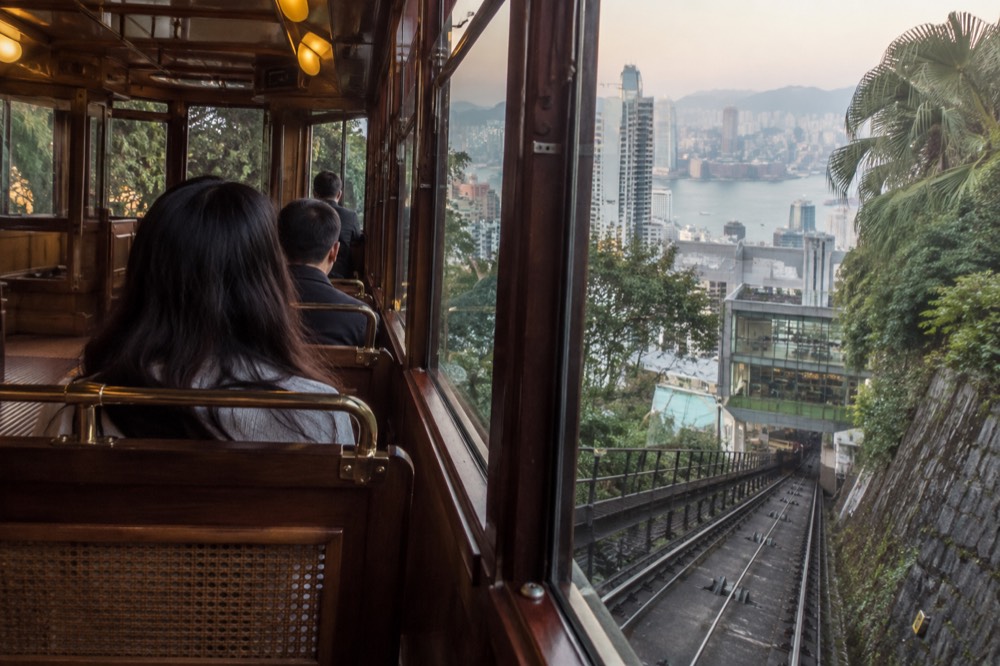
For what the ride itself feels like today, the sixth-generation cars and the view on the way up are covered in the guide to the Peak Tram ride.
What happened to the tram in the war?
On 11 December 1941, after the Japanese occupation of Kowloon, the engine room was damaged in an attack, and service did not resume until Christmas Day 1945. When the tram started again, part of a Japanese shell was still lodged under the main base plate of the haulage drums. Two exact dates and one shell fragment are the war record of this line.
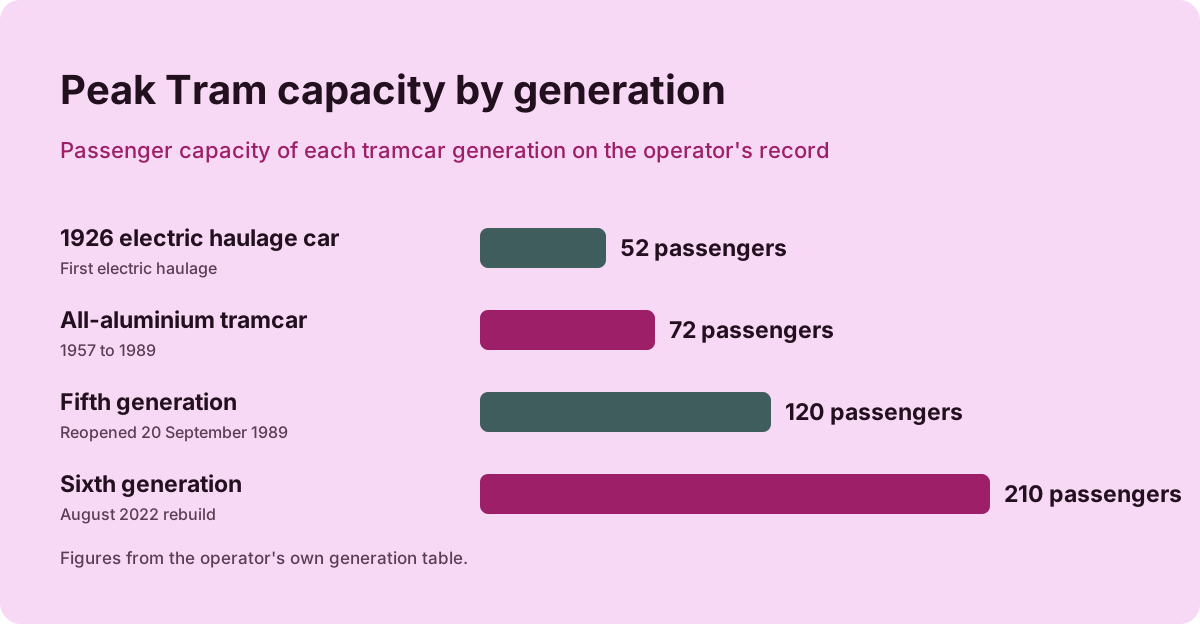
The December 1941 attack and the 1945 restart bracket four years of silence on the hill. The operator's history page records the resumption on Christmas Day 1945 and the shell fragment left under the haulage drums, a detail no amount of rewriting from secondary sources would recover. The line that reopened was still the steam-age tram in most respects, but electrification was already behind it: in 1926, electric haulage had replaced the coal-fired boilers, and the car of that generation carried 52 passengers.
The interwar years left their own trace, one of the strangest facts on the whole line. Between 1908 and 1949 a brass plaque on the back of the first two seats read "This seat is reserved for His Excellency, the Governor", and those seats could not be occupied until two minutes before departure. The verbatim wording, the date range and the two-minute rule all come from the operator's own page.
| Generation | Capacity | Date on the operator's record |
|---|---|---|
| 1926 electric haulage car | 52 passengers | 1926 |
| All-aluminium tramcar | 72 passengers | 1957 to 1989 (the operator's own table gives a range) |
| Fifth generation | 120 passengers | Reopened 20 September 1989 |
| Sixth generation | 210 passengers | August 2022 |
The fifth generation arrived in 1989 after a HK$60-million overhaul to microprocessor-controlled electric drive, and was reopened by Governor Sir David Wilson on 20 September 1989. That is the generation most photographs online still show, and the 120-passenger figure attached to it is the number that stale articles keep printing as current.
How did the tram change generation by generation?
Six generations of tramcar have ridden the line: the steam-era originals, the 1926 electric car carrying 52, the all-aluminium 72-seat car, the 1989 fifth generation carrying 120, and the 2022 sixth generation carrying 210. Each rebuild replaced the haulage as well as the cars, and the 1989 overhaul alone cost HK$60 million.
The generational table above shows the capacity arc, but the engineering changed as much as the seating. The 1926 electrification removed the boilers that had powered the line for nearly four decades. The all-aluminium car of the late 1950s cut weight. The 1989 rebuild moved control to microprocessors. The 2022 project went furthest of all, replacing the haulage, control and signalling systems, the track rails and the foundations, and refurbishing both termini with enhanced queuing capacity.
The 2022 rebuild is the dividing line in this subject's literature. Anything written before August 2022, and much of it still ranks highly, describes a system that no longer exists: the red fifth-generation cars, the old terminus layouts, the 120-passenger capacity. The operator's own history page is the source of record for the change, and it is explicit that capacity rose by 75 per cent, from 120 to 210, with the sixth generation.
For anyone planning to ride rather than read, the practical details of hours and scheduling are in the Peak Tram hours and timetable guide, and the ticket this site features is the standard admission, not a fast-track product:
The listing carries an aggregate of 4.6 across 41,347 reviews, a figure tied to the product's own statistics rather than pasted from a neighbouring listing. The supplier named on it is Peak Tramways Co Ltd. and The Peak Tower Ltd., the same two companies behind the tram itself, which is an attraction e-ticket rather than a guided tour. Its cheapest option is the one-way tram ride at $10.59, with dearer options adding Sky Terrace 428 admission or a return ride.
What did the 2022 rebuild actually change?
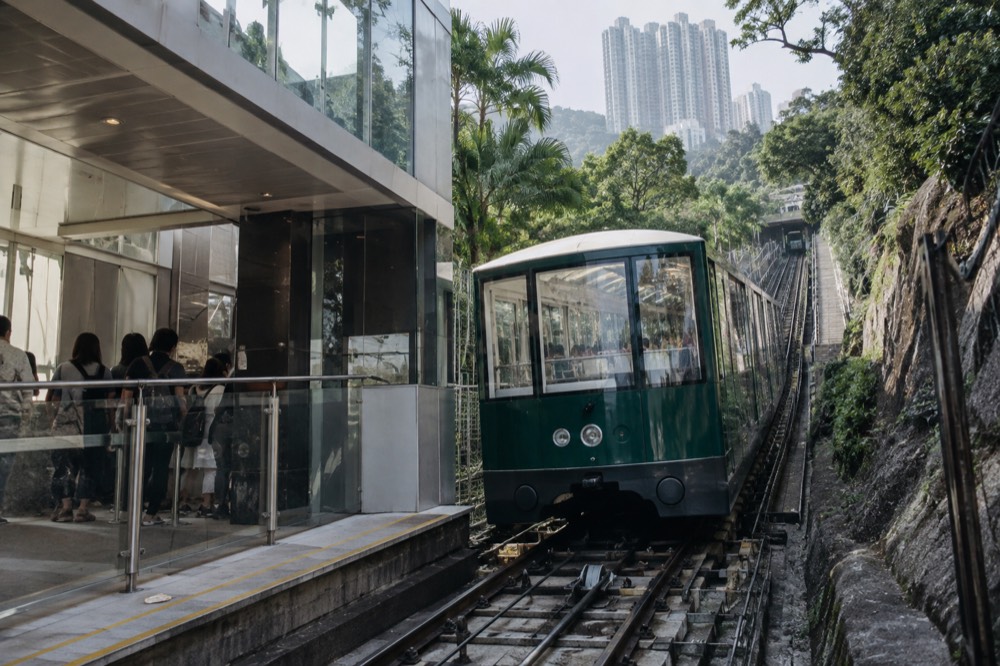
The August 2022 project replaced all haulage, control and signalling systems, laid new track rails, strengthened the foundations and refurbished both termini. The new cars carry 210 passengers, 167 seated and 43 standing, were manufactured in Switzerland by Garaventa, CWA and Frey, and wear a bespoke colour the operator calls Peak Tram Green. Capacity rose 75 per cent.
The sixth-generation rebuild is the reason a current page can beat an incumbent one that has not been touched since 2019. The seated-and-standing split, 167 and 43, is published by the operator and answers the question every family asks: will we get a seat. The standing floor carries a unique waveform design for standing passengers. The rebuild also brought wider doors, larger panoramic windows and step-free access for persons with a disability, the one accessibility fact on this trip that is actually verified. More of these guides are collected on Victoria Peak Hong Kong.
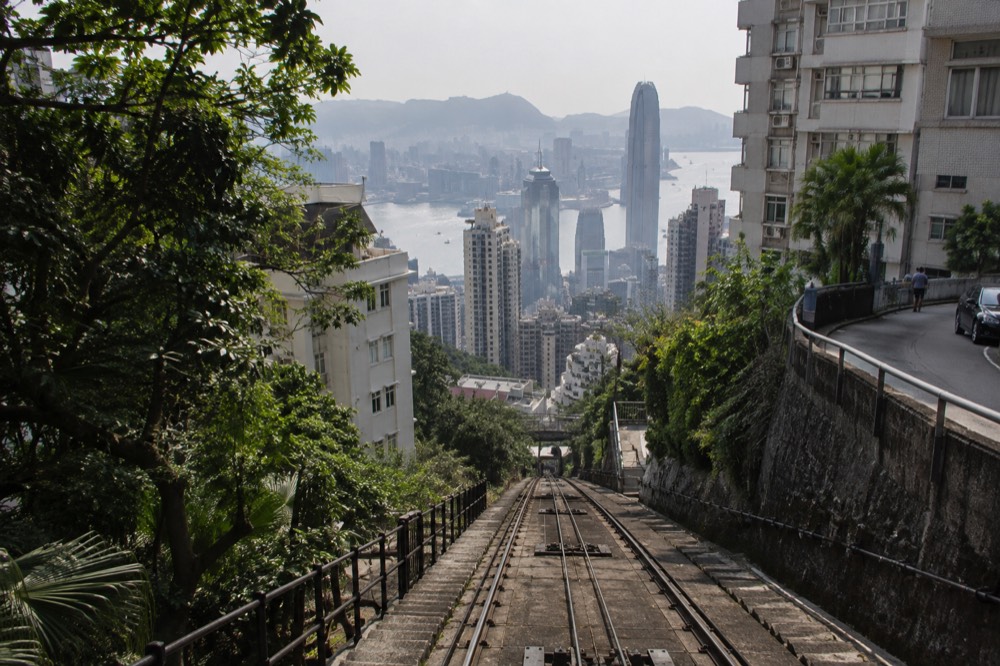
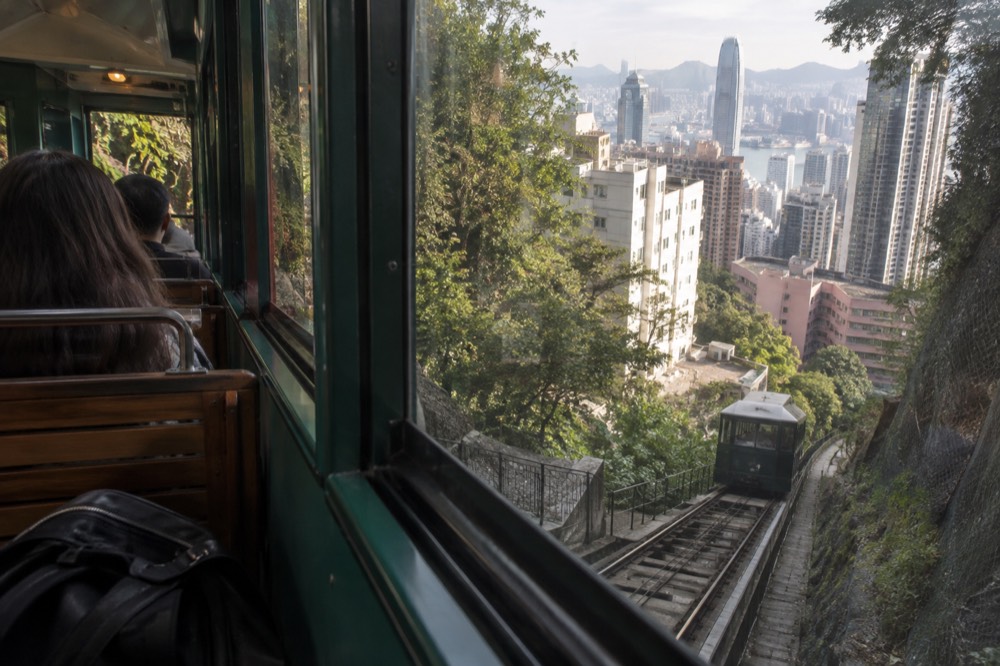
The engineering underneath is worth the words. The tram is a double reversible funicular running on 1,278 metres of track between the Central Terminus at 33 metres above sea level and the Peak Terminus at 396 metres. The gradient runs from 4 degrees to 25.7 degrees, and the steepest section, 25.7 degrees to the horizontal, is where the tracks pass below May Road. Two haulage ropes of 50.5 mm diameter hold a 55-tonne tramcar, with a safety factor of 8, and the tram has four braking systems: Normal Stop, Service Stop, Emergency Stop, and a fourth fitted on the tramcars themselves. The journey takes approximately 6 minutes one way.
The current livery, Peak Tram Green, is the operator's own name for the colour, and it is a deliberate nod to the third and fourth generation cars. Any article illustrated with the old red cars is describing the retired system, whatever its publication date says.
What survives of the original line today?
The route still runs on its original 1888 alignment, raised over the years to give headroom over Kennedy Road, so the line a passenger rides today follows the path Findlay Smith's company cut. Both termini have been rebuilt, most recently in the 2022 project, and the upper terminus sits inside The Peak Tower, a building that opened in 1972.
The survival of the alignment is the quiet miracle of the story. Buildings around it have been demolished and replaced for a century, the cars have changed six times, the haulage has gone from coal to electricity to microprocessor control, but the track still climbs the corridor approved in 1882. The raising of the line over Kennedy Road is the one recorded alteration to the route itself.
The upper terminus has its own history. Construction of the original Peak Tower began in 1971 and it was unveiled to the public on 29 August 1972, housing the upper terminus of the tram and, originally, the Tower Restaurant on the top deck. A HK$500-million redevelopment designed by the British architect Sir Terry Farrell was carried out in 1993 and opened to the public in May 1997, and work began in March 2005 on the revitalisation programme that produced the building visitors see now, the one the Hong Kong Tourism Board calls wok-shaped.
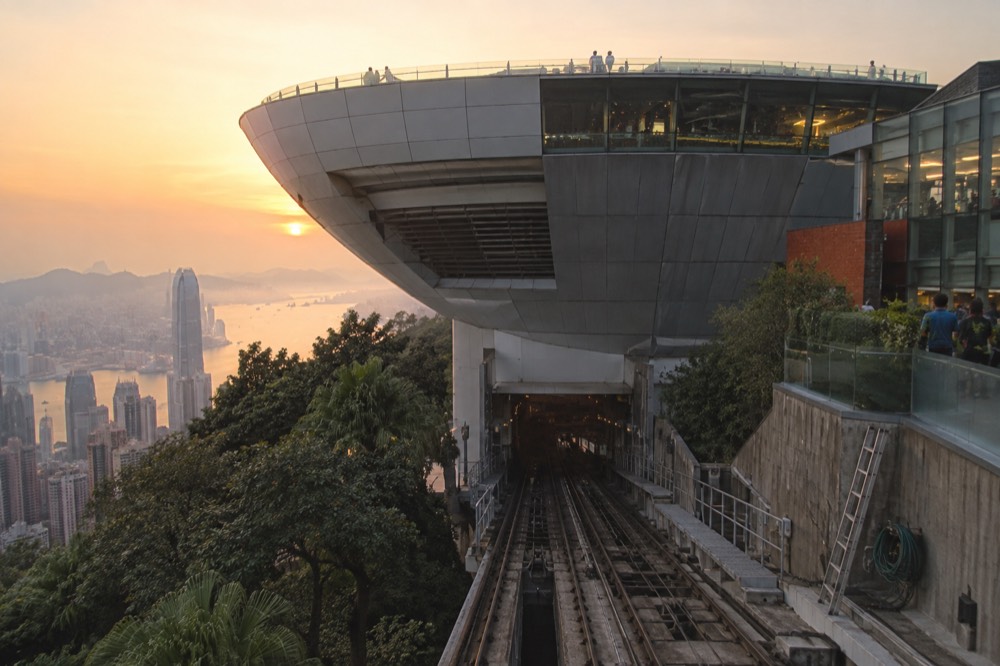
The heights on the hill are three different things, and the history of the line is the clearest way to keep them apart:
| Point on the hill | Height above sea level | Status |
|---|---|---|
| Central Terminus | 33 metres | Lower end of the line |
| Victoria Gap, the upper terminus | 396 metres | Where the tram actually goes |
| Sky Terrace 428, the Peak Tower roof | 428 metres | Paid viewing deck |
| Victoria Peak summit | 552 metres | Closed to the public, radio installation |
| Victoria Peak Garden | 554 metres | Free public park, the highest ground a visitor can stand on |
The operator publishes both the 552-metre summit and the 554-metre garden, each with its own subject, and the two numbers are not a contradiction to be resolved. Victoria Peak is the highest point on Hong Kong Island, though not the highest peak in Hong Kong: the tourism board gives that title to Tai Mo Shan. More on what the modern ticket buys, and the free alternatives at the top, is in the site's coverage of whether the Peak is worth going.
Is the leaning-buildings illusion on the ride real?
Yes, and it has a published study behind it. The operator's page states that a study by The University of Hong Kong found that passengers riding uphill experience a visual illusion in which the high-rises to the right of the tram appear to lean toward the Peak, and that the study was published in Psychological Science in 2013. The effect is real, named and documented, not a travel myth.
The attribution matters here. The finding belongs to the University of Hong Kong researchers and the journal, as reported on the operator's own page, and this site passes it on in that form rather than presenting it as an independent observation. Passengers notice the effect on the climb and it is one of the small reasons the ride has outlived its original commuting purpose.
The tram's screen career is part of the record too. The Peak Tram appears in the 1950s film Soldier of Fortune starring Clark Gable, whose opening and closing scenes were shot inside the tramcar, and in an episode of The Love Boat. The General Post Office issued centenary commemorative stamps in May 1988. These credits come from the operator's history page rather than a fan wiki, which is the difference between a dated detail and a rumor.
How do the 1888 fares compare with a ticket today?
The 1888 ladder ran from 10 to 30 cents single, with returns at half price. Today the operator's published adult gate fares run from HK$82 for a single tram ride to HK$182 for the return tram plus Sky Terrace 428, and the featured listing's cheapest option is $10.59, which buys the one-way tram only. The class system is gone; the single-versus-return structure never left.
The modern fare ladder, as the operator publishes it:
| Ticket type | Adult single | Adult return | Child 3-11, senior 65+, concession, single | ... return |
|---|---|---|---|---|
| Peak Tram only | HK$82 | HK$116 | HK$52 | HK$75 |
| Tram plus Sky Terrace 428 | HK$146 | HK$182 | HK$95 | HK$118 |
| Sky Terrace 428 admission alone | HK$80 | HK$50 | ||
| Peak Tram Ruby Special | HK$342 | HK$222 |
Two cautions come with that table. "Concession" is not a tourist discount: it is the rate for holders of the HKSAR Registration Card for people with Disabilities, and it is available only when buying on arrival. And the operator states that the combo saving cannot be assembled from parts, in its own words: "you must select the Peak Tram Special Combo tickets to enjoy the best price." The full structure of the ticket options is documented on the site's home guide to the Peak, alongside the free alternatives at the top.
The booking side has its own published boundaries. The operator sells tickets online for same-day visits and up to 30 days ahead, with a maximum of 10 tickets per ticket type per transaction and group rates starting at 20 people. Hong Kong has no VAT or GST, and the operator charges no online handling fee. An Octopus card can pay on board at the intermediate stations and at the counter, but not for direct entry at the admission gate. These mechanics are on the operator's official FAQ page, and the fare ladder is published on the operator's own ticket page.
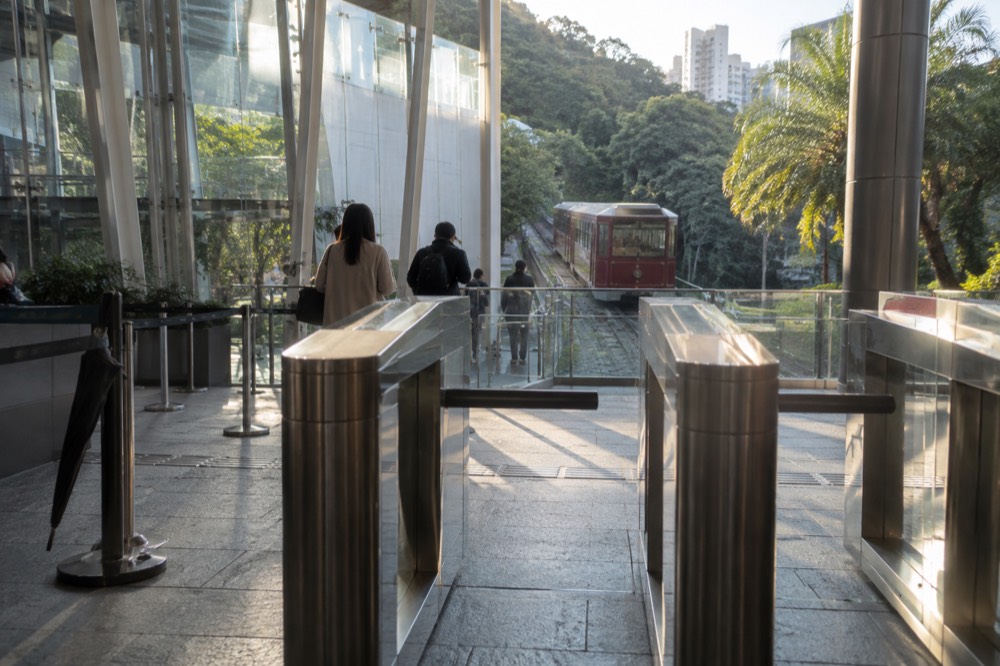
One last distinction from the record, because the history makes it obvious. This is a standard ticket, not a fast-track product. Buying ahead puts the holder in the "Pre-purchased Ticket Holder" queue, which removes the ticket-buying line, not the boarding line, and the operator states that its timed tickets "do not provide priority boarding" and that queueing time depends on the number of visitors on the day. The genuine priority product is the Ruby Special at HK$342, a different ticket entirely.
For the three ways a visitor typically buys, the comparison stands as follows:
Common questions about the Peak Tram's history
Who built the Peak Tram, and when did it open?
Alexander Findlay Smith, a Scotsman who had worked for Scotland's Highland Railway, petitioned the Governor in May 1881. Approval was granted in 1882, the Hong Kong High Level Tramways Company was formed, and service commenced on 30 May 1888, officially opened by Governor Sir William Des Voeux. It was the first cable funicular in Asia.
How many passengers did the original Peak Tram carry?
The tram carried 600 passengers on its first day and about 150,000 in its first year, figures published by the operator. The first cars were far smaller than today's: the 1926 electric generation carried 52 passengers, and capacity only reached 210 with the August 2022 rebuild.
Was the Peak Tram damaged in the war?
Yes. On 11 December 1941, after the Japanese occupation of Kowloon, the engine room was damaged in an attack. Service resumed on Christmas Day 1945, with part of a Japanese shell still lodged under the main base plate of the haulage drums.
Does the Peak Tram still follow its original route?
Yes. The route still runs on its original alignment, raised over the years to give headroom over Kennedy Road. The track now measures 1,278 metres between the Central Terminus at 33 metres above sea level and the Peak Terminus at 396 metres, in Victoria Gap.
What is the oldest surviving tradition on the tram?
The single-versus-return fare structure. The 1888 ladder charged 30, 20 and 10 cents by class, with the return trip at half price, and today's fares still split single from return, from HK$82 to HK$116 for the tram alone. The governor's reserved seats, plaque and all, ended in 1949.
Is the leaning-buildings effect on the ride a myth?
No. The operator's page states that a University of Hong Kong study found that passengers riding uphill experience a visual illusion in which the high-rises to the right of the tram appear to lean toward the Peak, and that the study was published in Psychological Science in 2013.