Why is Victoria Peak so famous?
The fame of Victoria Peak rests on a colonial hill station, Asia's first cable funicular, and a harbour view, and the history behind the photograph explains why the place still draws crowds.
Why is Victoria Peak so famous?
Victoria Peak is famous for three stacked reasons: it was the segregated summer retreat of Hong Kong's colonial elite, it became reachable for ordinary people when Asia's first cable funicular opened on 30 May 1888, and it offers the signature panorama of Victoria Harbour and the skyline that has defined the city's image for over a century. The fame is historical first and photographic second, which most visitors never realise.
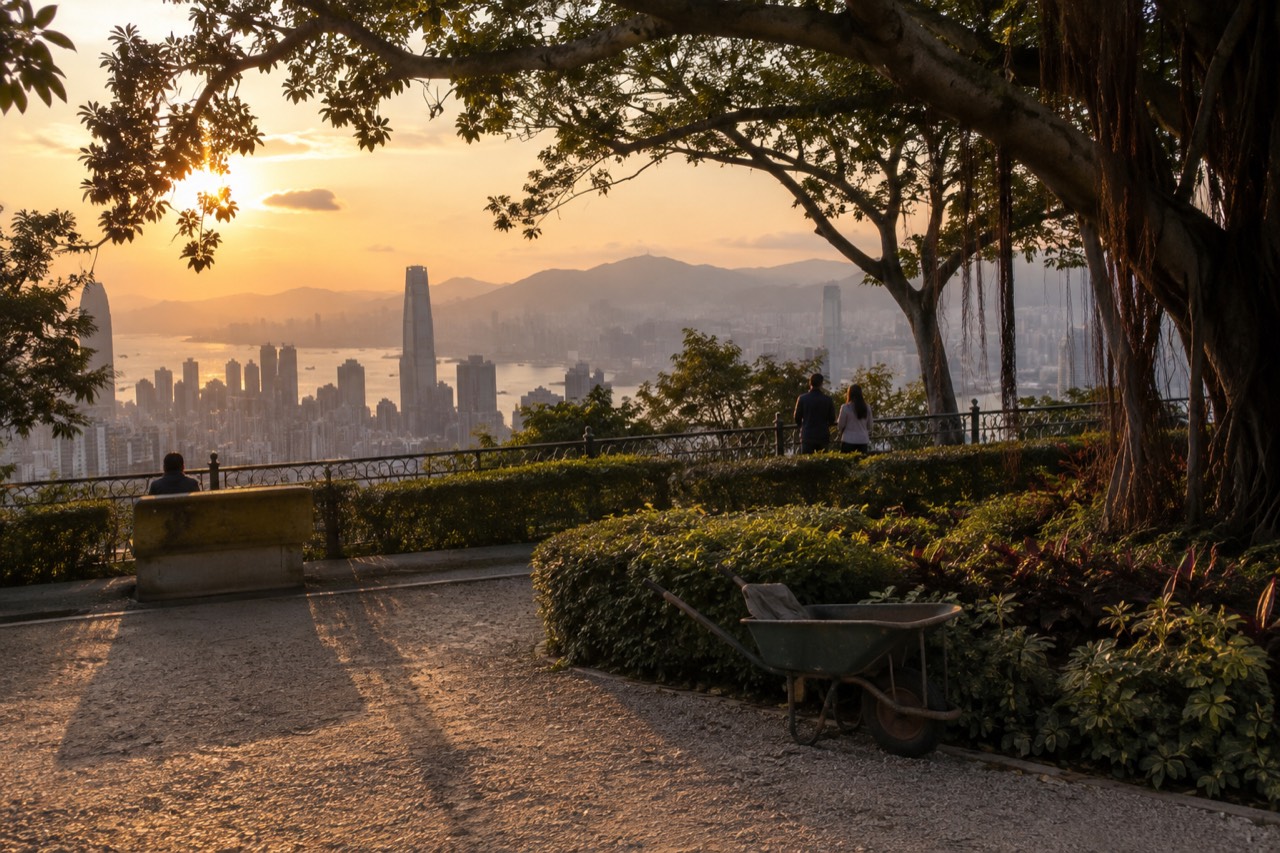
The photograph is what travels. A dense wall of towers pressed against a harbour, shot from a hillside above the city, is the image that appears on tourism posters, in films and on a century of postcards. But the reason there is anything to photograph from up there at all is a social story from the 1800s, and it is a stranger story than the view suggests.
Before any of it, the hill was malarial scrubland that colonial officials considered unhealthy to live on. That belief inverted within a generation, and the inversion is what built everything a visitor now touches at the top: the roads, the mansions, the tram and the tower. The fame of the Peak is really the fame of that reversal.
The place visitors ride to is not one simple thing either, and untangling it helps. The Peak Tram delivers you to Victoria Gap, a dip in the hill line at 396 metres above sea level, where The Peak Tower stands. The operator states plainly that the tower "does not sit atop Victoria Peak but is situated in Victoria Gap". The true summit, at 552 metres, is closed to the public and occupied by a radio installation. The highest ground a visitor can freely stand on is Victoria Peak Garden, a free public park the operator publishes at 554 metres. Four different heights, three of them visitable, and almost every article about the Peak flattens them into one.
A hill station built on a medical theory
The Peak became famous because colonial Hong Kong turned it into a hill station on the belief that the upper air was healthier, and by the 1900s a law reserved most of the hill for European residents. That exclusivity is the origin of the mansions, the roads and eventually the tram, and it made the hill a byword for wealth and status long before tourists arrived.
In the early colonial decades, Hong Kong's summers killed. Fever was blamed on the air of the low-lying town, and the standard colonial remedy, used from Simla to the Cameron Highlands, was to move uphill where the air was believed cooler and cleaner. Hong Kong's elite looked up at the ridge behind the town and did the same thing. The first summer houses went up along the ridge in the 1860s and 1870s, and the district acquired a name that stuck: the Peak, spoken of as a place rather than a summit.
The segregation was formal, not just customary. A 1904 ordinance and its 1918 successor reserved the Peak district, with narrow exceptions for servants and licence holders, and the restriction stayed on the books into the 1940s. The mansions that line Lugard Road and the roads above it are the physical residue of that arrangement. When the tourism board describes the graded historic residences still standing on Lugard Road today, including the white Grade II historic building at 1 Lugard Road and the Grade I historic residence at 27 Lugard Road, it is describing the architecture that exclusivity produced.
That legal exclusivity did something else that matters to the fame: it made the Peak the address. To live at the top was to have arrived, in the most literal sense the city offered. The word carried that meaning for generations, and the tram that eventually opened the hill to everyone inherited the prestige rather than abolishing it. The deeper history of the line is covered in the Peak Tram history guide, but the short version is that the railway was built to serve the residents, and the residents existed because of the hill station idea.
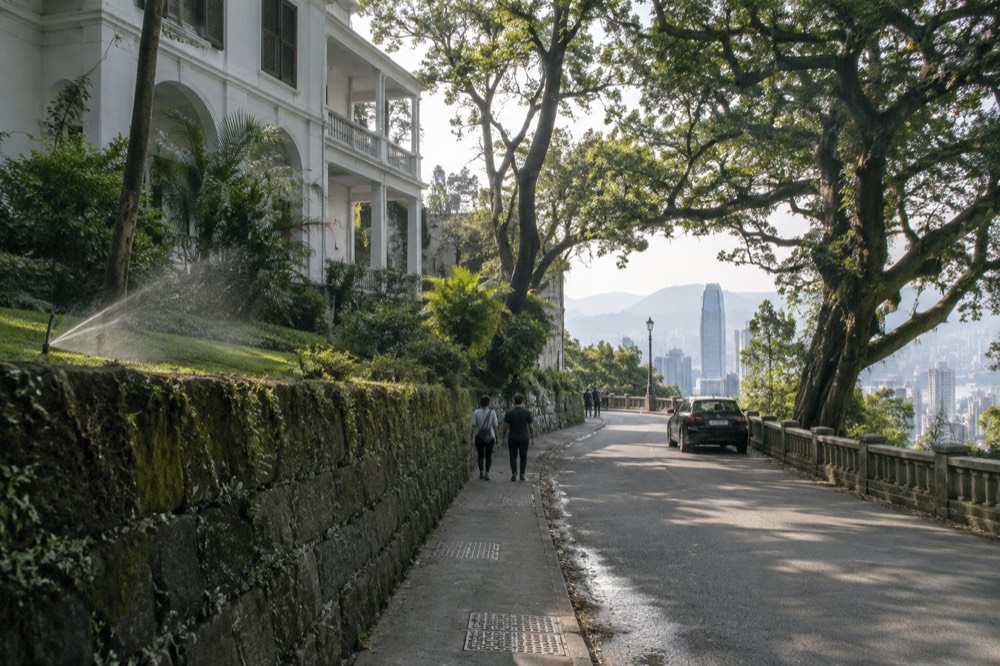
The hill station also explains the odd geography a visitor notices today. The Peak was never planned as a single attraction, so there is no single entrance and no one viewpoint. Instead there is a scatter of pieces: a funicular terminus, a tower with a paid deck, a neighbouring mall with a free rooftop deck, a loop road, a garden uphill. The fame of the place grew around all of them together.
The tram made the hill everyone's
The Peak Tram, opened on 30 May 1888, was the first cable funicular in Asia, and it converted a private hill station into a place the whole city could reach. The operator records 600 passengers on its first day and about 150,000 in its first year, and the ride, about 6 minutes one way, is itself now a reason the Peak is famous.
The founder was Alexander Findlay Smith, a Scot who had worked for Scotland's Highland Railway. He petitioned the Governor, Sir John Pope-Hennessy, in May 1881 for permission to run tram routes, one of them connecting Murray Barracks to Victoria Gap. Approval came in 1882, the Hong Kong High Level Tramways Company was formed, and service commenced on 30 May 1888, officially opened by Governor Sir William Des Voeux. The original line ran 1,350 metres and connected five intermediate stations, several of which still appear on the route today.
The early fare structure tells the social story in numbers. The operator's history records first class at 30 cents, second at 20 and third at 10 cents for the ride up, with the return at half price. Class travelled with you up the hill, in other words, and the tram's early decades even carried a brass plaque on the back of the first two seats reading "This seat is reserved for His Excellency, the Governor", which could not be occupied until two minutes before departure. That rule ran from 1908 to 1949.
The line survived war and reinvention. On 11 December 1941, after the Japanese occupation of Kowloon, the engine room was damaged in an attack, and service resumed on Christmas Day 1945 with part of a Japanese shell still lodged under the main base plate of the haulage drums. Electric haulage had replaced coal-fired steam boilers in 1926, when a car carried 52 passengers. The fifth generation arrived in 1989 after a HK$60-million overhaul, carrying 120 passengers. The current sixth generation, completed in August 2022, carries 210, of which 167 are seated and 43 standing, on tramcars built in Switzerland by Garaventa, CWA and Frey. The engineering detail behind today's ride is in the Peak Tram ride guide.
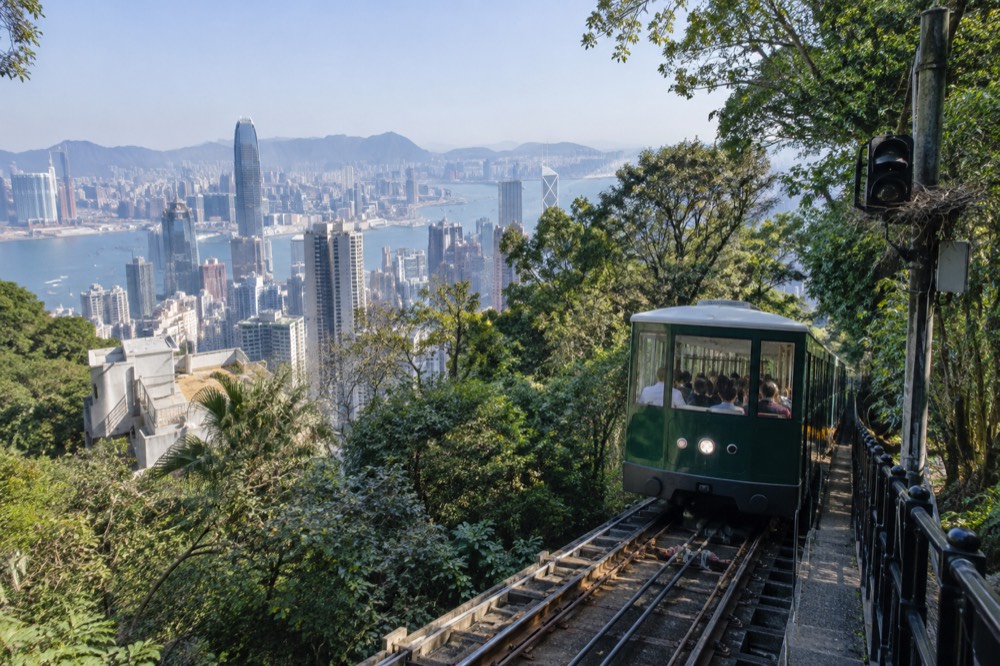
The ride itself became part of the fame for a reason nobody could explain until 2013. The operator's own page cites a study by The University of Hong Kong, published in Psychological Science, which found that passengers riding uphill experience a visual illusion in which the high-rises to the right of the tram appear to lean toward the Peak. Every generation of visitor has noticed the slanting buildings. Only recently has there been a named university, a named journal and a year attached to the explanation.
The view, and the four heights people confuse
The view is the modern engine of the fame, but the numbers around it are widely misstated: the tram reaches Victoria Gap at 396 metres, the Sky Terrace 428 deck sits at 428 metres on the tower roof, the true summit is 552 metres and closed, and the free Victoria Peak Garden stands at 554 metres. Getting these right is the difference between a planned visit and a confused one.
Start with the claim that travels worst. Victoria Peak is the highest point on Hong Kong Island, at 552 metres above sea level, and the tourism board states exactly that. It is not the highest peak in Hong Kong: that is Tai Mo Shan, as the tourism board's own Tai Mo Shan guide records. The distinction sounds pedantic until you notice how many pages get it wrong, and getting it right is a small marker of which sources to trust. More of these guides are collected on Victoria Peak Hong Kong.
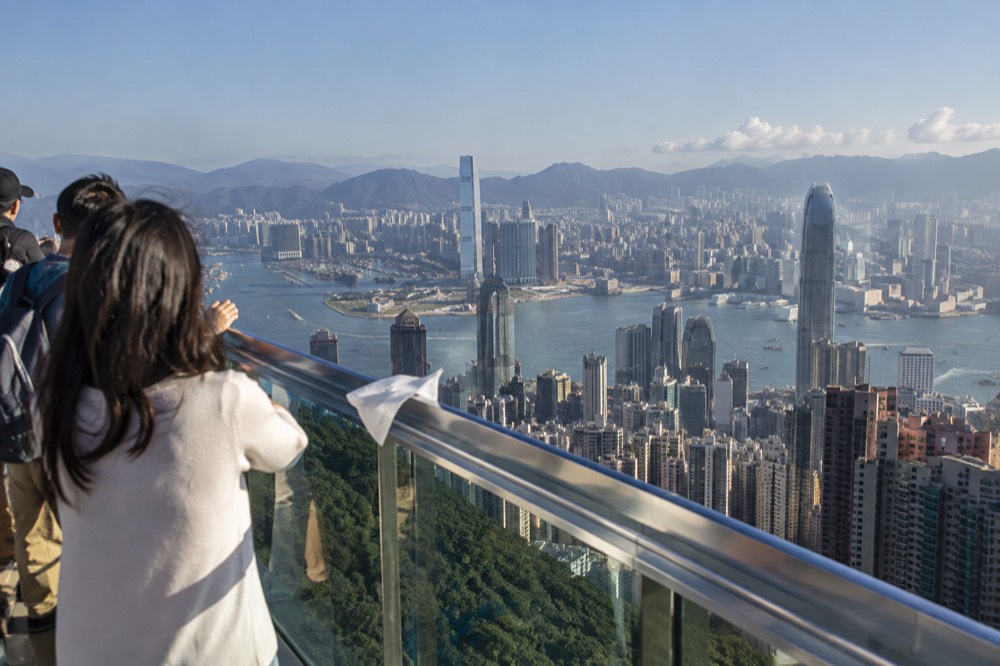
Then the geometry. The Central Terminus stands at 33 metres above sea level and the Peak Terminus at 396, along 1,278 metres of track, with a gradient that runs from 4 degrees to 25.7 degrees, steepest where the tracks pass below May Road. So the tram climbs a real mountain, but it stops at the gap, not the summit. The summit is occupied by a radio installation and closed to visitors. The paid deck, Sky Terrace 428, sits on the roof of The Peak Tower at 428 metres, and the operator describes it as "the highest observation deck in Hong Kong", a claim we repeat as the operator's, not as fact in our own voice.
The fourth height is the one that undercuts the ticket economics, and the operator publishes it itself. Victoria Peak Garden, a free public park uphill along Mount Austin Road, is published at 554 metres above sea level, which makes it the highest ground at the Peak a visitor can freely stand on. The free park is higher than the paid deck. Both numbers come from the same operator, each for a different place, and no incumbent page sets them side by side.
| Place | Height | Access |
|---|---|---|
| Central Terminus | 33 m | Public, tram boarding |
| Victoria Gap, tram terminus | 396 m | Public, where the tower stands |
| Sky Terrace 428, tower roof | 428 m | Paid deck, HK$80 adult alone |
| Victoria Peak, true summit | 552 m | Closed, radio installation |
| Victoria Peak Garden | 554 m | Free public park |
| High West | 493 m | Free, famous sunset spot |
The view from the paid deck and the free alternatives are compared honestly elsewhere, including the Sky Terrace 428 guide and the Peak Galleria free deck guide. The short version of the honest split: the panoramic view from the top of the hill is free at the Peak Galleria rooftop, the Sky Terrace ticket buys the extra height at 428 metres, and the tram ticket buys the ride. Whether the ride alone earns its fare is the question the is the Peak Tram worth it post takes on directly.
The free viewpoints that spread the fame
Much of the Peak's fame rests on viewpoints that cost nothing: the Peak Galleria rooftop deck, Lugard Road, Harlech Road and Victoria Peak Garden are all free, and the tourism board recommends them in its own words. The paid deck is one option at the top, not the price of entry to the hill.
The tourism board states that the Peak Galleria "offers a range of shopping and dining as well as a free viewing deck", and its body text says: "One of the highlights is the free viewing deck. Head to the rooftop for panoramic views of Hong Kong's skyline, Victoria Harbour and beyond." That is a government tourism board saying in plain words that the postcard view does not need a ticket. The same building holds a kids' playground the tourism board recommends to families, and the public car park, since The Peak Tower has none.
The loop road is the other free pillar. Lugard Road, built between 1913 and 1914 and named for Sir Frederick Lugard, the 14th governor of Hong Kong, encircles the Peak, and the tourism board calls it "a great spot to enjoy sunset and night views of Victoria Harbour". It describes the signed Lugard Road Lookout as "one of Hong Kong's best-kept secrets, offering breathtaking views without the crowds". The operator's own walking route for the Hong Kong Trail loop runs out along Lugard Road and back by Harlech Road, past the first bridge built over the city's steep hills, and publishes a duration of 40 to 60 minutes. The tourism board grades the full Peak Circle Walk, 3.5 km, as easy and says it "can be completed in an hour".
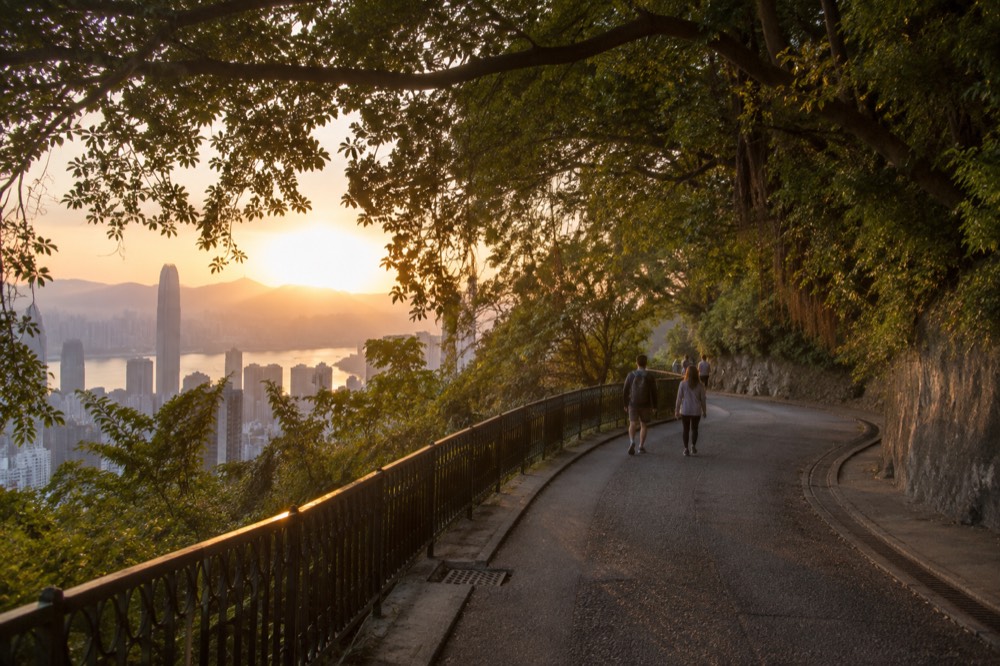
Victoria Peak Garden completes the free set. The tourism board describes it as "a hidden gem above Victoria Peak, offering stunning views, charming Victorian landscaping and a serene retreat for nature lovers", the operator publishes the 30 to 40 minute uphill walk along Mount Austin Road, and the Leisure and Cultural Services Department manages the park, which sits approximately 1.2 km from The Peak Tower. A kiosk at the top sells snacks and drinks, and there is a car park. The Victorian landscaping is the visible echo of the hill station era: the garden sits on the old Governor's mountain lodge grounds, which is why the style up there is English garden rather than anything local.
High West deserves its line too. At 493 metres, it is the sunset peak next door, and the tourism board calls it "one of the most famous sunset spots on The Peak". It is free, it is higher than the paid deck, and almost no visitor itinerary includes it. The full set of walking routes, with the operator's published timings, is in the Lugard Road loop guide.
The 2022 rebuild, and why so much written about the Peak is stale
The Peak Tram was rebuilt in August 2022: new haulage, control and signalling systems, new Swiss tramcars, new track and refurbished termini, and capacity up 75 per cent from 120 to 210 passengers. Any article describing the tram from before that date describes a system that no longer exists, which is why the fame has a freshness problem online.
The rebuild matters to a reader in 2026 because the open web is full of pre-2022 descriptions. The "the tram carries 120" line, repeated across countless pages, is the retired fifth generation, out of service since 2021. The current cars carry 210 passengers, 167 seated and 43 standing, in a bespoke colour the operator calls Peak Tram Green, a nod to the third and fourth generation cars. The rebuild brought wider doors, larger panoramic windows and step-free access for persons with a disability, which is the one verified accessibility fact about this trip.
The engineering is worth a sentence because it is part of the romance the fame feeds on. Two haulage ropes of 50.5 mm diameter hold a 55-tonne tramcar, with a safety factor of 8, and the tram carries four braking systems: Normal Stop, Service Stop, Emergency Stop, and a fourth fitted on the tramcars themselves. The route still runs on its original 1888 alignment, raised over the years for headroom over Kennedy Road. When you ride it, you are on the line the Governor opened, on the same hill the taipans reserved for themselves.
The tower has its own dates. Construction of the original Peak Tower began in 1971 and it was unveiled to the public on 29 August 1972, housing the upper tram terminus. A HK$500-million redevelopment designed by Sir Terry Farrell opened in May 1997, and the revitalisation that produced today's building began in March 2005. The tourism board calls the shape wok-shaped, which is its own word and better than any invented simile. Entering the building costs nothing; the paid part is the deck on its roof.
What the fame means for your visit today
Fame has practical consequences at the Peak: the tram runs 7:30 am to 11 pm but Sky Terrace 428 opens only at 8:30 am and closes at 10 pm, the operator's only crowd guidance is to come before 3pm during non-peak hours, and October through December are the clearest months on the Observatory's 30-year record. Planning around those three facts is what separates a good visit from a famous disappointment.
The hours trap catches people at both ends. A visitor on the first tram of the day arrives at 7:30 am, an hour before the deck opens, and a visitor aiming for the last tram of the night finds the deck shut at 10 pm while the tram runs to 11 pm. The Peak Tower itself is open 7 am to 11 pm, and entering it is free, so an early arrival is not wasted: the shops, the restaurants and the indoor views cost nothing. But the deck ticket cannot be used in full on an early arrival, and the timing detail is in the Peak Tram hours and timetable guide.
The weather decides whether the photograph happens. On the Hong Kong Observatory's 1991 to 2020 normals, which are Hong Kong-wide figures rather than measurements taken on the Peak, October is the clearest month of the year at 55 per cent of possible bright sunshine and 58 per cent mean cloud, with 120.3 mm of rain. November is nearly as good, December is the driest and least cloudy month on the record, and March is the murkiest, with the lowest sunshine share of any month at 27 per cent and 1.47 mean days with visibility under 1,000 metres. February is the other poor month for a view, and the reason is fog, not rain. The operator itself tells visitors to check the Observatory's two Victoria Peak webcams before travelling, which is the only live visibility check that exists.
On tickets, the honest framing is this. The headline from-price of $10.59 buys a one-way adult tram ride only, with no Sky Terrace 428 admission and no ride back down. The operator's published gate fares put the tram and deck together at HK$146 adult with a single tram ride and HK$182 with a return, and the operator states you cannot assemble the combo saving by buying the parts separately. This is a standard ticket, not a fast-track product: buying ahead removes the ticket-counter line, not the boarding line, and the operator says its timed tickets "do not provide priority boarding". You can check the live listing for the option that fits, and the tram-only return option is the natural pick if you plan to see the view from the free decks instead.
One last fame fact that dates the page less than you would expect: the tram has appeared on screen since the 1950s, including the film Soldier of Fortune starring Clark Gable, whose opening and closing scenes were shot inside the tramcar, and an episode of The Love Boat, and the General Post Office issued centenary commemorative stamps in May 1988. The fame is old enough to have a stamp. What keeps it current is that the hill still does what it did in the 1880s, which is hold the whole city in one frame, and it now does so for anyone who rides up rather than only those who lived there.
Common questions about why the Peak is famous
Why is Victoria Peak so famous?
It combines a colonial hill-station history, Asia's first cable funicular, opened on 30 May 1888, and the signature panorama of Victoria Harbour and the skyline. The fame began as exclusivity, spread when the tram opened the hill to everyone, and is now sustained by the view, which is partly free.
Is Victoria Peak the highest point in Hong Kong?
No. It is the highest point on Hong Kong Island, at 552 metres above sea level, as the tourism board states. The highest peak in Hong Kong is Tai Mo Shan, in the New Territories.
Can you stand on the actual summit of Victoria Peak?
No. The true summit, at 552 metres, is closed to visitors and occupied by a radio installation. The highest ground the public can freely reach is Victoria Peak Garden, a free park the operator publishes at 554 metres.
Does the Peak Tram go to the top of Victoria Peak?
No. The tram runs to Victoria Gap, at 396 metres above sea level, where The Peak Tower stands. The operator states the tower "does not sit atop Victoria Peak but is situated in Victoria Gap".
Do you have to pay for the view at the Peak?
No. The Peak Galleria rooftop viewing deck is free, and so are Lugard Road, Harlech Road and Victoria Peak Garden. The paid option is Sky Terrace 428 on The Peak Tower roof, at HK$80 for an adult on its own.
When did the Peak Tram first open?
Service commenced on 30 May 1888, officially opened by Governor Sir William Des Voeux. It was the first cable funicular in Asia, originally running 1,350 metres and connecting five intermediate stations.