What time is the Nightly Light Show in Hong Kong?
The Symphony of Lights starts at the same time every night, and watching it from the Peak changes the answer in ways harbourside guides never mention. Hours, fares, spots and how to get down afterwards.
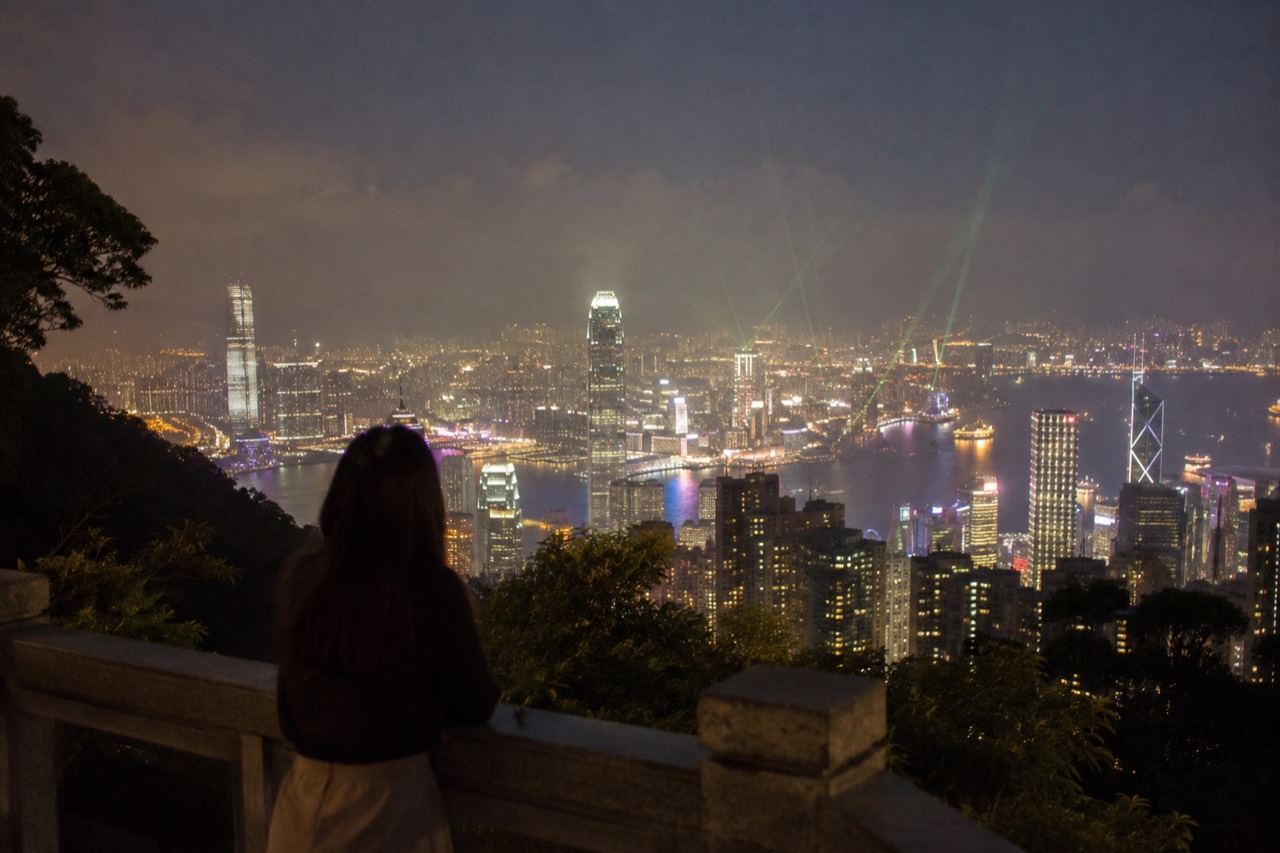
The Symphony of Lights runs on a clock that never moves, which is the easy half of this question. The hard half is whether the Peak is a good place to watch it, and the honest answer depends on which part of the Peak you are standing on, what time the paid deck locks its doors, and how you plan to get back down afterwards. Most guides answer only the harbourside version of the question. This one answers it from the hill.
What time is the Nightly Light Show in Hong Kong?
The Hong Kong Tourism Board stages the Symphony of Lights every evening at 8 pm, with synchronized lights and music on both sides of Victoria Harbour. The show runs for roughly ten minutes, and no tickets or bookings are needed, so you can simply show up at 8 pm sharp for one of the city's most popular free nighttime spectacles. The show is free to watch, needs no ticket, and happens every night of the year, so there is no season, no booking window and no schedule to catch. From the Peak, the practical reading is different from the waterfront: at 8 pm you are looking down on the harbour from hundreds of metres up, the lasers and building lights read as a wide panorama rather than a surround-sound spectacle, and the show's audio, which is played through speakers on the Tsim Sha Tsui promenade, does not reach you at all. That trade-off is the whole decision, and it is worth making consciously rather than by accident.
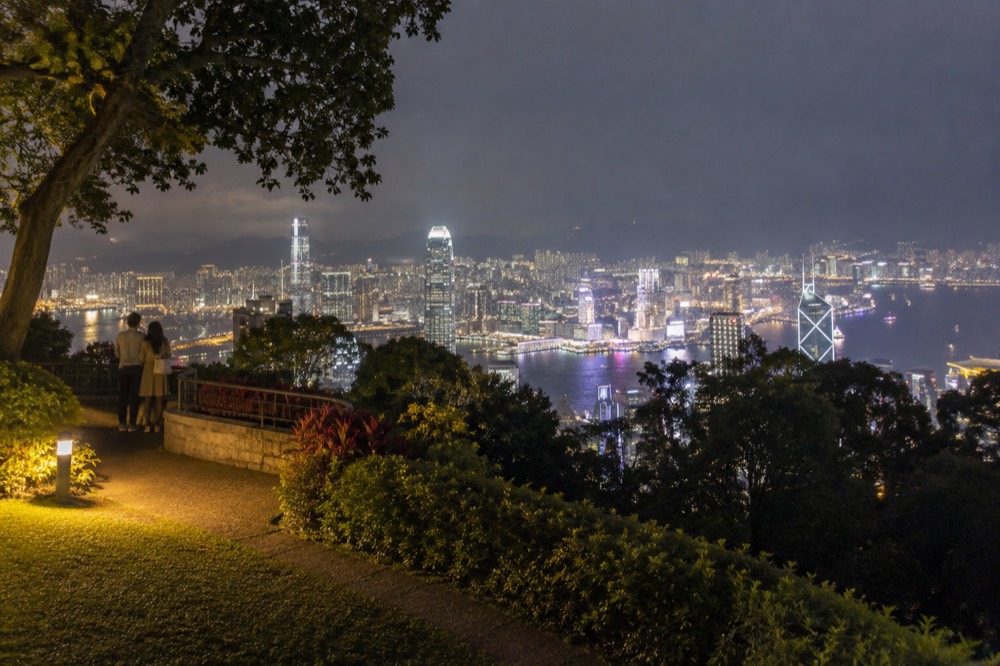
The tourism board produces the show, and its scale is the reason the Peak works at all. The display draws on lights, lasers and searchlights mounted on buildings across both Kowloon and Hong Kong Island, which means the pattern is kilometres wide. A waterfront viewer stands inside it. A Peak viewer sees the whole canvas at once, with the harbour, the Kowloon peninsula and the island skyline laid out in one frame. Neither view is wrong. They are different products, and the Peak version is quieter, colder and considerably less crowded.
What the Peak version is not, is immersive. Reviewers of the paid deck sometimes describe the show from up top as distant, and that is a fair reading of the geometry. If the light show is the single reason you are going out in the evening, the Tsim Sha Tsui promenade is the purpose-built answer. If the light show is one item on an evening that already includes the Peak, then 8 pm is simply the moment you should already be standing somewhere with a view, and the hill gives you that in several forms, some free and some ticketed.
The three options above are the ones an evening visitor actually weighs: the combined round-trip tram and Sky Terrace 428 ticket, the one-way tram-only fare, and deck-only admission for someone arriving by road. The cheapest option on the listing is the one-way adult tram ride at $10.59, which buys the ride up and nothing else, no deck admission and no ride down. The operator's own published gate fares for the combined tickets are HK$146 for a single tram ride with deck admission and HK$182 for the round trip, and those are the honest numbers for the evening most visitors want.
Can you actually see the Symphony of Lights from the Peak?
Yes, the whole harbour panorama is visible from the Peak's viewing points, and the show reads clearly at that distance, but the experience is panoramic rather than immersive, and the paid deck closes at 10 pm, two hours after the show starts. The geometry is on your side. The Peak looks down over Victoria Harbour from Victoria Gap, which the operator places at 396 metres above sea level, and the Sky Terrace 428 deck sits on the Peak Tower roof at 428 metres. From either height, the harbour is the middle distance and the light show plays out across it in full view. What you lose is scale in the foreground and all of the sound.
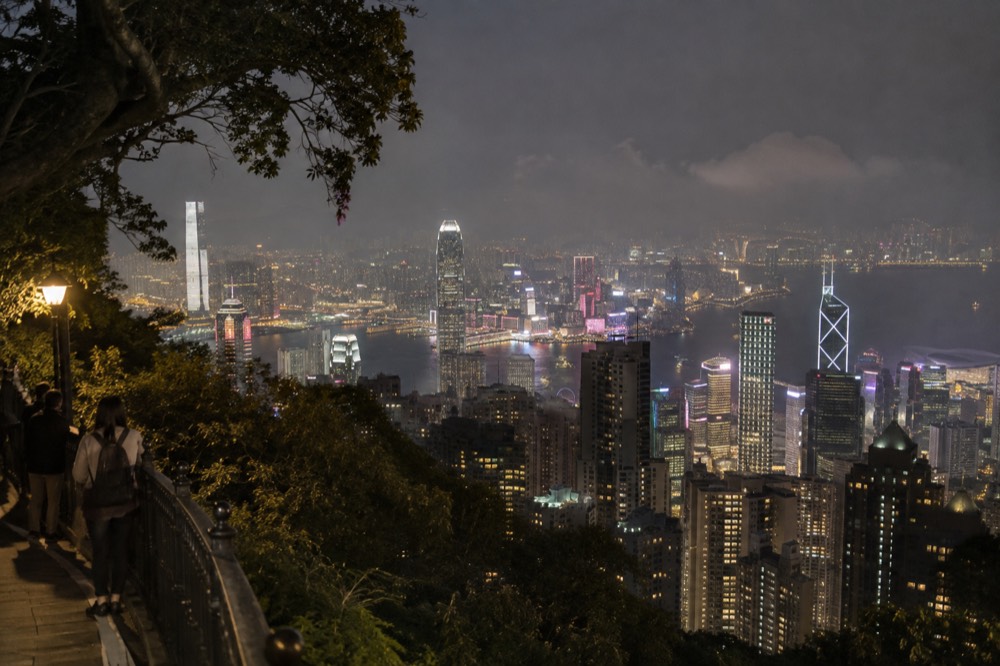
The free options matter here as much as the paid one. The Hong Kong Tourism Board states that the Peak Galleria "offers a range of shopping and dining as well as a free viewing deck", and its own words on the rooftop are "panoramic views of Hong Kong's skyline, Victoria Harbour and beyond". Lugard Road is another free answer: the tourism board calls it "a great spot to enjoy sunset and night views of Victoria Harbour", and describes the signed Lugard Road Lookout as "one of Hong Kong's best-kept secrets, offering breathtaking views without the crowds". A visitor who wants the show without a ticket has two honest ways to get it, and the site would rather you knew that than not.
The paid deck's case is height and framing. The operator describes Sky Terrace 428 as "the highest observation deck in Hong Kong", a claim that belongs to the operator and should be read as one, and its FAQ calls it "the highest outdoor viewing platform in Hong Kong ... a stunning 360-degree panoramic view across the Victoria Harbour". At 8 pm the deck is still open, with a 10 pm close published for every day of the week, so the show falls comfortably inside the ticket's window. The trade is money against a free rooftop a short walk away, and the honest framing is that the ticket buys the extra height at 428 metres, not the view itself.
One more practical point that no harbourside guide has to think about: tripods. The operator's rules state that tripods and lighting equipment are not allowed in the Peak Tram, The Peak Tower or Sky Terrace 428, and drones are prohibited on the operator's property without management permission. Night photography advice for the show often recommends a tripod for the long exposures the scene needs. Up here, that advice collides with the operator's own published rules, so plan on a steady rail, a high ISO or a surface to rest the camera on.
Which spot at the top works best for the show?
Sky Terrace 428 gives the highest framed view at 428 metres, the Peak Galleria rooftop gives a free panorama, and the Lugard Road Lookout gives a free, quieter angle, so the best spot depends on whether you are paying and how far you want to walk. The three-way split is the honest structure of the decision, and each part of it is separately sourced. The paid deck is the operator's product at 428 metres on the Peak Tower roof. The free deck is the tourism board's own recommendation at the Peak Galleria. The Lookout is the tourism board's "best-kept secret" on the circle road.
The heights deserve one clarification, because the whole subject is routinely garbled. The Peak Tower does not stand on the summit. The operator states that the tower "does not sit atop Victoria Peak but is situated in Victoria Gap, a dip along the line of the hills at an elevation of 396 metres". Victoria Peak itself is 552 metres, the highest point on Hong Kong Island, and its summit is closed to visitors behind a radio installation. Victoria Peak Garden, a free public park uphill along Mount Austin Road, is published by the operator at 554 metres, which makes it the highest ground a visitor can freely stand on, higher than the paid deck. None of these numbers changes where the show is visible from, but knowing them stops you from believing you are standing on the top of the mountain when you are standing in the gap.
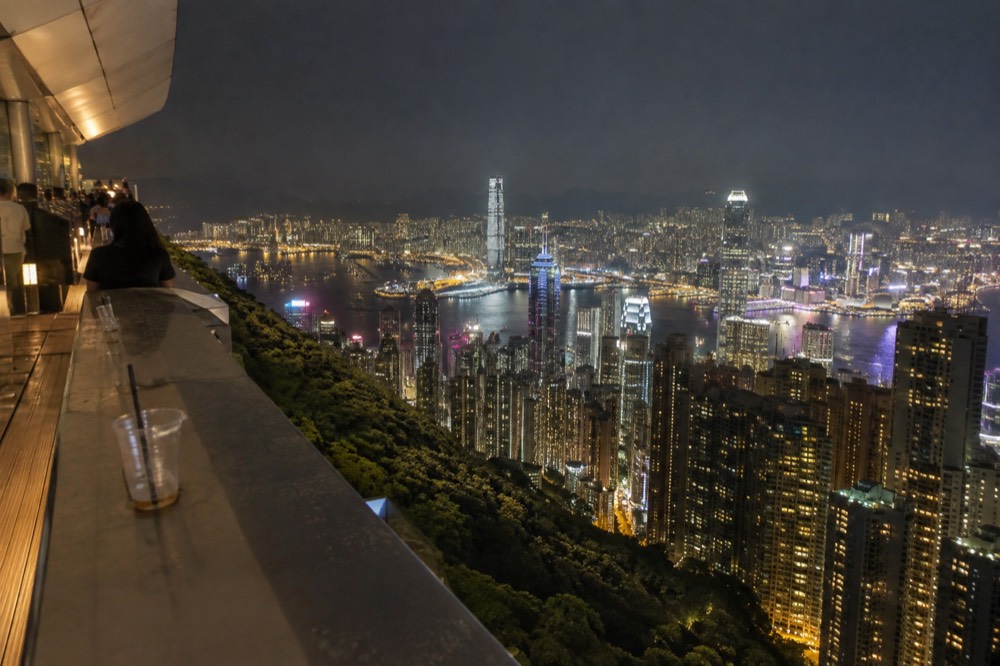
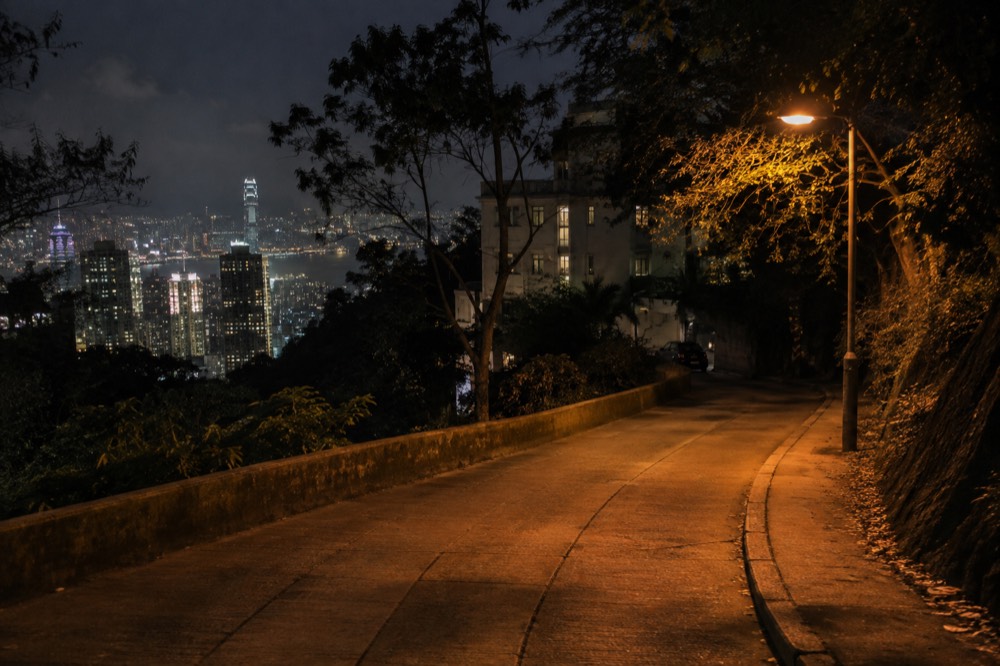
For the show specifically, the practical ranking is about comfort and light. The paid deck is the most engineered viewing surface, with free Wi-Fi published for the deck, the tower and the tram termini, which matters to anyone uploading video of the display. The Galleria rooftop is free, indoors-adjacent and next to shops and dining, which matters on a cold night. Lugard Road is the darkest and quietest of the three, and the walk out along it passes real history: the road was built between 1913 and 1914 and named for Sir Frederick Lugard, the 14th governor of Hong Kong, and early examples of the city's development remain on it, including the Grade II historic building at 1 Lugard Road and the Grade I historic residence at 27 Lugard Road.
The evening visitor with a ticket in hand should also know what else is lit up here. The operator runs and sells tickets for the HSBC Life Illuminations at The Peak, a 3D mapping show, alongside the Amusing Moment selfie studio and the MeiLok Experience Studio. Those exist, and they are almost never mentioned by competing pages, but their content, hours and prices are not verified here, so they can be named and nothing more. Madame Tussauds Hong Kong is inside The Peak Tower, and MONOPOLY DREAMS, which the tourism board calls "the world's first ever MONOPOLY-themed attraction", is at the Peak Galleria, a split that visitors constantly mix up.
How late do the tram and the viewing deck stay open?
The Peak Tram runs until 11 pm, The Peak Tower until 11 pm, and Sky Terrace 428 only until 10 pm, every day including public holidays, so an 8 pm show fits inside everything, but the deck gives you just two hours of viewing after it starts. The hours come from the operator's own published panel, which repeats across its Peak Experience pages. The asymmetry matters in both directions. In the morning, the tram starts at 7:30 am while the deck opens at 8:30 am, an hour's gap that catches early combo-ticket holders. At night the gap runs the other way: the deck shuts an hour before the tram and the tower do, so a late-evening visitor can still ride, shop and eat after the paid view has closed.
| What | Opens | Closes | Days |
|---|---|---|---|
| Peak Tram | 7:30 am | 11 pm | Monday to Sunday and public holidays |
| The Peak Tower | 7 am | 11 pm | Monday to Sunday and public holidays |
| Sky Terrace 428 | 8:30 am | 10 pm | Monday to Sunday and public holidays |
For the show, the arithmetic is simple. The lights start at 8 pm and run roughly ten minutes. A ticketed visitor who arrives at the deck by 7:45 pm has the full display plus more than an hour of ordinary night view afterwards, and the deck's 10 pm close still leaves time to walk Lugard Road or eat in the tower before the last tram down. Entering The Peak Tower building itself costs nothing, a fact the operator publishes and readers routinely get wrong: the shops, the restaurants and the indoor views are free to walk into, and the paid part is Sky Terrace 428 on the roof. A visitor who times the deck for the show and then stays in the building afterwards is using the ticket exactly the way the hours allow.
The one closure rule that overrides all of this is weather. When a tropical cyclone warning signal no. 8 or above, or a special inclement weather warning, is hoisted, the Peak Tram and Sky Terrace 428 close. That is the operator's published rule, and it is the only closure fact that can be written into a permanent article. On such a night the show itself is a moot point, and the road services become the way up and down.
What does it cost to be up there for the show?
The operator's published adult gate fares run from HK$82 for a one-way tram ride to HK$182 for a round-trip tram with Sky Terrace 428 admission, with the deck alone at HK$80, and the booking listing's cheapest option is the one-way adult tram ride at $10.59. The from-price is the number most pages get wrong, because it buys the ride up and nothing else: no deck admission, no ride down, no show ticket, because the show has never needed a ticket. The full ladder below is the operator's own published gate fare list, in the currency the operator publishes it in.
| Ticket (adult) | Single | Return |
|---|---|---|
| Peak Tram only | HK$82 | HK$116 |
| Peak Tram + Sky Terrace 428 combo | HK$146 | HK$182 |
| Sky Terrace 428 admission alone | HK$80 | |
| Peak Tram Ruby Special (priority access) | HK$342 |
The concession column, for a child aged 3 to 11, a senior 65 or above, or a concession holder, runs HK$52 single and HK$75 return on the tram alone, HK$95 and HK$118 on the combo, and HK$50 for the deck alone. One caution on the word "concession": the operator states it is not a tourist discount but the rate for holders of the HKSAR Registration Card for people with Disabilities, and it is available only when buying on arrival. Families should also note the published stroller rule: strollers must be folded before entering the tram and must not exceed 26 inches, or 66 cm, in width when folded.
The combo deserves one sentence of explanation, from the operator itself. You cannot assemble the combo saving by buying the parts separately at the top: the operator states plainly that "you must select the Peak Tram Special Combo tickets to enjoy the best price". For a show-night visitor who wants the deck, that makes the combo the honest default and the tram-only fare a choice for someone planning to watch from the free decks instead. Hong Kong has no VAT or GST, and the operator charges no online handling fee, so the numbers above are the numbers.
The listing behind that tile is not one ticket but a menu: it carries separate bookable options spanning tram-only, deck-only and several combinations, and its aggregate rating is 4.6 across 41,347 reviews. The supplier named on it is Peak Tramways Co Ltd. and The Peak Tower Ltd., which tells you who actually runs the ride and the deck. Redemption is by e-voucher: you line up at the "Pre-purchased Ticket Holder" queue and show the QR code at the admission gate, with no separate redemption step, and the operator adds that the best scanning distance is about 2 to 3 cm from the sensor, on a phone with the brightness turned up or on paper.
One distinction that the whole affiliate web gets wrong, and that this site exists to get right: this is a standard ticket, not a fast-track product. Buying ahead removes the ticket-counter line, not the boarding line. The operator states that its timed tickets "do not provide priority boarding" and that queueing time depends on the number of visitors on the day, and no queue duration is published for any hour, day or season. The genuine priority-access product is a different, dearer one: the Ruby Special, published at HK$342 adult, which the operator describes as "Priority Exclusive Access, Daily Limited Quota".
Getting down after the show
The tram runs until 11 pm, so most show-night visitors ride down afterwards, and the published road alternatives are Citybus route 15 at HK$13.00, Citybus X15 at HK$16.80 and green minibus route 1 at HK$11.80, all full adult fares for the whole route. Those fares come from the Hong Kong Transport Department's routes-and-fares open data, and they are evergreen numbers, printed in the currency they are published in. Route 15 runs from Central, boarding at the Central Ferry Piers or Exchange Square, up to The Peak. X15 runs from Central Ferry Pier No. 6. Minibus route 1 connects the Peak Public Transport Terminus with the Hong Kong Station Public Transport Interchange, which is the useful one for anyone arriving on the Airport Express or the Tung Chung line.
A taxi is the flexible option, and its tariff is published even though no total fare to the Peak is. Urban red taxis on Hong Kong Island charge HK$29 for the first 2 km or any part of it, then HK$2.10 for every subsequent 200 m or every minute of waiting time, until the chargeable amount reaches HK$102.50, after which the increment drops to HK$1.40. Two surcharges catch visitors: baggage other than light hand baggage costs HK$6 per piece, and a telephone booking costs HK$5. Wheelchairs and crutches for disabled passengers are carried free. The address to give a driver for the lower terminus is 33 Garden Road, Central.
The other way down costs nothing and takes the longest: walking. Old Peak Road runs between the top of the hill and Mid-Levels, and the Pok Fu Lam Country Park walk, which the operator times at 35 to 45 minutes, heads south past the Peak Lookout Restaurant and down towards Pok Fu Lam Road. No walking time or distance is published for Old Peak Road, and none is stated here. A visitor who walks down after the show saves the return fare entirely, which is one more way the free options at the Peak are real rather than buried.
Drivers have one published negative to plan around: there is no car park in The Peak Tower, and parking is at the adjacent Peak Galleria, telephone 2849 4113. There is also no luggage storage at the tram stations or in the tower, which decides the evening for anyone routing the Peak between a hotel checkout and a flight. Victoria Peak Garden, uphill along Mount Austin Road, has its own car park and a kiosk for snacks and drinks, which the tourism board and the operator both publish, and it is a real answer for a family that wants the show from the highest free ground on the hill.
Is the view better in some months than others?
Yes, and the difference is measurable: October, November and December are the clearest, driest months on the Hong Kong Observatory's 30-year record, while February and March carry the most fog, and a fog day means visibility below 1,000 metres. Every figure in this section is a Hong Kong Observatory monthly normal for the period 1991 to 2020, recorded at the Observatory's own station. They are Hong Kong-wide normals, not measurements taken on the Peak, and saying so honestly is part of using them. Night shows need clean air more than they need clear skies, and the fog-day column is the one that predicts whether the harbour lights will read from the hill.
| Month | Possible bright sunshine | Mean cloud | Rain | Mean fog days |
|---|---|---|---|---|
| October | 55% | 58% | 120.3 mm | 0 |
| November | 52% | 58% | 39.3 mm | 0 |
| December | 48% | 57% | 28.8 mm | 0.03 |
| February | 32% | 72% | 38.9 mm | 1.10 |
| March | 27% | 77% | 75.3 mm | 1.47 |
October is the clearest month of the year on this record. November is nearly as clear and much drier. December has the lowest mean cloud amount of any month and the year's lowest rainfall, which contradicts the common assumption that winter is a poor time to go up. February is dry, so rain-based advice calls it a good month, but the fog count says otherwise, and March is the year's murkiest month, with the lowest sunshine share of any month and the most days under 1,000 metres of visibility. Across the whole year, Hong Kong averages 3.70 fog days, and February and March hold 2.57 of them between them.
The typhoon column matters for an evening plan too. The Observatory's normals put the mean number of days a year with a signal no. 8 or above at 0.80 in August, 0.67 in September and 0.53 in July, falling to 0.13 in October and nil from November through April. When such a signal is hoisted, the tram and the deck close, so a summer evening booking carries a small, quantifiable weather risk that a December one does not. The operator itself tells visitors to check the Hong Kong Observatory's two Victoria Peak webcams before travelling, one looking east and one looking north-northeast, which is a live visibility check no travel page should withhold.
On crowding, exactly one official sentence exists anywhere, and it comes from the operator: "During public holidays or festive seasons, crowd control management will be implemented. Visitors are encouraged to purchase tickets in advance and come before 3pm during non-peak hours." No queue duration is published for any hour or season, and this site does not invent one. For a show-night visitor the published facts are enough: the show is at 8 pm, the deck closes at 10 pm, the tram runs to 11 pm, and the operator sells tickets online for same-day visits and up to 30 days ahead. If you want the deeper planning picture, the guide to the best time to visit the Peak works through the whole year month by month, and the after dark guide covers the rest of the evening up there.
For a show night, the round-trip combo is the option most visitors land on, the one-way tram fare suits a visitor planning to watch from the free decks and walk or ride down by road, and the deck-only admission suits anyone already coming up by bus or taxi. Whichever you choose, buy it as what it is: a ride and, optionally, a roof at 428 metres, with the light show itself thrown in by the city for nothing, every night of the year. More on the whole evening question sits in night or day at the Peak, and the planning side of the hill is covered across Victoria Peak Hong Kong, the site this article belongs to.
Common questions about the Symphony of Lights from the Peak
What time is the Nightly Light Show in Hong Kong?
8 pm every evening, on both sides of Victoria Harbour, running roughly ten minutes. The Hong Kong Tourism Board stages it nightly and it is free to watch. From the Peak you see the full panorama but hear none of the promenade audio.
Can you see the Symphony of Lights from Sky Terrace 428?
Yes. The deck sits at 428 metres on the Peak Tower roof and looks over the whole harbour, so the display reads as a wide panorama. The deck is open until 10 pm, so the 8 pm start falls well inside a ticket's window.
Is there a free place to watch the show at the Peak?
Yes, several. The Peak Galleria rooftop viewing deck is free, the tourism board recommends it in its own words, and Lugard Road and the Lugard Road Lookout are free night-view spots the tourism board also recommends.
Does the Peak Tram still run after the show?
Yes. The tram runs until 11 pm every day, and the tower stays open until 11 pm, though Sky Terrace 428 closes at 10 pm. The published road alternatives down are bus 15 at HK$13.00, X15 at HK$16.80 and green minibus 1 at HK$11.80.
What is the cheapest ticket up for the show?
The listing's cheapest option is a one-way adult Peak Tram ride at $10.59, tram only, with no Sky Terrace 428 admission and no ride down. The operator's published gate fare for the round-trip tram and deck combo is HK$182.
Is the tram ticket a skip-the-line product?
No. Buying ahead removes the ticket-counter queue, not the boarding queue. The operator states its timed tickets "do not provide priority boarding" and that queueing time depends on the number of visitors on the day. The priority-access product is the separate Ruby Special at HK$342.