Is there a tram in Hong Kong that goes to Victoria Peak?
Hong Kong has two famous trams and only one of them climbs. Here is the difference between the ding ding and the Peak Tram, with fares, heights and the mix-ups that catch first-time visitors.
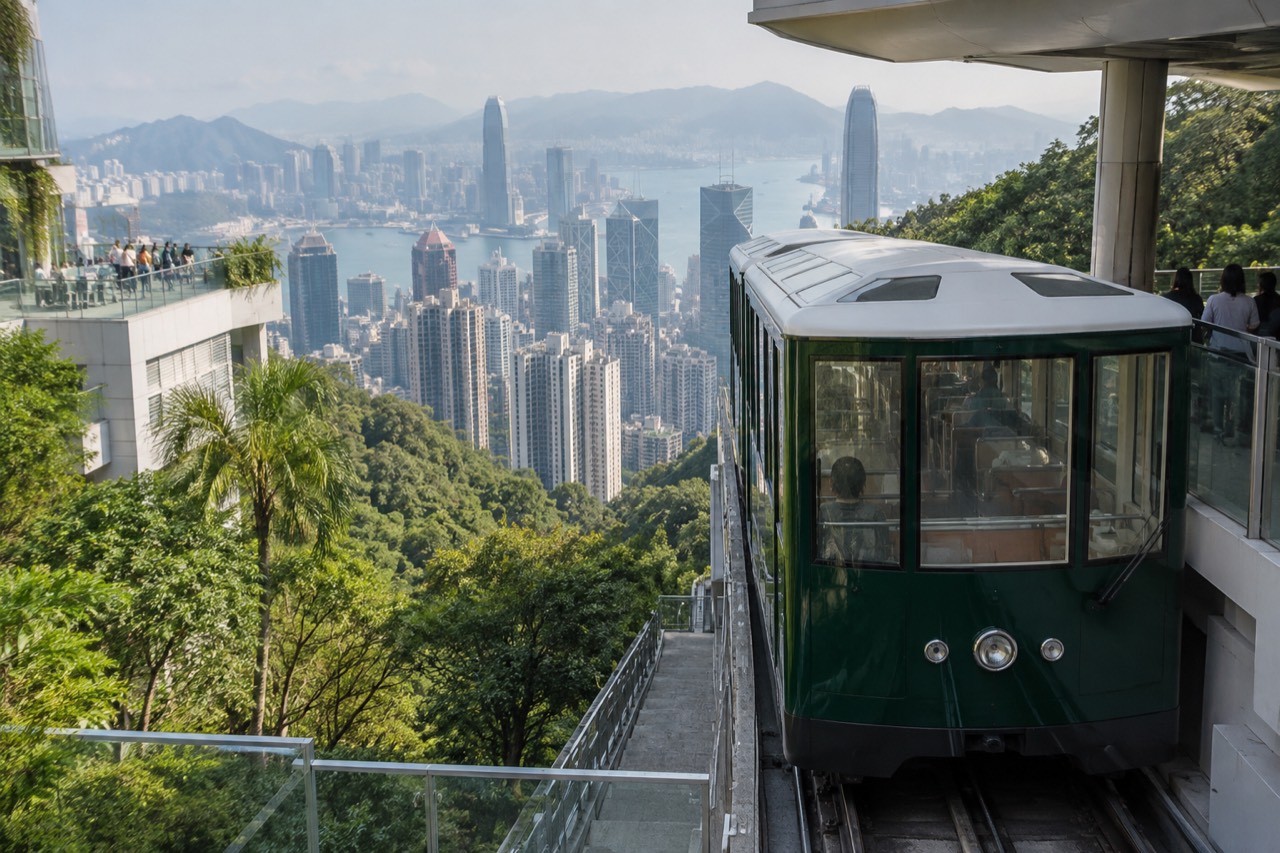
Is there a tram in Hong Kong that goes to Victoria Peak?
Yes, but it is not the tram most first-time visitors picture. The famous double-decker ding ding tram runs on flat ground along the north shore of Hong Kong Island and never climbs a metre of the Peak. The tram that does go up is the Peak Tram, a funicular on 1,278 metres of track between the Central Terminus at 33 metres above sea level and the Peak Terminus at 396 metres.
The confusion is easy to understand. Ask a search engine for "the Hong Kong tram" and you will get answers about both, often interleaved. One is a street tramway with double-decker cars that has run along the waterfront for over a century, known locally as the ding ding for the bell its drivers ring. The other is a cable-hauled funicular that has been dragging passengers up the hillside since 30 May 1888, when it opened as the first cable funicular in Asia. They share a name in English and almost nothing else.
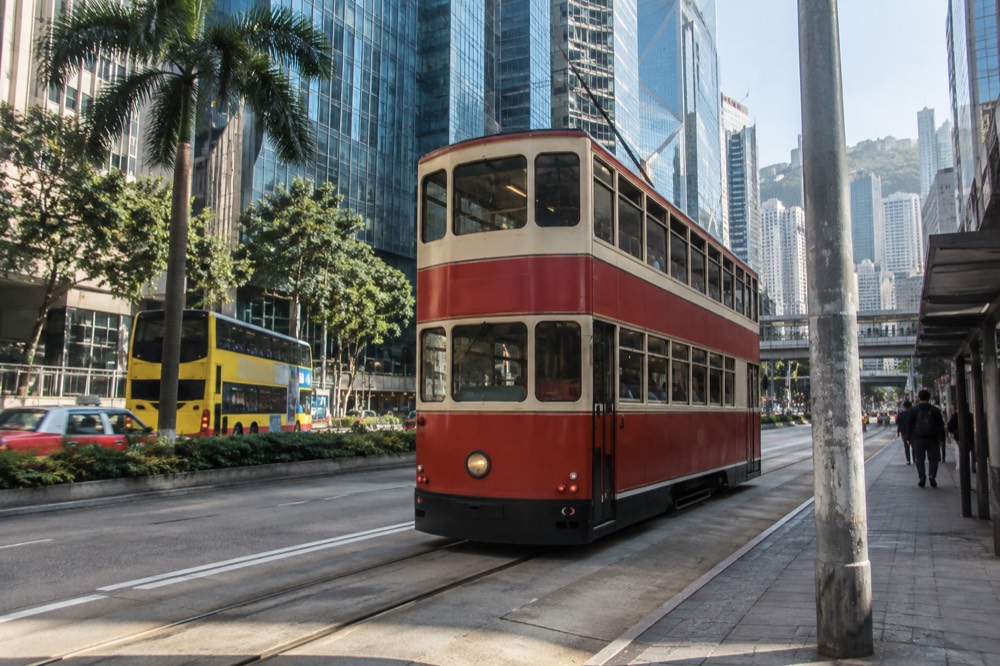
The practical consequence of mixing them up is wasted time in the wrong part of the city. A visitor who boards a double-decker street tram expecting a mountain climb will ride a flat, slow, scenic-but-level route along the harbour front and never gain any altitude. A visitor who asks a hotel concierge for "the tram" may be pointed to either system depending on what the concierge assumes. Naming the system you mean, the Peak Tram for the hill, the ding ding for the waterfront, solves the problem in one sentence.
If the climb is what you came for, the ticket that covers it is the operator's Peak Tram product, and the cheapest version of it is a one-way adult tram ride with no viewing-deck admission. The options that add Sky Terrace 428 cost more, which is the single most common pricing surprise on this whole attraction, and it is worth checking the live listing before you commit to a combo.
What is the ding ding tram, exactly?
The ding ding is Hong Kong Island's double-decker street tramway, a flat-ground urban service running along the northern waterfront of the island. It shares the word tram with the Peak Tram and nothing else: no track connection, no climb, no shared terminus, no shared operator. It cannot take you to Victoria Peak because its entire route stays at sea level along the shore. Locals call it the ding ding after the bell the drivers ring to warn pedestrians.
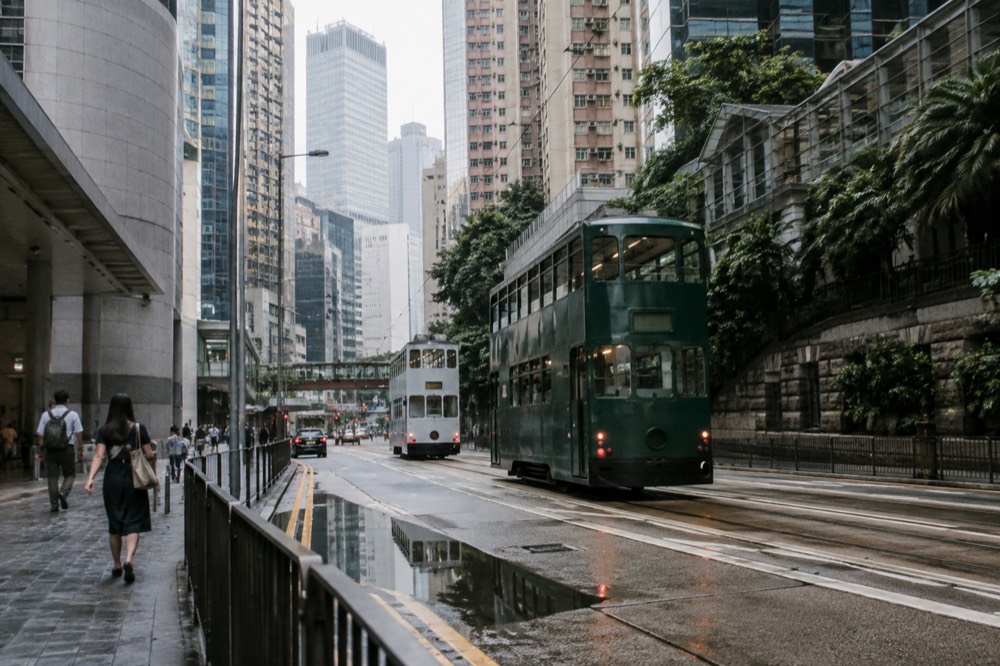
The street tram is a genuine Hong Kong institution and worth riding for its own sake. Double-decker cars, narrow streets, front-row views of shopfronts and signage rolling past at street level. But everything about it is horizontal. Its route serves the dense commercial and residential strip along the island's north shore, from the ferry piers eastward through Wan Chai, Causeway Bay and beyond. Nothing in its route profile involves a hill, and no branch of it has ever pointed at the Peak.
The mistake usually happens in one of two directions. A visitor reads that "Hong Kong has a famous tram" and boards the street version expecting the mountain. Or a visitor reads about the Peak Tram, arrives in Central, sees an actual tram in the street outside the MTR exit, and boards it. Both versions end the same way, with a pleasant flat ride and no view from the top. The fix is to know that the hill tram does not run in the street at all. It departs from its own dedicated terminus building at 33 Garden Road, Central, and its track is a private funicular line, not a street railway.
There is also a terminology trap in the other direction. Some travel writing refers to "the tram up the Peak" loosely, and readers who know the ding ding well sometimes assume the Peak Tram must be a steep branch of the same system. It is not. The Peak Tram is a double reversible funicular, which means pairs of cars counterbalance each other on a single steep haulage rope, an entirely different engineering principle from a street tramway drawing power from overhead lines. The operator's own history page describes the system in detail, including the two haulage ropes of 50.5 mm diameter that hold a 55-tonne tramcar.
If the ride up the hill is the part you want, tickets for the funicular are sold as a standard admission product, and buying ahead removes the ticket-counter line rather than the boarding line.
So what is the tram that does go to the Peak?
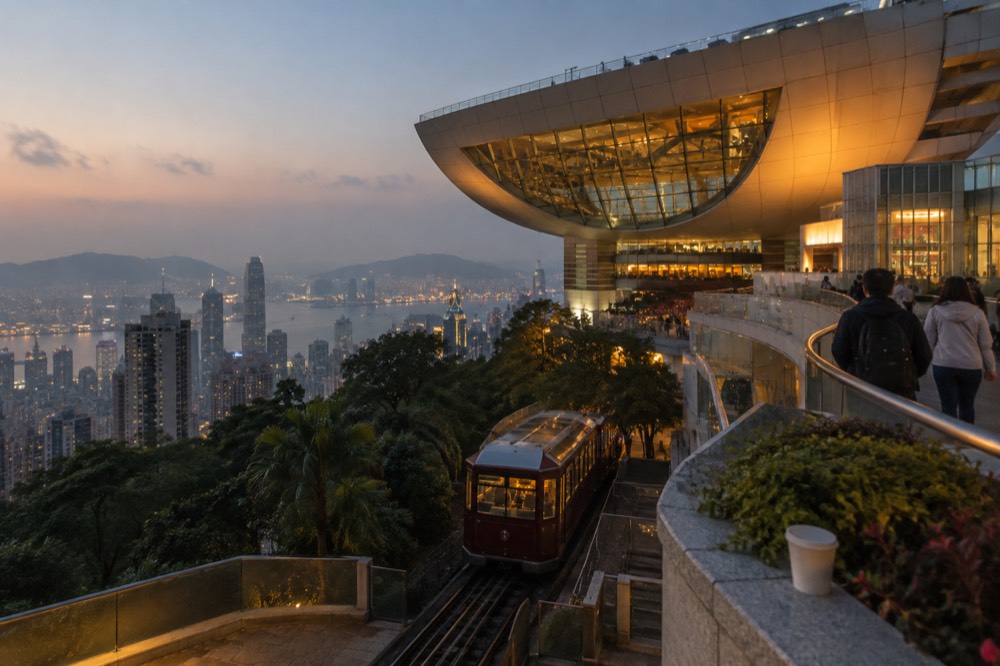
The Peak Tram is a funicular railway between the Central Terminus at 33 Garden Road and the Peak Terminus at Victoria Gap, climbing from 33 metres to 396 metres above sea level on 1,278 metres of track. The journey takes approximately 6 minutes one way, on a gradient that runs from 4 degrees to a maximum of 25.7 degrees. It opened on 30 May 1888 as the first cable funicular in Asia.
That is the machine you actually want when you want altitude. The current system is the sixth generation, completed in August 2022, which replaced the haulage, control and signalling systems, installed new tramcars and new rails, and raised capacity by 75 per cent, from 120 passengers to 210, broken down as 167 seated and 43 standing. Any article describing the tram as carrying 120 passengers is describing the retired fifth generation, which left service in 2021, and there is a lot of that stale copy on the open web.
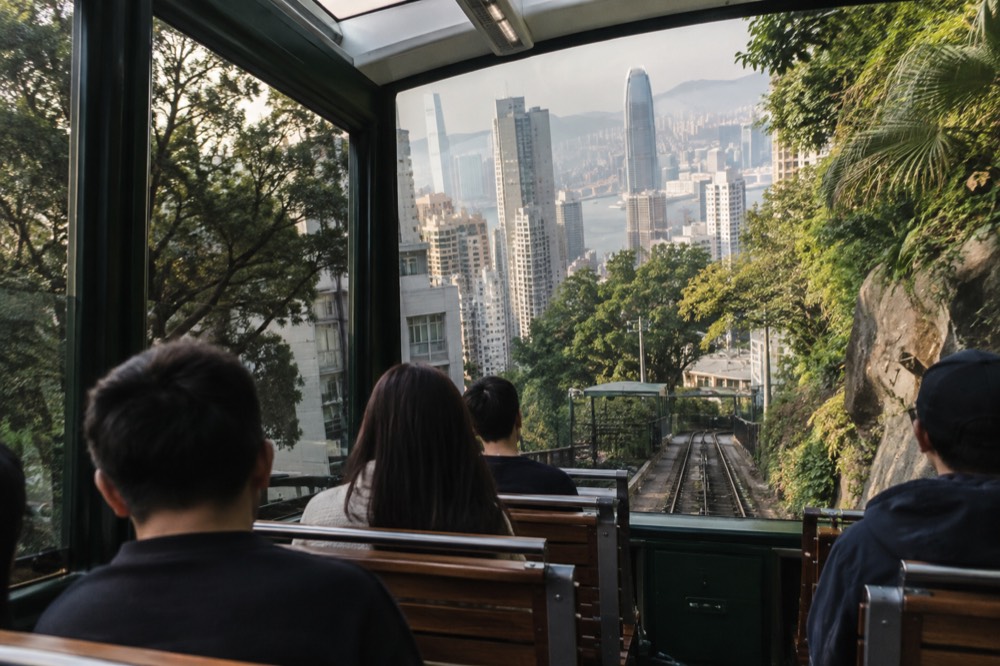
The rebuild also brought wider doors, larger panoramic windows and step-free access, which matters to families with strollers and to wheelchair users. The stroller rule is specific and published: strollers must be folded before entering and must not exceed 26 inches, or 66 cm, in width when folded. Pets are not allowed on the tram except qualified guide dogs, though pets on a leash or in a stroller are allowed inside The Peak Tower building itself, a split the operator publishes and almost nobody reports.
One detail that surprises nearly every first-time rider: the buildings appear to lean. The operator's own page cites a University of Hong Kong study, published in Psychological Science in 2013, finding that passengers riding uphill experience a visual illusion in which the high-rises to the right of the tram appear to tip toward the Peak. It is a real, studied effect of the steep grade, not a trick of your eyes alone.
What the ride costs, in the currency the operator publishes
The Peak Tram's published gate fares are HK$82 for a single adult ride and HK$116 for a return, covering the tram only, while adding Sky Terrace 428 admission raises the price to HK$146 one way or HK$182 return; deck-only entry for those arriving by bus or on foot is HK$80, and the cheapest bookable option on the live listing is $10.59 for the one-way tram ride.
Those HK$ figures are the operator's own published gate fares, and they are the honest baseline for planning. The $10.59 figure is the only dollar price that may be quoted, and it is worth being blunt about what it buys: one adult, one ride up, no deck, no ride down. The listing carries many separate options rather than one ticket, spanning tram-only, deck-only and combinations, which is why its observed price range runs from $10.59 to $38.79 in the US locale. Everything else covered here is indexed on Victoria Peak Hong Kong.
| Ticket type | Adult single | Adult return | Child, senior or concession, single | Child, senior or concession, return |
|---|---|---|---|---|
| Peak Tram only | HK$82 | HK$116 | HK$52 | HK$75 |
| Tram + Sky Terrace 428 combo | HK$146 | HK$182 | HK$95 | HK$118 |
| Sky Terrace 428 admission alone | HK$80 | not applicable | HK$50 | not applicable |
The concession column has a definition worth reading twice. "Concession" on the operator's price list is not a tourist discount. It is the rate for holders of the HKSAR Registration Card for people with Disabilities, and it is available only when buying on arrival. The child band runs from age 3 to 11 and the senior band starts at 65, both published. The operator also states that you cannot assemble the combo saving by buying the parts separately: the combo ticket is the price, and the operator's own FAQ says you must select it to get the best price. Hong Kong charges no VAT or GST, and the operator adds no online handling fee, so the number you see is the number you pay.
How the two trams compare at a glance
The street tram is a double-decker urban service on flat ground along the waterfront. The Peak Tram is a cable funicular climbing from 33 metres above sea level to 396 metres on a private steep-gradient track between two dedicated termini. They have different vehicles, different track, different power systems, different operators and different purposes. The only thing they share is the word tram, which is exactly why this question gets asked so often.
| The ding ding street tram | The Peak Tram | |
|---|---|---|
| What it is | Double-decker street tramway | Double reversible funicular |
| Where it runs | Flat ground along the north shore of Hong Kong Island | 1,278 m of steep track, Garden Road to Victoria Gap |
| Does it reach the Peak | No, never | Yes, to the Peak Terminus at 396 m above sea level |
| Climb | None, sea-level route | 33 m to 396 m, gradient 4 to 25.7 degrees |
| Ride length | Not applicable to this article's sources | Approximately 6 minutes one way |
| Current cars | Double-deckers | Sixth-generation cars from August 2022, capacity 210 |
One more distinction completes the picture, and it is the one that ends most arguments. The Peak Tram does not take you to the top of Victoria Peak. The operator states plainly that the tower "does not sit atop Victoria Peak but is situated in Victoria Gap, a dip along the line of the hills at an elevation of 396 metres". The true summit, at 552 metres, is closed to the public and occupied by a radio installation. The highest ground a visitor can freely stand on is Victoria Peak Garden, which the operator publishes at 554 metres, and it is free. If you want the full picture of what is actually at the top, the guide to things to do at the Peak covers the free ground as well as the ticketed deck.
Other ways up the hill when the tram is not your choice
The Peak Tram is one of several ways up, and on the government's published fares it is not the cheapest. Green minibus route 1 runs between the Hong Kong Station Public Transport Interchange and the Peak for a full adult fare of HK$11.80. Citybus route 15 runs from Central, boarding at the Central Ferry Piers or Exchange Square, for HK$13.00. Citybus route X15 runs from Central Ferry Pier No. 6 for HK$16.80.
Those fares come from the Hong Kong Transport Department's routes-and-fares open data, which is the same primary source that confirms the Central to Peak pairing on route 15 through the government's real-time transport API. Two independent government feeds agree on the route, which is more grounding than most travel writing offers. The minibus is the cheapest published fare of any way up the hill, and it boards at Hong Kong Station, which means anyone arriving on the Airport Express or the Tung Chung line can reach it without going to Central station at all.
| Service | Route | Full adult fare |
|---|---|---|
| Peak Tram, single | Central Terminus to Peak Terminus | HK$82 |
| Green minibus route 1 | Hong Kong Station interchange to the Peak | HK$11.80 |
| Citybus route 15 | Central, ferry piers or Exchange Square, to the Peak | HK$13.00 |
| Citybus route X15 | Central Ferry Pier No. 6 to the Peak | HK$16.80 |
| Urban taxi | Metered, HK$29 flagfall for the first 2 km | meter continues after that |
The taxi row deserves its own sentence. The Transport Department's tariff is published: HK$29 for the first 2 km, then HK$2.10 for every subsequent 200 m or minute of waiting, stepping down to HK$1.40 once the meter reaches HK$102.50. A total fare from Central to the Peak is not published anywhere, so no honest page can print one. The address to give a driver is the Peak Tram Lower Terminus, 33 Garden Road, Central. Baggage beyond light hand luggage costs HK$6 per piece in an urban taxi, a detail that catches airport arrivals routing the Peak between a hotel and a flight, and there is no luggage storage at either tram terminus or in The Peak Tower.
Drivers should also note that there is no car park in The Peak Tower at all. Parking is at the adjacent Peak Galleria, and the free rooftop viewing deck is in that same building, which the Hong Kong Tourism Board describes in plain words as a free viewing deck with panoramic views of the skyline and Victoria Harbour. The Peak Galleria free deck guide covers what that costs, which is nothing.
Common mix-ups that cost visitors real time
Three mix-ups here cost real money or real time. The $10.59 starting price buys a one-way tram ride only, with no viewing deck. The operator states its timed tickets "do not provide priority boarding" and that queueing time depends on visitor numbers on the day. And the tram starts at 7:30 am while Sky Terrace 428 does not open until 8:30 am, so an early combo arrives an hour before the deck does.
Each of those three is published, and each is routinely got wrong elsewhere. The hours trap cuts at both ends of the day: the deck also closes at 10 pm, an hour before the tram and The Peak Tower shut at 11 pm, so a late visit can ride up and find the deck dark. The deck's standalone price of HK$80 exists precisely because plenty of people arrive by bus, minibus, taxi or on foot and never touch the tram at all.
The weather rule is worth knowing before you book rather than after. The operator's FAQ states the closure plainly for signal 8 or above and special inclement weather warnings, and the operator itself points visitors to the Hong Kong Observatory's two Victoria Peak webcams as a live visibility check before travelling. One webcam looks east and one looks north-northeast, and both are exactly the tool a visitor needs on a doubtful morning. The full seasonal picture, including which months the Observatory's 30-year normals flag as murky, is in the best time to visit the Peak.
For the tram itself, the practical guidance that actually exists is the operator's own: during public holidays or festive seasons crowd control management is implemented, and visitors are encouraged to buy tickets in advance and come before 3pm during non-peak hours. That is the only official crowd-timing sentence published anywhere on this subject, and it is the one to plan around. Redemption is by e-voucher, with the QR code scanned at the admission gate, no separate redemption step, and the operator's own tip for scanning is to turn the screen brightness up and hold the code about 2 to 3 cm from the sensor.
Common questions about the Hong Kong trams and the Peak
Is there a tram in Hong Kong that goes to Victoria Peak?
Yes. The Peak Tram is a funicular railway that climbs from the Central Terminus at 33 Garden Road to the Peak Terminus at Victoria Gap, 396 metres above sea level, on 1,278 metres of track. The double-decker ding ding street tram does not go to the Peak at all; it runs on flat ground along the island's north shore.
Is the ding ding tram the same as the Peak Tram?
No. They are separate systems with separate track, separate vehicles and separate operators. The ding ding is a street tramway on flat waterfront roads. The Peak Tram is a cable funicular on a steep private line between two dedicated termini, opened in 1888 and rebuilt as its sixth generation in August 2022.
Can you take the street tram part of the way and walk up?
The street tram never leaves sea level, so it cannot shorten the climb. The published walking routes up the hill start from Central, and the operator's own walk list covers routes at the top, including Victoria Peak Garden at 30 to 40 minutes uphill along Mount Austin Road. No verified walking time from Central to the tram terminus exists in any source.
Does the Peak Tram go to the actual summit of Victoria Peak?
No. The tram ends at Victoria Gap, a dip in the hill line at 396 metres, where the operator states the Peak Tower stands. The true summit, at 552 metres, is closed to the public and occupied by a radio installation. The highest ground visitors can freely reach is Victoria Peak Garden, published at 554 metres, which is free.
Is the Peak Tram the cheapest way up the hill?
On published fares, no. Green minibus route 1 costs HK$11.80 for the full adult fare from the Hong Kong Station interchange, and Citybus route 15 costs HK$13.00 from Central. The tram's published adult single gate fare is HK$82. What the tram fare buys is the ride itself, approximately 6 minutes on a gradient reaching 25.7 degrees.
Do Peak Tram tickets include the Sky Terrace 428 viewing deck?
Only the options that name the deck include it. The cheapest option, from $10.59, buys a one-way adult tram ride with no deck admission and no ride down. The operator's combo gate fares that add Sky Terrace 428 are HK$146 with a single tram ride and HK$182 with a return.