Is Victoria Peak and Peak Tram the same?
Victoria Peak is the hill, the Peak Tram is the funicular that climbs it, and The Peak Tower and Sky Terrace 428 are two more names stacked on top. A plain guide to the four names visitors mix up.
Is Victoria Peak and Peak Tram the same?
No. Victoria Peak is the hill, 552 metres above sea level and the highest point on Hong Kong Island, and the Peak Tram is the funicular railway that runs from Garden Road in Central up to Victoria Gap at 396 metres. The tram is a mode of transport, the Peak is a place, and the two names get tangled because almost every visitor arrives at one by means of the other.
The confusion is understandable, because the names overlap in almost every sentence written about the area. People say "take the Peak Tram to Victoria Peak," which is roughly true but hides a detail that surprises a lot of first-time visitors: the tram does not actually reach the summit. The operator of the tram states plainly that the upper terminus "does not sit atop Victoria Peak but is situated in Victoria Gap, a dip along the line of the hills at an elevation of 396 metres." The gap is a saddle below the true summit, and the summit itself is closed to the public and occupied by a radio installation.
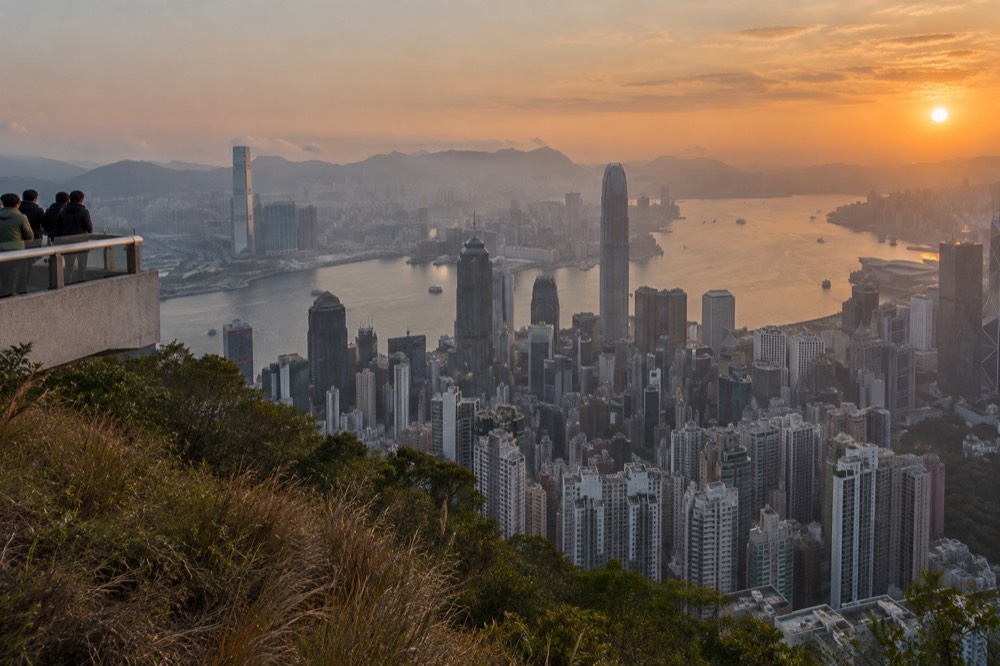
So a single trip to this corner of Hong Kong Island can involve four distinct things with four distinct names, and only one of them is free to enter by default. There is the hill, Victoria Peak. There is the ride, the Peak Tram. There is the building at the top of the ride, The Peak Tower, which costs nothing to walk into. And there is the paid viewing deck on that building's roof, Sky Terrace 428, which is the part most tickets are really about.
If you are weighing up whether the ride itself justifies its fare, the separate write-up on whether the Peak Tram is worth it goes deeper on that question alone. This page is about the names, because getting them straight changes what you buy, what you expect at the top, and whether you end up paying for something you did not need.
What exactly is Victoria Peak?
Victoria Peak is a hill on the western half of Hong Kong Island, 552 metres above sea level, and it is the highest point on the island. It is not the highest peak in Hong Kong, that is Tai Mo Shan in the New Territories, and the actual summit of Victoria Peak is closed to visitors because a radio installation stands on it. The public high ground nearby is Victoria Peak Garden, which the tram operator publishes at 554 metres.
The Hong Kong Tourism Board confirms the 552-metre figure and calls the hill the highest point on Hong Kong Island, while naming Tai Mo Shan, elsewhere on its site, as Hong Kong's highest peak. That distinction, island versus territory, is one that a remarkable number of travel articles get wrong, usually by calling Victoria Peak the highest point in Hong Kong outright.
The summit closure is the part nobody expects. The very top of the hill is a fenced-off compound, so the highest ground a visitor can freely stand on is Victoria Peak Garden, a free public park uphill from the main tourist area along Mount Austin Road. The operator publishes that garden at 554 metres, which is higher than the paid viewing deck, and the tourism board describes the garden as "a hidden gem above Victoria Peak, offering stunning views, charming Victorian landscaping and a serene retreat for nature lovers."
The name "the Peak" is the everyday shorthand locals use for the whole tourist district at the top of the hill, which includes the tram terminus, two malls, restaurants and the walking circuit around the ridge. When someone says they are "going to the Peak," they almost always mean this district, not the closed summit. The free options up there are real: the Peak Galleria's free rooftop viewing deck, Lugard Road, Harlech Road and Victoria Peak Garden all cost nothing, a point the tourism board itself makes about the Galleria deck in plain words.
What exactly is the Peak Tram?
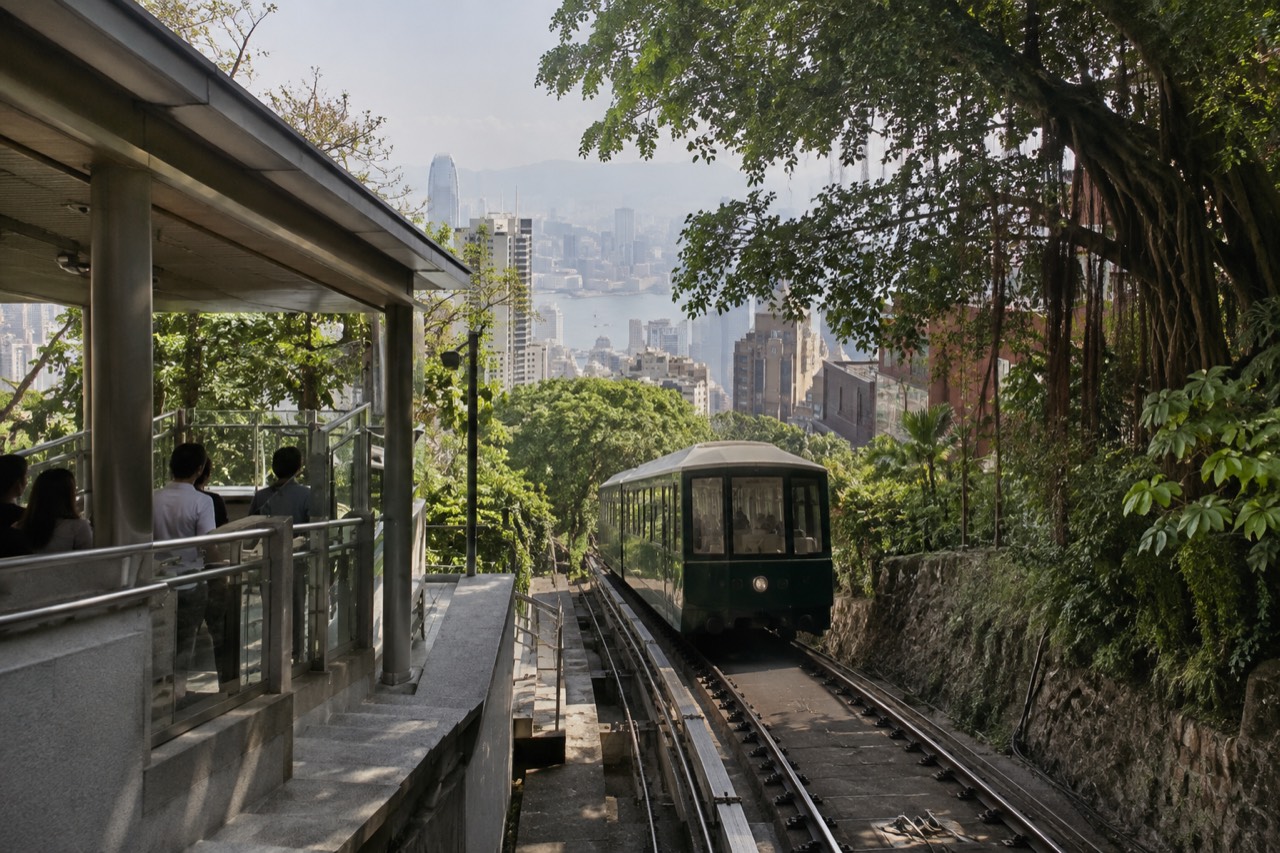
The Peak Tram is a double reversible funicular railway running on 1,278 metres of track between the Central Terminus at 33 metres above sea level and the Peak Terminus at 396 metres, a climb the operator says takes approximately 6 minutes one way. It opened on 30 May 1888 as the first cable funicular in Asia, and its current sixth-generation cars, in service since August 2022, carry 210 passengers each.
Two words in that answer do a lot of work. "Funicular" matters because the Peak Tram is not a tram in the street sense at all: it is a cable-hauled railway that winches two cars up and down a steep incline, with a gradient that runs from 4 degrees to 25.7 degrees, the steepest section passing below May Road. The Hong Kong street tramway, the double-decker "ding ding" that runs on flat ground through the northern shore of the island, is a completely separate system that never goes anywhere near the hill, a mix-up that has its own explanation in the ding ding tram is not this one.
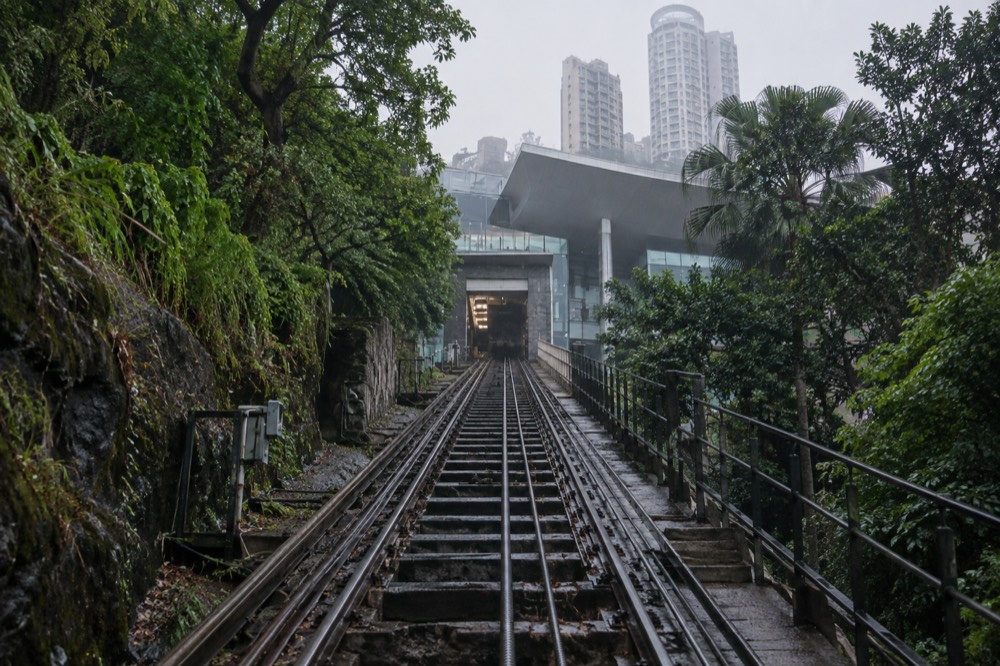
The date matters too. The rebuild completed in August 2022 replaced the haulage, control and signalling systems, installed new tramcars built in Switzerland by Garaventa, CWA and Frey, and raised capacity from 120 to 210 passengers, split as 167 seated and 43 standing. Anything you read describing 120-passenger cars describes a system retired in 2021, and a great deal of what is still published does exactly that. The current cars wear a bespoke colour the operator calls Peak Tram Green, and the rebuild brought wider doors, larger panoramic windows and step-free access.
The ride is also where a famous visual illusion happens. The operator's own page cites a University of Hong Kong study, published in Psychological Science in 2013, finding that passengers riding uphill perceive the high-rises to the right of the tram as leaning toward the Peak. It is a real, documented effect, not a travel myth, and it is one of the small reasons the six-minute ride has kept its reputation since 1888.
What are The Peak Tower and Sky Terrace 428?
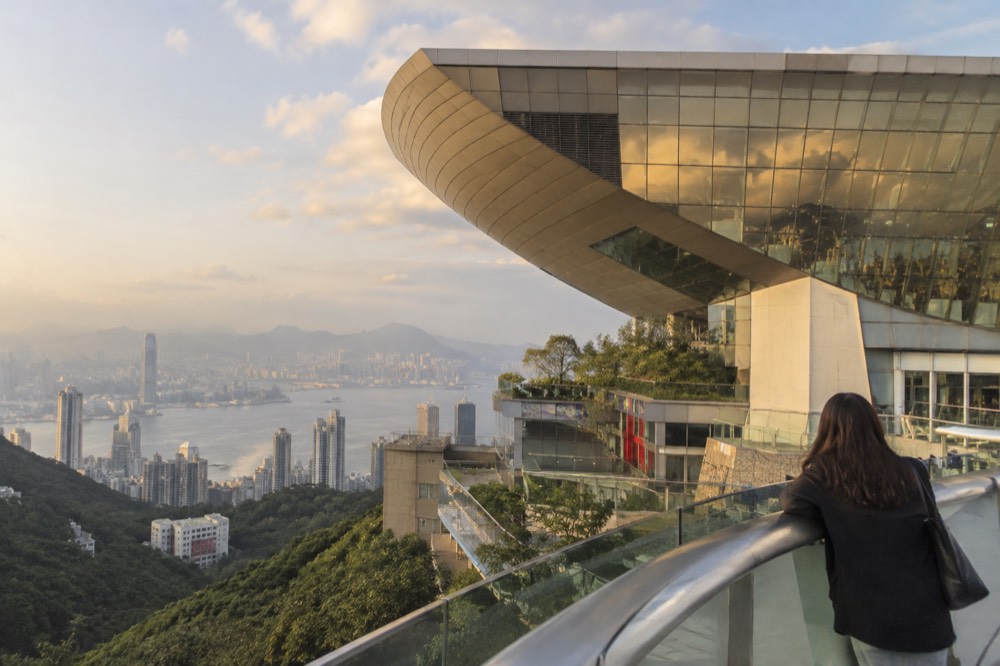
The Peak Tower is the wok-shaped building at the upper tram terminus, opened in its current form after a revitalisation programme, and entering it costs nothing. Sky Terrace 428 is the paid observation deck on its roof, at 428 metres above sea level, open 8:30 am to 10 pm while the tram runs from 7:30 am to 11 pm. The tower stands in Victoria Gap, not on the summit.
The tourism board describes the building's shape as wok-shaped, and the original tower on the site was unveiled to the public on 29 August 1972, housing the upper terminus of the tram. A HK$500-million redevelopment designed by Sir Terry Farrell opened in May 1997, and the revitalisation that produced today's building began in March 2005. Inside, the tower holds shops, restaurants including Bubba Gump Shrimp Co., Lavache and Petit Jardin, and Madame Tussauds Hong Kong. None of that requires a Sky Terrace ticket. The wider set of guides lives on Victoria Peak Hong Kong.
The paid part is the roof deck, and the operator describes Sky Terrace 428 as "the highest observation deck in Hong Kong," a claim worth attributing rather than asserting, since it is the operator's own marketing language. Deck admission on its own costs HK$80 for an adult and HK$50 for a child aged 3 to 11, a senior 65 or above, or a concession holder, which matters to anyone arriving by bus, minibus, taxi or on foot rather than by tram. The deeper comparison of the deck itself, including what the ticket buys and what the free alternatives look like, lives in the Sky Terrace 428 guide.
The hours are the trap that catches people who have not separated the names. The tram starts at 7:30 am, The Peak Tower is open 7 am to 11 pm, but Sky Terrace 428 does not open until 8:30 am and shuts at 10 pm, an hour before the rest. A visitor on the first tram of the day with a combo ticket arrives a full hour before the deck opens, and a late-evening visitor finds the deck closed while the tower and the tram are still running. There is a full breakdown in the Peak Tram hours and timetable guide.
The tram and the deck also share one closure rule: when a tropical cyclone warning signal no. 8 or above, or a special inclement weather warning, is hoisted, both close, per the operator's own FAQ. On a day like that the road services, bus and minibus, remain the way up and down, which is worth knowing before you commit to a date.
The four heights, side by side
Four different elevations get quoted about this hill and they are not interchangeable: 396 metres for Victoria Gap where the tram terminates, 428 metres for the Sky Terrace 428 roof, 552 metres for the true summit of Victoria Peak, and 554 metres for Victoria Peak Garden, the highest ground the public can reach. Mixing them up is how people end up believing the tram takes them to the top of Hong Kong.
Each number belongs to a different thing, and each comes from a published source. Here they are in one place, which is something the incumbent pages rarely do:
| Name | Elevation | What it is | Can the public go there? |
|---|---|---|---|
| Central Terminus | 33 m | Lower tram station, 33 Garden Road | Yes, it is the boarding point |
| Victoria Gap | 396 m | The saddle where the upper terminus, The Peak Tower and the Peak Galleria stand | Yes, freely |
| Sky Terrace 428 | 428 m | The paid observation deck on the roof of The Peak Tower | Yes, with a ticket |
| Victoria Peak summit | 552 m | The true top of the hill, the highest point on Hong Kong Island | No, closed, radio installation |
| Victoria Peak Garden | 554 m | Free public park along Mount Austin Road | Yes, freely |
The operator publishes both the 552-metre summit figure and the 554-metre garden figure, each for its own subject, and there is no contradiction to resolve between them. The garden sits on high ground beside the summit rather than on the summit itself. The striking comparison is the middle of the table: the free park is published higher than the paid deck, 554 metres against 428 metres, and almost nothing on the open web puts those two numbers next to each other.
The gap figure explains something visitors feel but cannot always name. Standing at the upper terminus, you are not standing on top of the mountain; you are standing in a dip on the ridge line, which is exactly why the surrounding walks, Lugard Road, Harlech Road and the climb to the garden, all add height after you leave the tram.
Why do visitors mix these names up?
The names blur because the tram, the hill and the tower all appear in the same photos, because the tram's own marketing says "the Peak" as shorthand, and because the Hong Kong street tram gives the word "tram" a second local meaning. One more trap: the summit is invisible behind trees and fencing, so nothing at the top ever tells you that you are not standing on it.
The street tram is the biggest single source of the word confusion. Hong Kong's "ding ding" double-deckers have run along the north shore of the island for well over a century and are famous in their own right, so a visitor who has read about "the tram" can easily board the wrong system. The street tram runs on flat ground and never climbs the hill; the Peak Tram is a funicular that runs on 1,278 metres of steep track between two fixed termini. They share a word and nothing else.
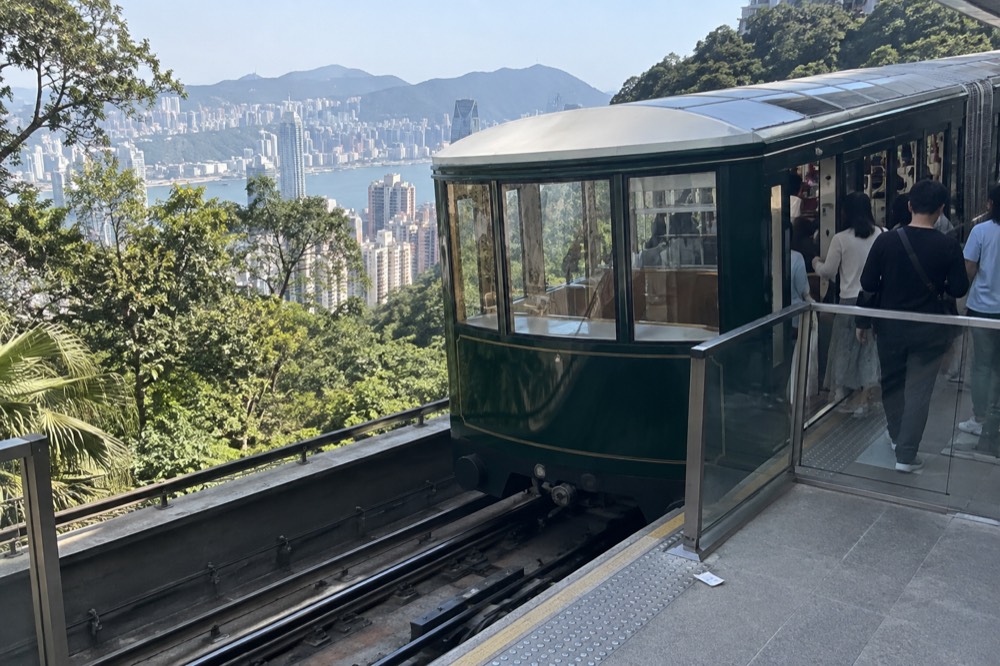
The ticket listing adds its own layer of fog. The featured listing is titled "The Peak Tram Ticket in Hong Kong," and its name contains no mention of Sky Terrace 428, even though the deck is one of the options inside it. The listing is not one ticket at all but a menu of bookable options spanning tram-only, deck-only and several combinations, with a price range wide enough, $10.59 to $38.79 in US dollars on the observed listing, to prove it is several products rather than one. The headline $10.59 buys a one-way adult tram ride with no deck admission and no ride back down, which is the single most important thing to understand before buying anything.
The operator's gate fares make the same point in Hong Kong dollars: HK$82 for an adult single tram ride, HK$116 return, HK$80 for deck admission alone, HK$146 for a single tram plus the deck and HK$182 for the return combination. Those are the operator's own published gate fares, not booking-page prices. The operator also states that you cannot assemble the combination saving by buying the parts separately, in its words, "you must select the Peak Tram Special Combo tickets to enjoy the best price."
Which name do you actually need?
If you want the view, you need the Peak, and the view is free from several spots. If you want the historic ride, you need the Peak Tram. If you want the highest ticketed deck, you need Sky Terrace 428, and if you just want shops and restaurants at the top, you need only The Peak Tower, which is free to enter. Match the name to what you want and the ticket choice follows.
Start with what you actually want from the visit. A reader whose only goal is the postcard panorama over Victoria Harbour does not strictly need the tram or the deck at all: the tourism board states in plain words that the Peak Galleria "offers a range of shopping and dining as well as a free viewing deck," and it calls the signed Lugard Road Lookout "one of Hong Kong's best-kept secrets, offering breathtaking views without the crowds." Both are free, and the board recommends both in its own voice.
A reader who wants the ride as an experience, the 1888 funicular, the illusion of the leaning towers, the 25.7-degree gradient below May Road, needs the tram, and the cheapest way to ride it is the tram-only option. A reader who wants the paid deck can buy deck admission alone, which is what anyone arriving by bus, minibus or taxi should be comparing against. And a reader who wants both should be looking at the combination options, because the operator says the combination price cannot be rebuilt from separate purchases.
The Hong Kong Tourism Board's own Peak Circle Walk pulls the whole district together in one easy loop it grades as easy, 3.5 km, which the board says "can be completed in an hour," with seven official stops running from the tram through The Peak Tower, the Peak Galleria, The Peak Lookout, Lugard Road and Victoria Peak Garden. That loop is the best single answer to the question of what "the Peak" means in practice: it is all of these, on one hill, and only some of it is ticketed.
Common questions about Victoria Peak and the Peak Tram
Is Victoria Peak and Peak Tram the same?
No. Victoria Peak is the hill, 552 metres above sea level and the highest point on Hong Kong Island, while the Peak Tram is the funicular railway that climbs from Garden Road in Central to Victoria Gap at 396 metres. The tram serves the Peak district but does not reach the summit, which is closed to the public.
Does the Peak Tram take you to the top of Victoria Peak?
No. The operator states the upper terminus "does not sit atop Victoria Peak but is situated in Victoria Gap, a dip along the line of the hills at an elevation of 396 metres." The true summit, at 552 metres, is occupied by a radio installation and closed to visitors. The highest public ground is Victoria Peak Garden, published at 554 metres.
Is the Peak Tram the same as the Hong Kong ding ding tram?
No. The Peak Tram is a cable funicular running on 1,278 metres of steep track between Central and Victoria Gap. The ding ding is the double-decker street tramway on flat ground along the island's north shore, a separate system that never goes up the hill.
Is The Peak Tower the same as Sky Terrace 428?
No. The Peak Tower is the wok-shaped building at the upper tram terminus, and entering it is free. Sky Terrace 428 is the paid observation deck on the building's roof, at 428 metres above sea level, open 8:30 am to 10 pm while the tower itself is open 7 am to 11 pm.
Do I need a tram ticket to see the view from the Peak?
No. The view from the top of the hill is free at several places: the Peak Galleria rooftop viewing deck, Lugard Road, Harlech Road and Victoria Peak Garden. The tram ticket buys the ride, and the Sky Terrace 428 ticket buys the deck on The Peak Tower's roof.
Is Victoria Peak the highest point in Hong Kong?
No. It is the highest point on Hong Kong Island at 552 metres. The highest peak in Hong Kong is Tai Mo Shan in the New Territories, as the Hong Kong Tourism Board itself states.