Is the Peak Tram worth it?
An honest cost-versus-value breakdown of the Peak Tram: what the ticket buys, what the bus does for less, and when the ride earns its fare.
Is the Peak Tram worth it?
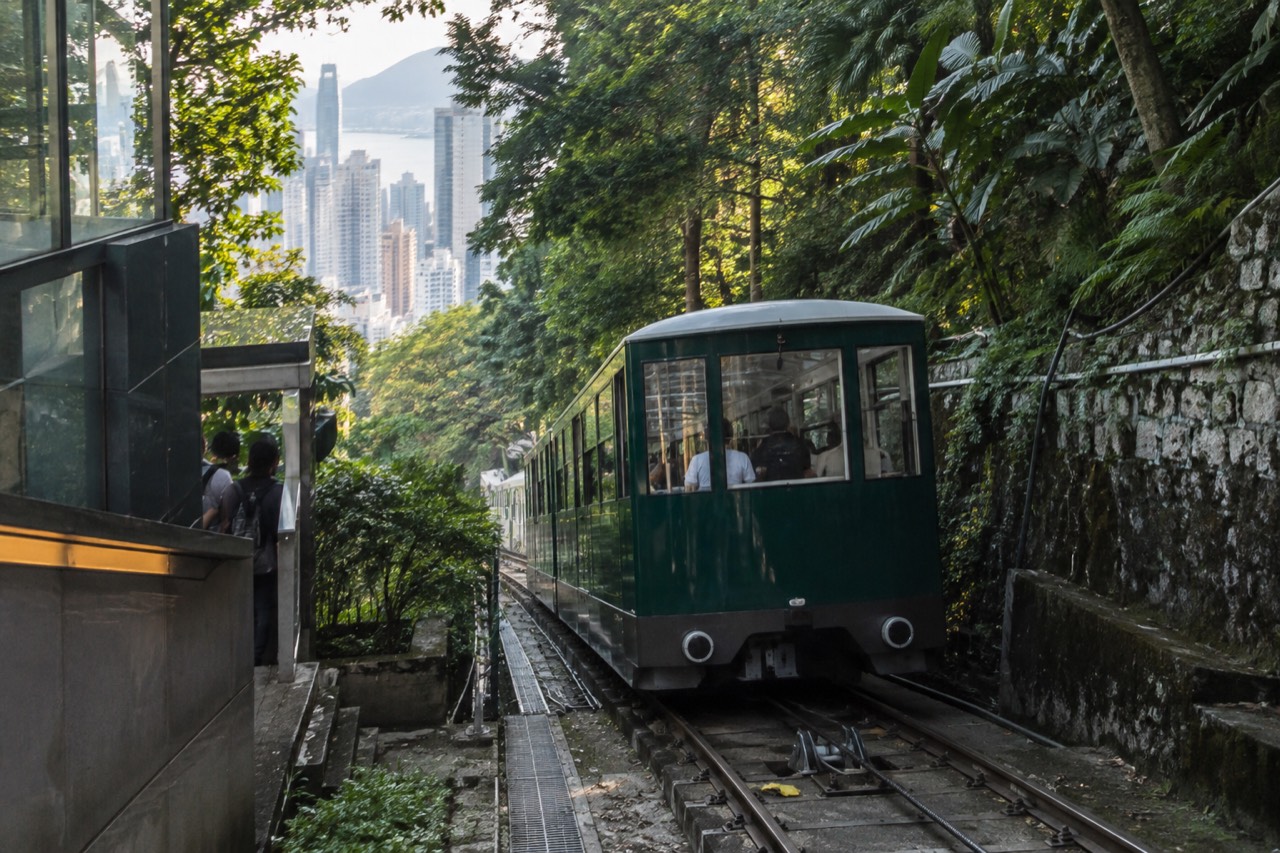
Yes, for most first-time visitors the Peak Tram is worth the fare, because the ride itself is the attraction: a 6-minute climb on a 1,278-metre funicular from 33 metres to 396 metres above sea level, at gradients up to 25.7 degrees, on Swiss-built sixth-generation cars in service since August 2022. It is worth it as an experience, not as transport, because green minibus route 1 reaches the same hilltop for HK$11.80.
The honest framing is this: nobody needs the tram. Four road services, a taxi rank and two walking routes all reach the Peak, and the cheapest of them costs less than a seventh of the tram's published single fare. What the tram sells is not altitude, it is the manner of arriving. A funicular that opened in 1888, rebuilt into its sixth generation in 2022, hauling a 55-tonne car up a slope steep enough that the high-rises outside the window appear to lean, is a piece of working heritage. Whether that piece of heritage is worth HK$82 one way, or $10.59 through the booking listing, is a question about what kind of traveller you are, and this page works through it with real numbers rather than enthusiasm.
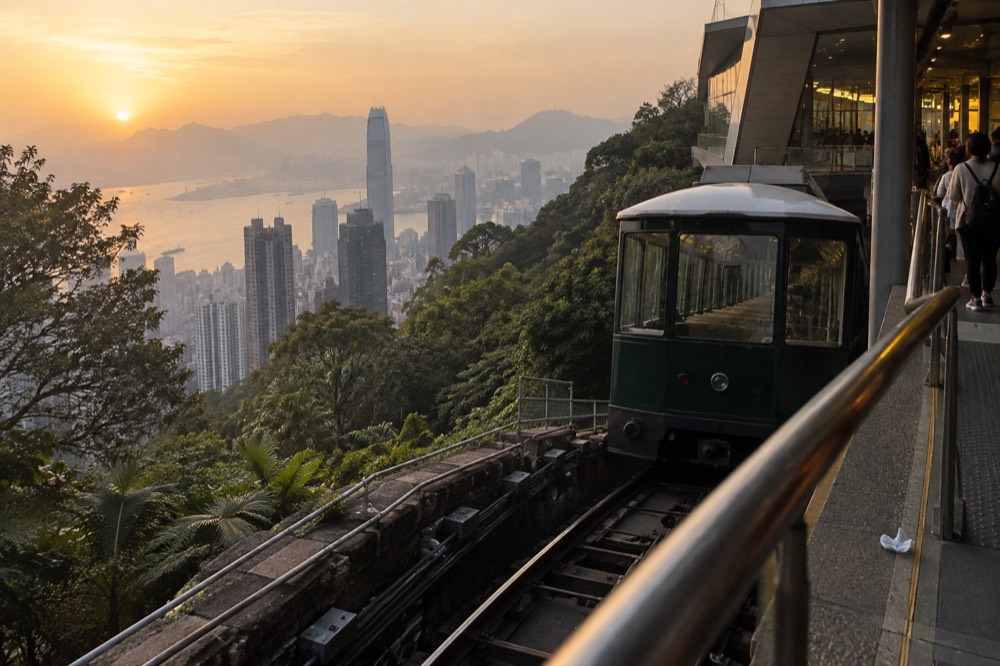
The verdict splits cleanly by traveller type, and the table below is the short version of the whole argument. Families with young children, railway enthusiasts, photographers and most first-time visitors tend to get their money's worth. Visitors on a tight budget, anyone routing the Peak between a hotel checkout and a flight with luggage in tow, and anyone visiting in the murkiest months of the year often do not. Both answers are defensible once the facts are laid out, which is what the rest of this page does.
| Traveller type | Is the tram worth it | Why |
|---|---|---|
| First-time visitor | Usually yes | The ride is part of the Peak experience and the history is genuine |
| Tight budget | Usually no | Minibus route 1 costs HK$11.80 against the tram's HK$82 single |
| Family with children | Yes | The 6-minute ride is short enough to hold attention, and the 2022 cars are step-free |
| Railway or history enthusiast | Yes | Asia's first cable funicular, on its original 1888 alignment |
| Visitor with luggage | No | There is no luggage storage at either tram station or in The Peak Tower |
| Photographer | Depends | The leaning-building illusion is real, but tripods are banned on the tram |
If you already know you want the tram, the choice is not whether to buy but which option to buy, and the three below cover the spread: the tram-only single that matches the from-price, and the two combos that add the Sky Terrace 428 deck.
What the $10.59 price actually buys
The headline price of $10.59 buys exactly one thing: a one-way Peak Tram ride for one adult, tram only. It includes no Sky Terrace 428 admission and no ride back down. The operator's own published gate fare for that ticket is HK$82, and the match between the two figures is what proves what the cheap option contains. Anyone expecting the viewing deck at that price is buying the wrong ticket.
This is the single most common confusion about the product, and it is worth being blunt about it. The booking listing is not one ticket. It carries many separate bookable options spanning tram-only rides, deck-only admission and several combinations, and the observed price range on the listing runs from $10.59 up to $38.79, roughly 3.7 times from floor to ceiling. A range that wide only exists because the listing is a menu, not a product. The English title, "The Peak Tram Ticket in Hong Kong", does not even mention Sky Terrace 428, even though the tram-and-deck combo is what most visitors actually want and what most competing pages assume the headline price covers.
The operator's own gate fares make the ladder clear, and they are published in Hong Kong dollars, which is how the operator prints them. An adult tram single is HK$82 and an adult return is HK$116. Sky Terrace 428 admission alone is HK$80. The combination of a single tram ride and one deck admission is HK$146, and with a return tram ride it is HK$182. So the deck is not a small add-on: pairing it with even a one-way tram raises the adult cost from HK$82 to HK$146, and the full return combo sits at HK$182. The operator also states plainly that the combo saving cannot be assembled by buying the parts separately: "you must select the Peak Tram Special Combo tickets to enjoy the best price."
One more pricing fact that visitors from Europe and North America rarely expect: Hong Kong has no VAT or GST, and the operator charges no online handling fee, as stated in the operator's own FAQ. The number printed is the number charged. Children aged 3 to 11, seniors 65 or above and holders of the HKSAR Registration Card for people with Disabilities pay concession rates on every ticket type, and the child band starting at 3 and the senior band starting at 65 are both published, so families do not have to guess.
How the tram compares with the bus and minibus
As transport, the tram loses on price to every road alternative. Green minibus route 1 costs HK$11.80 for the full route, Citybus route 15 costs HK$13.00 and express route X15 costs HK$16.80, all published adult fares, against the tram's HK$82 single and HK$116 return. The tram wins on experience, on the 6-minute journey time and on arriving inside the rebuilt terminus at Victoria Gap rather than at the bus stop.
The road fares come from the Hong Kong Transport Department's own routes-and-fares open data, which is why they can be printed with confidence. Minibus route 1 runs between the Peak Public Transport Terminus and the Central, Hong Kong Station Public Transport Interchange, which makes it the natural choice for anyone arriving on the Airport Express or the Tung Chung line, since the connection happens inside the same station complex without a transfer to Central MTR. Citybus route 15 boards at the Central Ferry Piers or Exchange Square, the same pier complex as the Star Ferry, which matters for visitors staying in Kowloon: the ferry crossing plus bus 15 is the cheapest two-leg answer from Tsim Sha Tsui, and our guide to reaching the Peak from Kowloon works it through in detail.
| Way up the hill | Published adult fare | What it is |
|---|---|---|
| Green minibus route 1 | HK$11.80 | Cheapest published fare of any way up |
| Citybus route 15 | HK$13.00 | From Central Ferry Piers or Exchange Square |
| Citybus route X15 | HK$16.80 | Express from Central Ferry Pier No. 6 |
| Peak Tram, single | HK$82 | One ride, no deck admission |
| Peak Tram, return | HK$116 | Two rides, no deck admission |
| Urban taxi | HK$29 flagfall for the first 2 km | Meter runs HK$2.10 per 200 m after, per the Transport Department tariff |
The taxi row deserves its own sentence, because the flagfall figure is published by the Transport Department while any total fare to the Peak is not, and inventing one would be arithmetic on an unverified input. What can be said is the tariff itself: HK$29 for the first 2 km, then HK$2.10 for every subsequent 200 m or minute of waiting, stepping down to HK$1.40 once the meter reaches HK$102.50. There is also a HK$6 per piece charge for baggage other than light hand baggage, which catches airport arrivals who route the Peak into a landing day.
So the price question resolves like this. If the tram were only a way of getting up the hill, it would be roughly seven times the minibus for no additional arrival, and the answer to this page's question would be a flat no. The reason the answer is not a flat no is the ride, which is the next section. Before that, if you have decided the tram is for you and you want the deck too, the combo question is worth settling at the point of purchase rather than at the top of the hill.
Is the ride itself special?
Yes, and more than most competing articles still realise, because the August 2022 sixth-generation rebuild replaced the haulage, control and signalling systems, the track rails and the tramcars, and raised capacity by 75 per cent, from 120 to 210 passengers. Any description of the tram written before that date describes a system that no longer exists, and much of the open web is still describing the old one.
The current cars are manufactured in Switzerland by Garaventa, CWA and Frey, and the 210-passenger capacity breaks down as 167 seated and 43 standing, with a waveform floor pattern designed for standing passengers. The livery is a bespoke colour the operator calls Peak Tram Green, a nod to the third and fourth generation cars, which is why every photograph taken since 2022 shows green rather than the red of the retired fifth generation. The rebuild also brought wider doors, larger panoramic windows and step-free access for persons with a disability, which is the one verified accessibility fact anywhere on this trip. The engineering underneath is unchanged in kind: two haulage ropes of 50.5 mm diameter hold each 55-tonne car, with a safety factor of 8, and four braking systems, the Normal Stop, Service Stop, Emergency Stop and a fourth fitted on the tramcars themselves.
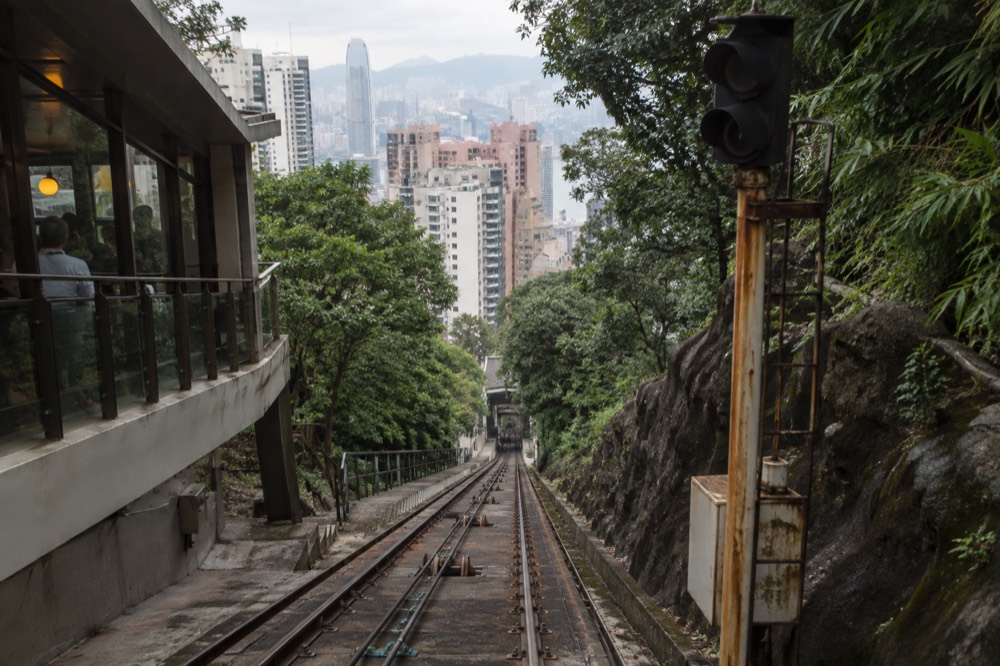
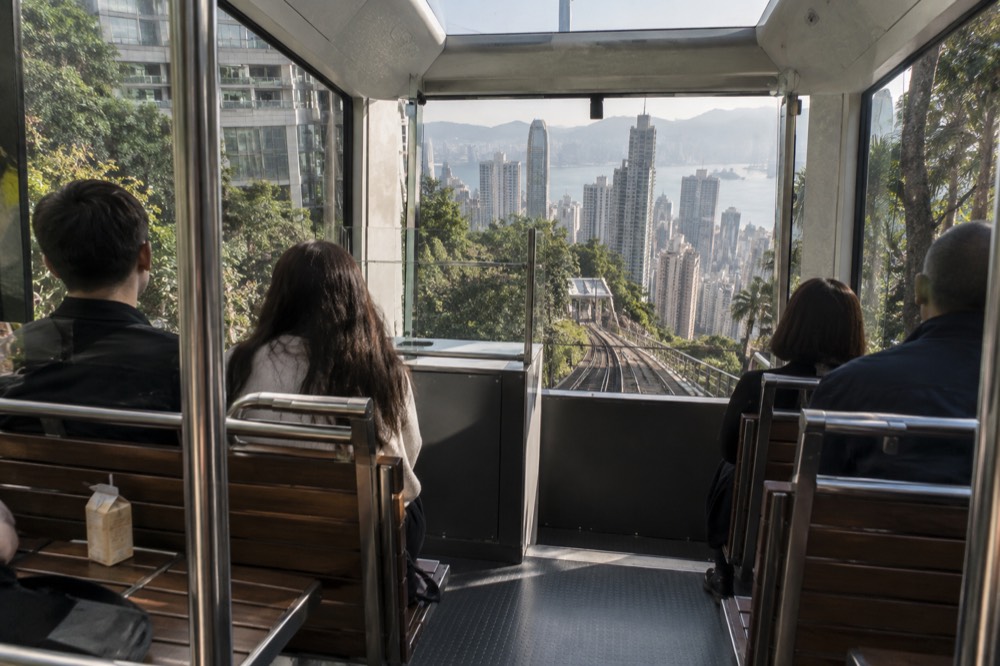
Then there is the illusion. The operator's own page cites a study by The University of Hong Kong, published in Psychological Science in 2013, which found that passengers riding uphill experience a visual effect in which the high-rises to the right of the tram appear to lean toward the Peak. This is not travel-writing folklore; it is a named university, a named journal and a year, and it is the detail that turns the ride from a commute into something people talk about afterwards. The gradient itself runs from 4 degrees to 25.7 degrees, with the steepest section where the tracks pass below May Road.
The history is real too, and it is the kind that survives scrutiny. Service commenced on 30 May 1888, and it was the first cable funicular in Asia, officially opened by the Governor, Sir William Des Voeux. The line still runs on its original alignment. Alexander Findlay Smith, a Scotsman who had worked for Scotland's Highland Railway, petitioned for permission in May 1881, approval came in 1882, and the Hong Kong High Level Tramways Company was formed. Our longer history of the Peak Tram carries the full story, including the 1941 engine room damage and the shell fragment that stayed under the haulage drums after service resumed on Christmas Day 1945.
What the tram does not include at the top
Arriving by tram puts you inside The Peak Tower, in Victoria Gap at 396 metres above sea level, and nothing at the top is included in a tram-only ticket. Sky Terrace 428, on the tower roof at 428 metres, costs HK$80 for an adult on its own. Entering the tower building itself costs nothing, and the free Peak Galleria rooftop viewing deck sits across the road, so a tram-only visitor still has free views.
The geometry matters more than most pages admit. The Peak Tower does not stand on the summit; the operator states it "does not sit atop Victoria Peak but is situated in Victoria Gap, a dip along the line of the hills at an elevation of 396 metres". Victoria Peak itself is 552 metres, the highest point on Hong Kong Island, and the summit is closed to the public behind a radio installation. Victoria Peak Garden, a free public park uphill along Mount Austin Road, is published by the operator at 554 metres, which makes the free park higher than the paid deck, 554 metres against 428. Two operator-published numbers, one free and one ticketed, and almost nobody in the travel web sets them side by side.
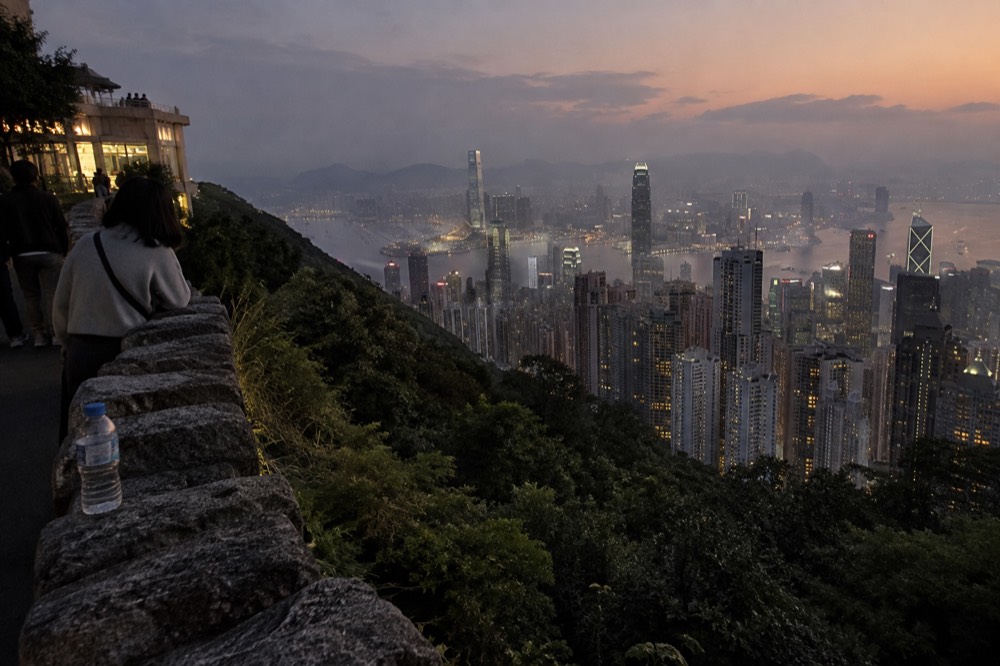
This is where the worth-it question gets its honest nuance. The panoramic view from the top of the hill is free at the Peak Galleria rooftop deck, a fact stated in plain words by the Hong Kong Tourism Board, and Lugard Road, Harlech Road and Victoria Peak Garden are free as well. What the Sky Terrace 428 ticket buys is the extra height at 428 metres and the operator's 360-degree deck, which the operator itself describes as "the highest observation deck in Hong Kong", a claim that belongs to the operator rather than to this page. What the tram ticket buys is the ride. Three separate purchases, three separate values, and the failure mode of most advice is collapsing them into one.
For a reader weighing the tram-only ticket, the practical consequence is this: you can ride up, walk out of the tower, and still have a complete Peak visit for nothing further, using the free deck and the free roads. Whether you then add the paid deck is a separate decision with its own comparison in our guide to Sky Terrace 428 versus Sky100, and for the deck itself, the listing below covers the admission-only option alongside the tram combos.
When the tram is not worth it
The tram is weak value in three situations: when the view is the only goal and the weather is against you, when the budget is tight enough that HK$11.80 matters, and when the visit is squeezed between luggage and a flight, since neither tram station nor the tower offers luggage storage. The hours trap also bites early risers: the tram starts at 7:30 am but Sky Terrace 428 opens only at 8:30 am.
The weather case is stronger than most seasonal advice admits, because it can be made with a 30-year government dataset rather than opinion. The Hong Kong Observatory's monthly normals for 1991 to 2020, recorded at the Observatory's own station and Hong Kong-wide rather than Peak-specific, show October as the clearest month of the year, with 55 per cent of possible bright sunshine and 58 per cent mean cloud, and December as the driest and least cloudy month, with 28.8 mm of rain and 57 per cent cloud. March is the year's murkiest month, with only 27 per cent of possible sunshine, 77 per cent cloud and 1.47 mean days with visibility under 1,000 metres, and February carries 1.10 such fog days. The whole year averages 3.70 of them, and February and March hold 2.57 between them. A tram ride into cloud buys a steep hill and a grey wall, and the bus up would have bought the same for less.
The budget case is arithmetic, not judgement. HK$82 against HK$11.80 is the tram single against the minibus, and the gap repeats for every member of a family on the round trip, before anyone has even decided about the deck. The luggage case is a hard published negative: the operator states there is no luggage storage at the Peak Tram stations or in The Peak Tower, and there is no car park in The Peak Tower either, parking being at the adjacent Peak Galleria. Anyone routing the Peak between checkout and a flight needs to hear that before they commit.
The hours trap deserves its own warning because it catches the most organised visitors, the ones who plan the first tram of the day. The tram runs from 7:30 am, The Peak Tower is open 7 am to 11 pm, and Sky Terrace 428 opens only at 8:30 am and closes at 10 pm, every day including public holidays, per the operator's published ticket and fare page. An early combo ticket cannot be used in full on arrival, and a late one loses the deck an hour before the last tram down.
The queue question, answered honestly
This is a standard ticket, not a fast-track product. Buying ahead puts you in the "Pre-purchased Ticket Holder" queue, which removes the ticket-counter line, not the boarding line, and the operator states its timed tickets "do not provide priority boarding" and that queueing time depends on the number of visitors on the day. No published wait figure exists for any hour, day or season, and any page printing one has invented it.
That is the whole answer, and it is worth dwelling on why so much of the web gets it wrong. The listing's own redemption text draws the distinction precisely: line up at the "Pre-purchased Ticket Holder" queue and present the e-voucher QR code at the admission gate, with no separate redemption step, and boarding subject to the queueing arrangement of Peak Tramways Co Ltd and The Peak Tower Ltd, the two companies that actually run the tram and the tower. The operator's FAQ says the same thing independently. Two sources, seller and operator, agreeing that pre-purchase buys convenience at the counter and nothing at the platform.
The genuine priority product exists, but it is not this one. The operator's own Peak Tram Ruby Special is published at HK$342 adult and HK$222 concession, described as "Priority Exclusive Access, Daily Limited Quota", and the listing's Ruby Pass option carries its own redemption route through Ruby Pass access points. That is the honest answer to anyone asking whether money can buy a shorter wait: yes, at a specific published price, in a specific product, and not in the cheap ticket. Our separate piece on whether a Ruby Pass is worth it works that trade-off through.
For everyone else, the only official crowd guidance that exists anywhere is one sentence from the operator: "During public holidays or festive seasons, crowd control management will be implemented. Visitors are encouraged to purchase tickets in advance and come before 3pm during non-peak hours." Build timing on that and on the weather normals, and on nothing else, because nothing else is published. The operator also recommends checking the Hong Kong Observatory's two Victoria Peak webcams before travelling, one looking east and one looking north-northeast, which is the only live visibility check on offer.
The verdict
For a first visit in a clear month, the tram is worth it: the 2022-generation ride, the 25.7-degree maximum gradient and the 1888 heritage are an experience the HK$11.80 minibus cannot replicate, and the return combo with the deck at HK$182 is the ticket most visitors actually want. For a budget trip, a murky March day or a luggage-encumbered transit, the road wins, and the free decks at the top complete the visit.
The way to buy, if you buy, is to decide the deck question first. A tram-only return at HK$116 suits the visitor who plans to spend the afternoon on Lugard Road and in Victoria Peak Garden, both free, and who values the ride over the roof. The single-plus-deck combo at HK$146 suits the visitor who will walk down, or take the bus, and the return combo at HK$182 suits the classic visit: up, deck, down. The operator's own sentence settles the assembly question, since the parts cannot be combined afterwards for the combo price. This site, Victoria Peak Hong Kong, exists to keep exactly these distinctions straight, because the from-price trap and the fast-track confusion are where most ticket advice goes wrong.
For the classic up, deck, down visit, the round-trip combo is the option that matches it, and it is the one most readers of this page end up comparing against the tram-only return.
One last practical note for the purchase itself. The operator sells online for same-day visits and up to 30 days ahead, with a maximum of 10 tickets per ticket type per transaction, and the e-voucher is shown at the gate from a phone or on paper, screen brightness up, at a scanning distance of about 2 to 3 cm. An Octopus card cannot be used for direct entry at the gate, though it can buy at the counter and pay on board at the intermediate stations, which is a three-part answer most forum advice compresses into a wrong one. Small mechanics, but they are the difference between a smooth arrival and a confused one.
Whichever option fits, the three below are the ones most visitors compare.
Common questions about the Peak Tram
Is the Peak Tram worth it?
For most first-time visitors, yes: the sixth-generation ride is a genuine 6-minute experience on Asia's first cable funicular, and no road service replicates it. For tight budgets, foggy February and March days, or luggage-encumbered transits, the HK$11.80 minibus and the free decks at the top are the better answer.
Does the tram ticket include Sky Terrace 428?
Only in the options that name it. The cheapest option, $10.59, is a one-way tram ride for one adult with no deck admission and no return ride. The operator's gate price for the tram-plus-deck combo is HK$146 with a single ride and HK$182 with a return.
Is the Peak Tram the same as the ding ding tram?
No. The Peak Tram is a funicular between Garden Road and Victoria Gap, climbing from 33 metres to 396 metres above sea level. The double-decker street tram on Hong Kong Island runs on flat ground along the north shore and never goes up the hill.
Does buying ahead let you skip the line?
No. Pre-purchase removes the ticket-counter queue, not the boarding queue. The operator states its timed tickets "do not provide priority boarding" and that queueing time depends on the number of visitors on the day. The only priority product is the separate Ruby Special at HK$342 adult.
How long is the tram ride?
Approximately 6 minutes one way, on 1,278 metres of track, at gradients from 4 degrees up to 25.7 degrees where the tracks pass below May Road.
Can I get up to the Peak without the tram?
Yes. Citybus route 15 costs HK$13.00, express route X15 costs HK$16.80, green minibus route 1 costs HK$11.80, taxis run on the published urban meter, and Old Peak Road connects the hilltop to Mid-Levels on foot.