How frequently does the Peak Tram run?
No published timetable exists for the Peak Tram. Here is what the operator does publish about departures, hours, capacity and what a ticket actually changes.
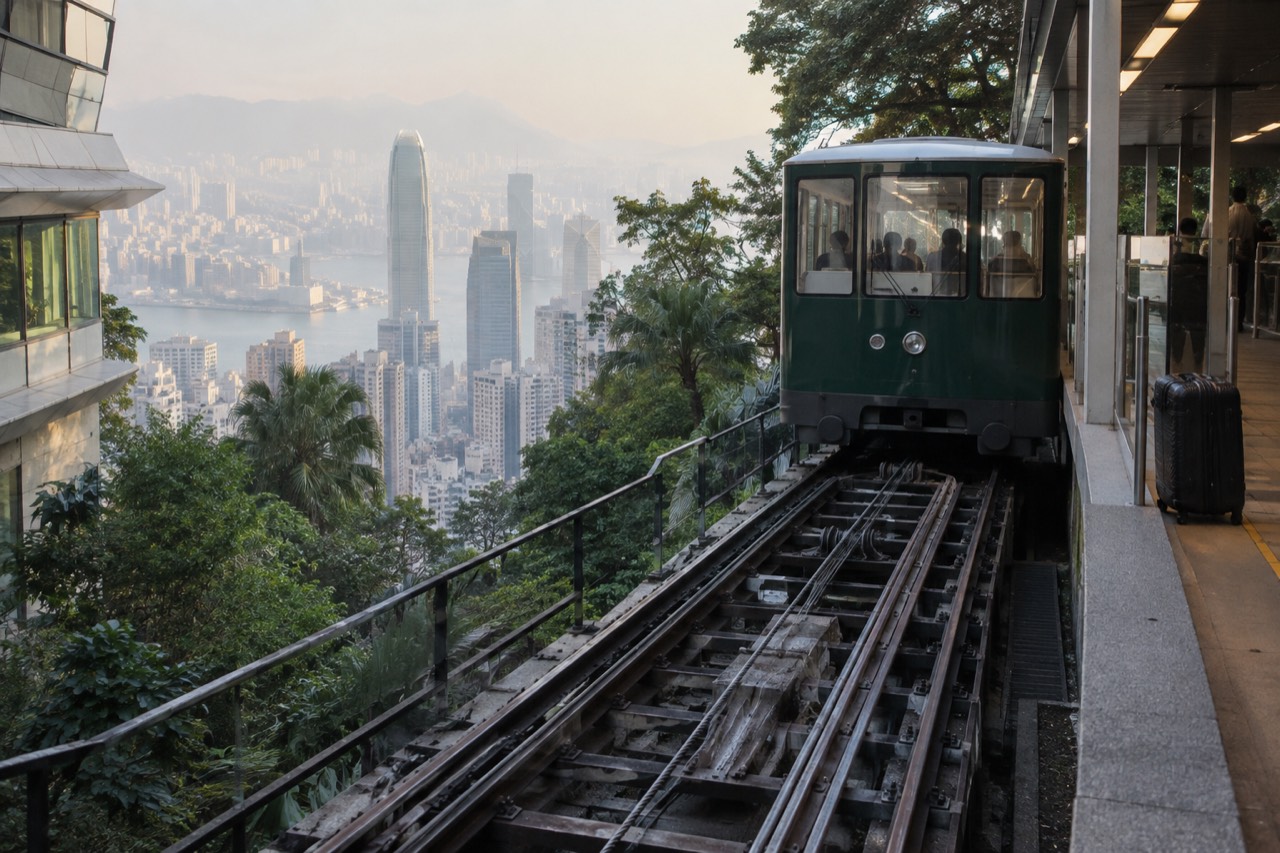
The Peak Tram does not run to a timetable that any visitor can look up, because no such timetable is published. The operator runs the funicular continuously across its operating day, and the only official statement about how the flow works is that queueing time depends on the number of visitors on the day. That single sentence, from the operator's own FAQ, is the whole of the published guidance on the matter, and it is more honest than the invented "every 10 to 15 minutes" figures that circulate on travel forums and stale blog posts.
What a reader planning a visit actually needs is a different set of numbers, all of them published and verifiable. The tram runs from 7:30 in the morning until 11 at night, every day of the week including public holidays. Each sixth-generation car carries 210 passengers, 167 of them seated. The ride itself takes roughly six minutes one way between the Central Terminus at 33 Garden Road and the Peak Terminus at 396 metres above sea level. This article sets out what those figures mean for turning up without a fixed time, what the 2022 rebuild changed, and why buying a ticket in advance does not change how the boarding queue works.
How frequently does the Peak Tram run?
The Peak Tram departs continuously throughout its operating day rather than on a fixed published schedule, and no official source states a departure frequency for any hour, day or season. The operator's own FAQ says only that "the queueing time will depend on the number of visitors on the day." The service runs 7:30 am to 11 pm, Monday to Sunday and on public holidays, at both termini.
That answer frustrates people who want a number, and the frustration is reasonable. But every specific frequency figure you will find on the open web, whether it is "every 10 minutes", "every 15 to 20 minutes" or "a car every few minutes in the morning", is an invention. None of those figures appears in any official source held for this site, and the operator, which runs the tram, publishes none of them. A page that prints a frequency is guessing, and a page that guesses about the tram is probably guessing about everything else on the subject too.
What continuous operation means in practice is simpler than a timetable would be. Cars go up, unload, reload and come back down, on a cycle short enough that the operator has never needed to publish intervals. The ride takes approximately six minutes one way on 1,278 metres of track, so the physical floor on the cycle is low. The real variable is not the machinery but the crowd: how many people are waiting at the Central Terminus determines how quickly the queue drains, and the operator says exactly that and nothing more.
The one piece of official crowd-timing guidance that exists anywhere is this, verbatim from the operator's FAQ: "During public holidays or festive seasons, crowd control management will be implemented. Visitors are encouraged to purchase tickets in advance and come before 3pm during non-peak hours." Every timing recommendation on this site is built on that sentence plus the Hong Kong Observatory's weather normals, and on nothing else, because nothing else is published.
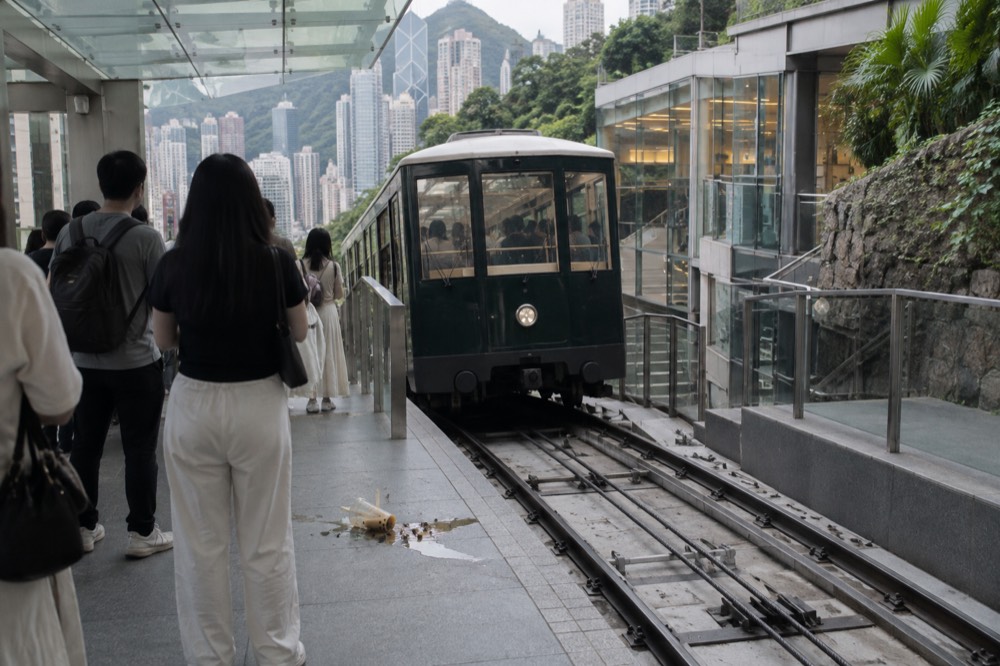
If you are deciding whether to commit to a date and time now, the practical question is not frequency but availability of the ticket type you want, since the operator sells online for same-day visits and up to 30 days ahead.
The three options above cover the decisions most visitors are actually making: a one-way tram ride at the published from-price, the round-trip tram with Sky Terrace 428 admission that most first-time visitors want, and deck-only admission for anyone planning to arrive by bus, minibus, taxi or on foot.
Why there is no timetable to print
The operator publishes no departure schedule, no trams-per-hour figure and no first or last car time beyond the 7:30 am opening and 11 pm closing of the service. It also publishes no queue duration for any hour or season. Anything more specific than that, on any other page, is an unsupported figure, and the tram's own FAQ is the only official word on how the flow is managed.
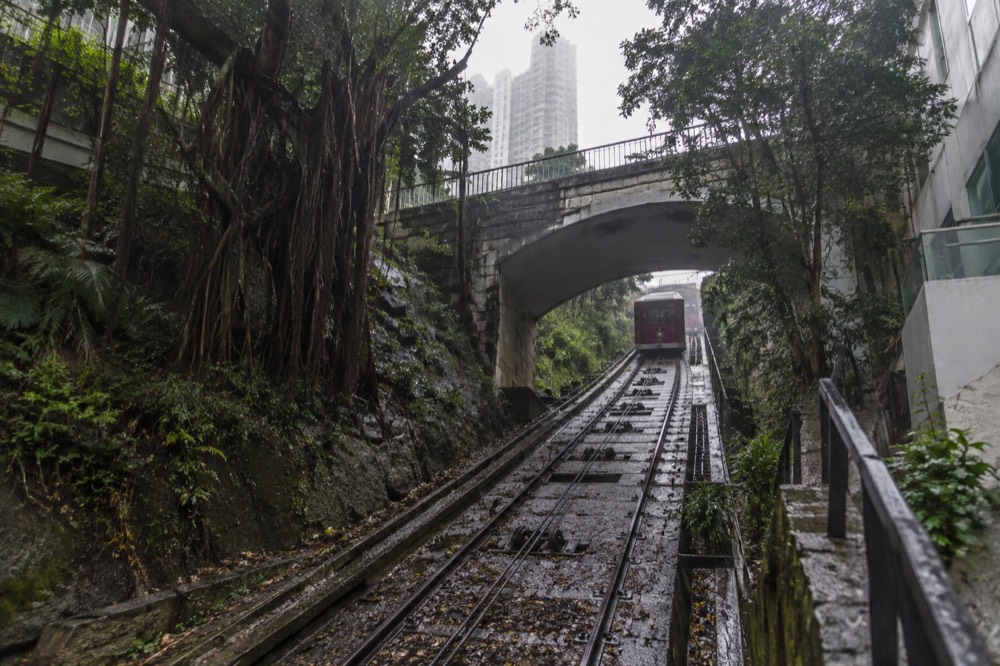
The reason is structural. A funicular on a single reversible track with two cars cannot meaningfully run to a public timetable the way a railway with passing loops can. The cycle is fixed by the physics of the haulage: two 50.5 mm ropes move a 55-tonne car up and down the 1,278-metre line, and the gradient runs from 4 degrees to a steepest section of 25.7 degrees where the tracks pass below May Road. When the system runs normally, the interval between departures is a function of loading and unloading, not of a printed grid.
This is also why the operator's timed tickets exist. The timed slots are, in the operator's own words from its official FAQ, "designed to help manage the flow of visitors, but they do not provide priority boarding." A timeslot is a planning tool for the operator's side of the gate, not a reservation of a seat on a named departure. The FAQ adds that timeslot holders should arrive at the Central Terminus within the timeslot stated on the ticket, and that queueing time depends on visitor numbers on the day.
For a reader used to European mountain railways or Japanese funiculars with printed minute-by-minute schedules, the adjustment is mental rather than practical. You do not plan around a departure time. You plan around a window of the day, a weather forecast and the operator's own advice to come before 3 pm outside peak periods. The Peak Tram hours and timetable guide on this site covers the full operating-day picture, including the trap that the tram opens at 7:30 am while Sky Terrace 428 does not open until 8:30 am.
What the 2022 rebuild changed about capacity
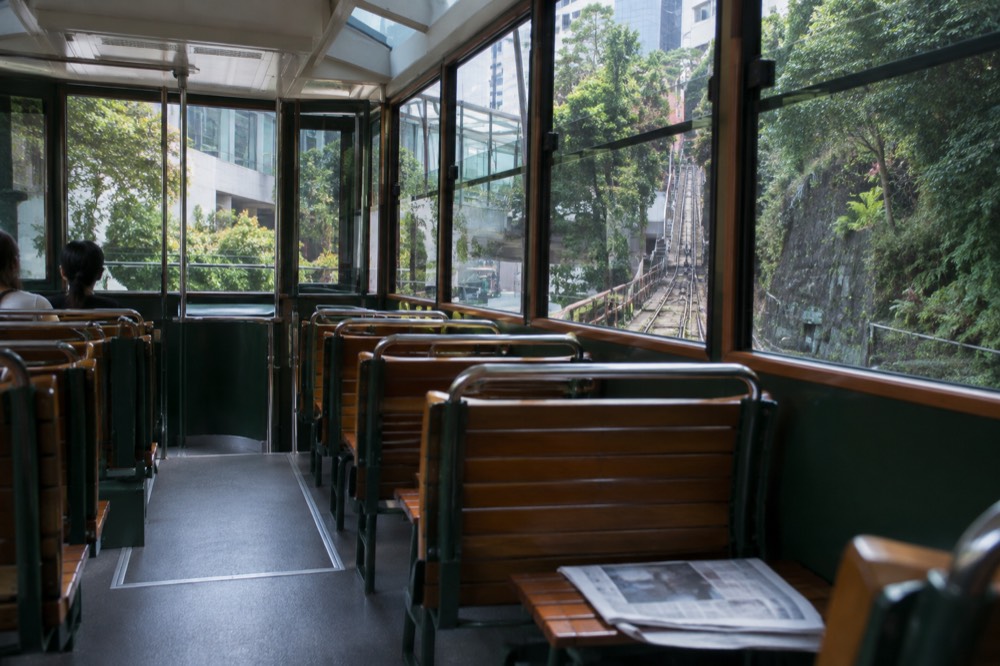
The current Peak Tram carries 210 passengers per car, up from 120 in the retired fifth generation, a 75 per cent capacity increase delivered by the August 2022 rebuild. The split is 167 seated and 43 standing. Any capacity figure below 210, in any article, describes a system that has been out of service since 2021 and is a reliable way to date a page as stale.
The sixth-generation rebuild, completed in August 2022, replaced the haulage, control and signalling systems, installed new tramcars and new track rails, strengthened the foundations and significantly refurbished both termini with enhanced queuing capacity. The new cars are manufactured in Switzerland by Garaventa, CWA and Frey, with wider doors, larger panoramic windows, step-free access for persons with a disability, and a floor with a waveform design for standing passengers. The livery is a bespoke colour the operator calls Peak Tram Green.
For the frequency question, capacity is the hidden half of the answer. A 210-passenger car drains a queue faster than a 120-passenger one ever could, which is why descriptions of queuing written before August 2022 describe a different experience from the one on the ground today. The operator's published fare and ticket page is also the source for the current ticket ladder, which matters here because ticket type determines which queue you stand in.
The seated and standing split answers a question visitors ask constantly: will we get a seat? With 167 seats against 43 standing spots, the odds are strongly in a boarding group's favour when the car is not full, and the operator's published figures let you reason about it rather than guess. The ride is short, roughly six minutes, so a standing spot is a minor cost even in the worst case.
One historical footnote puts the capacity story in perspective: the 1926 electric generation carried 52 passengers, the 1989 fifth generation carried 120, and today's cars carry 210. The tram has been growing its throughput for a century, and the 2022 step was the largest single jump in that arc.
Does buying a ticket change how you wait?
Buying ahead puts you in the "Pre-purchased Ticket Holder" queue, which removes the ticket-counter line, not the boarding line. The operator states plainly that its timed tickets "do not provide priority boarding." Pre-purchase changes where you queue and what you carry in your hand, and it changes nothing about how fast the cars cycle.
The distinction is the single most misrepresented fact about this attraction on the affiliate web. The standard ticket sold through the listing this site features is an entry product, not a queue product. Its own redemption instructions tell holders to line up at the "Pre-purchased Ticket Holder" queue and present the e-voucher QR code at the admission gate, with no separate redemption step. Boarding, the same text states, is subject to the queueing arrangement of Peak Tramways Co Ltd and The Peak Tower Ltd, the two companies that actually run the tram and the tower.
The genuine priority product exists, but it is separate and specific. The operator's own version is the Peak Tram Ruby Special, published at HK$342 for an adult and described by the operator as "Priority Exclusive Access, Daily Limited Quota". Inside the featured listing, priority access exists only in the Ruby Pass option. The cheap options carry no priority at all, and a page that promises "skip the line" on a standard tram ticket is describing a product that does not exist.
Redemption itself is frictionless in a way that does help the flow. The QR code can be shown on a phone or on paper, and the operator's FAQ advises turning the screen brightness up and holding the code about 2 to 3 cm from the sensor. An Octopus card, by contrast, cannot be used for direct entry at the gate: it works at the counter to buy a ticket, and on board at the intermediate stations, but not at the admission gate itself, which is a three-part answer most forum advice gets wrong. The Octopus card on the Peak Tram article covers that split in full.
If you are weighing whether to fix a date now against turning up on the day, the operator's own booking window runs from same-day purchases out to 30 days ahead, with a maximum of 10 tickets per ticket type per transaction and group rates starting at 20 people.
The featured listing carries a 4.6 rating across 41,347 reviews, and its headline from-price of $10.59 buys a one-way adult tram ride with no Sky Terrace 428 admission and no ride back down, which is worth knowing before you compare it against anything.
When the tram is running at all: hours and closures
The Peak Tram runs 7:30 am to 11 pm every day, including public holidays, at both the Central and Peak termini. The Peak Tower is open 7 am to 11 pm, and Sky Terrace 428 is open only 8:30 am to 10 pm. When a tropical cyclone warning signal no. 8 or above, or a special inclement weather warning, is hoisted, the tram and the deck close.
Those three opening spans sit side by side in the hours panel on the operator's own pages, and the mismatch between them is a trap visitors walk into at both ends of the day. Take one of the first trams at 7:30 am with a combo ticket and you arrive at the top a full hour before the paid deck opens. Stay for the last of the night view and the deck has already shut an hour before the tower and the tram do. The published enquiry number for the tram is (852) 2522 0922.
| What | Opens | Closes | Days |
|---|---|---|---|
| Peak Tram, both termini | 7:30 am | 11 pm | Monday to Sunday and public holidays |
| The Peak Tower | 7 am | 11 pm | Monday to Sunday and public holidays |
| Sky Terrace 428 | 8:30 am | 10 pm | Monday to Sunday and public holidays |
The cyclone rule is the one closure fact that can be stated permanently, because it is evergreen and published. Signal 8 or above, or a special inclement weather warning, closes both the tram and the deck, and the road services, bus 15 at HK$13.00, bus X15 at HK$16.80 and green minibus route 1 at HK$11.80 in full adult fares, remain the way up and down on such a day. Temporary maintenance suspensions and event-day arrangements also happen, and those are dated notices, which is why this article does not restate any of them: the site carries a self-updating notices surface for exactly that, and nothing dated belongs in evergreen prose.
One more published negative decides some trips entirely: there is no luggage storage at the Peak Tram stations or in The Peak Tower, which matters to anyone routing the Peak between a hotel checkout and a flight. And the Peak Tram is not the Hong Kong street tram, the double-decker "ding ding" that runs on flat ground along the north shore of Hong Kong Island. The Peak Tram is a funicular between Garden Road and Victoria Gap, and the two systems share nothing but the word tram.
Does the season or month matter for the ride?
No month changes how the tram runs, but the Hong Kong Observatory's 30-year normals change how likely you are to see anything from the top, and October, November and December are the clearest months on the record, at 55, 52 and 48 per cent of possible bright sunshine respectively. February and March are the poorest for a view, with the year's highest fog-day counts.
The Observatory's figures are Hong Kong-wide normals for 1991 to 2020, not measurements taken on Victoria Peak, and stating that scope honestly is part of using them. What they show is a pattern the vague "visit in autumn" advice never quantifies. October gives 55 per cent of possible bright sunshine, 58 per cent mean cloud and 120.3 mm of rain, with no normal fog days. November is close behind at 52 per cent sunshine and just 39.3 mm of rain. December has the lowest mean cloud of the year at 57 per cent and the lowest rainfall at 28.8 mm.
| Month | Possible bright sunshine | Mean cloud | Rainfall | Mean fog days |
|---|---|---|---|---|
| January | 43% | 62% | 33.2 mm | 0.20 |
| February | 32% | 72% | 38.9 mm | 1.10 |
| March | 27% | 77% | 75.3 mm | 1.47 |
| June | 36% | 77% | 491.5 mm | 0 |
| October | 55% | 58% | 120.3 mm | 0 |
| December | 48% | 57% | 28.8 mm | 0.03 |
March is the year's murkiest month, with the lowest sunshine share of any month and 1.47 mean days with visibility under 1,000 metres, and February holds another 1.10. A "fog day" in this dataset means exactly that visibility threshold, and the whole year averages 3.70 of them, of which February and March hold 2.57 between them. The reason a spring visit disappoints is cloud and fog, not rain, and only the fog column shows it.
The cyclone risk also has a published monthly profile in signal-8-or-above days per year: August 0.80, September 0.67, July 0.53, June 0.27, October 0.13, and nil from November through April. The operator recommends checking the Hong Kong Observatory's two Victoria Peak webcams before travelling, one looking east and one looking north-northeast, which is the only live visibility check that exists for this trip. The best time to visit the Peak guide works through the full month-by-month picture.
Turning up without a fixed time: how to plan around it
Plan around a window, not a departure. Arrive within the operator's advised non-peak window, before 3 pm, on a clear month if the view is the point, and buy whichever ticket type you actually need in advance so the counter queue is not part of your day. Then treat the boarding queue as the one part of the trip you cannot schedule, because no published figure lets you do otherwise.
The decision that matters most is ticket type, and it is worth making deliberately. A one-way tram ride gets you up the hill but leaves the descent to bus 15, bus X15, minibus 1 or a walk down, and a tram-only ticket of any kind carries no Sky Terrace 428 admission. The operator is explicit that you cannot assemble the combo saving by buying the parts separately: "you must select the Peak Tram Special Combo tickets to enjoy the best price." At the gate, the combo runs HK$146 adult single with the tram ride and HK$182 with a return, against HK$82 and HK$116 for the tram alone and HK$80 for deck admission on its own.
The featured listing packages those same choices, and its option names are the stable structure to shop by: One-way Peak Tram, Round-trip Peak Tram, Sky Terrace 428 admission, and the two tram-plus-deck combinations. Hong Kong has no VAT or GST and the operator charges no online handling fee, so the price you see is the price you compare. If the deck is roped off in part on the day you visit, the West Deck of Sky Terrace 428 can be hired as a private venue, which explains a closure visitors otherwise read as a fault.
For the wait itself, the honest framing is this: the queue at Victoria Peak Hong Kong tram stations is the one variable nobody can number for you in advance, and any page that tries is selling certainty that does not exist. What you can control is the ticket queue, by pre-purchasing; the weather odds, by picking a clear month; the time of day, by following the operator's own before-3 pm guidance; and the deck hours, by not booking the first tram of the morning with a combo ticket. The how long is the tram queue article covers why no honest answer to that question exists, and the buy Peak Tram tickets in advance piece covers what pre-purchase does and does not buy you.
You can also check live availability for your date through the operator's listing before committing to a plan.
Common questions about how often the Peak Tram runs
How frequently does the Peak Tram run?
The tram runs continuously rather than to a published timetable, and no official source states a departure frequency. The operator's own FAQ says queueing time depends on the number of visitors on the day. The service operates 7:30 am to 11 pm every day, including public holidays, at both termini.
Does the Peak Tram have a timetable I can download?
No. The operator publishes no departure schedule, no trams-per-hour figure and no frequency for any season. Any specific interval you read elsewhere is unsupported. The published facts are the operating span, the roughly six-minute one-way journey and the 210-passenger capacity of each current car.
Does buying a ticket in advance mean I skip the queue?
No. A pre-purchased ticket puts you in the "Pre-purchased Ticket Holder" queue, which removes the ticket-counter line, not the boarding line. The operator states that its timed tickets do not provide priority boarding. Priority access exists only in the Ruby Pass option and the operator's Ruby Special at HK$342 adult.
What time does the first Peak Tram leave?
The service starts at 7:30 am at both the Central and Peak termini, Monday to Sunday and on public holidays. Note that Sky Terrace 428 does not open until 8:30 am, so an early combo ticket cannot be used in full on arrival at the top.
Does the tram run less often in bad weather?
No reduced-weather schedule is published. The one published weather rule is a closure: when a tropical cyclone warning signal no. 8 or above, or a special inclement weather warning, is hoisted, the Peak Tram and Sky Terrace 428 close, and the road services remain the way up and down.
How many people fit on one Peak Tram car?
Each sixth-generation car carries 210 passengers, 167 seated and 43 standing, following the August 2022 rebuild. The previous fifth generation carried 120, so any capacity figure below 210 comes from a source describing the retired system.