Which side of the Peak Tram is better?
The seating decision that changes what you see on the climb: what each side of the Peak Tram shows, what reviewers say, and when the choice stops mattering.
Which side of the Peak Tram is better?
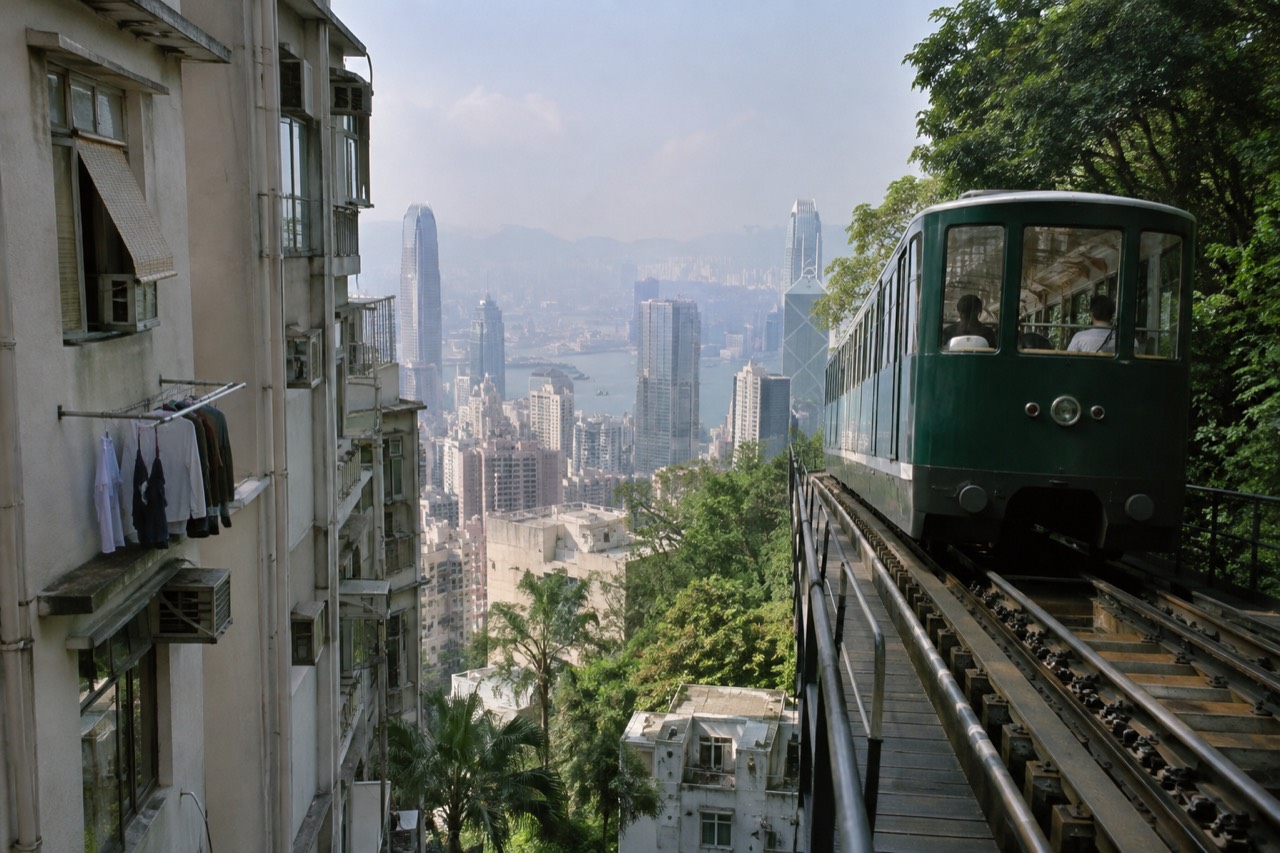
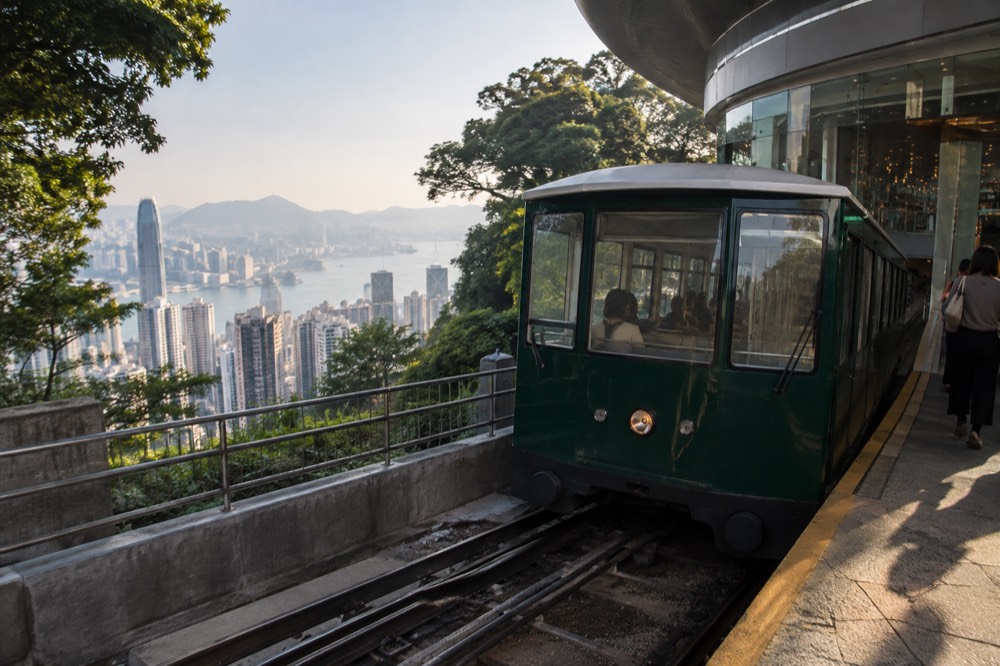
The popular answer, the one repeated across guest reviews of the tram, is the right side going up. The operator itself publishes nothing about seat sides, so this is visitor opinion rather than official guidance, but it has a physical logic: the right side faces the harbour and the tall buildings of Central and Mid-Levels as the car climbs, while the left side faces mostly into the hillside. Coming down, the sides swap.
The question matters more on this ride than on most, because the Peak Tram is not a normal railway carriage. It is a double reversible funicular on 1,278 metres of track, running between the Central Terminus at 33 metres above sea level and the Peak Terminus at 396 metres, and the six-minute journey is steep enough that the view out of the window is tilted with it. The gradient runs from 4 degrees to 25.7 degrees, with the steepest section where the tracks pass below May Road. At that angle the city does not just slide past the window, it appears to lean.
That lean is not an illusion invented by enthusiastic reviewers. The operator's own page on the tram records that a study by The University of Hong Kong, published in the journal Psychological Science in 2013, found that passengers riding uphill experience a visual illusion in which the high-rises to the right of the tram appear to lean toward the Peak. The operator is the source for that finding, and it is the single best documented reason the uphill ride feels strange and memorable on the right-hand side in particular.
Why reviewers point to the right side going up
Guest reviews of the tram, including the recent reviews attached to the standard ticket listing, repeatedly name the right side for the uphill ride, and the reason is the view of the harbour and the Central skyline. The operator publishes no seat-side advice at all, so the honest framing is that this is the consistent popular answer rather than an official fact. Going down, the same logic puts the harbour on the left.
The physical case for the right side is straightforward. The line climbs from Garden Road through Mid-Levels, and the harbour and the towers of Central and Wan Chai lie to the east of the alignment. A passenger seated on the right, facing up the hill, has those towers between themselves and the water for most of the climb. A passenger on the left is looking into the slope, the retaining walls and the vegetation, with occasional framed glimpses rather than a continuous panorama. The right side is the side the postcard photographs are taken from, and the reviews say so in almost identical words, one after another.
What the reviews cannot tell you, and what the operator's engineering pages can, is how steeply that view is presented. The track runs from the Central Terminus at 33 metres above sea level up to the Peak Terminus at 396 metres, and the steepest pitch sits below May Road. The 2013 University of Hong Kong study, cited on the operator's own tram page, found that the uphill visual illusion makes the buildings on the right appear to lean toward the Peak. That is the ride's signature effect, it happens on the right side going up, and no amount of seat-swapping reproduces it on the left.
What each side of the tram actually shows
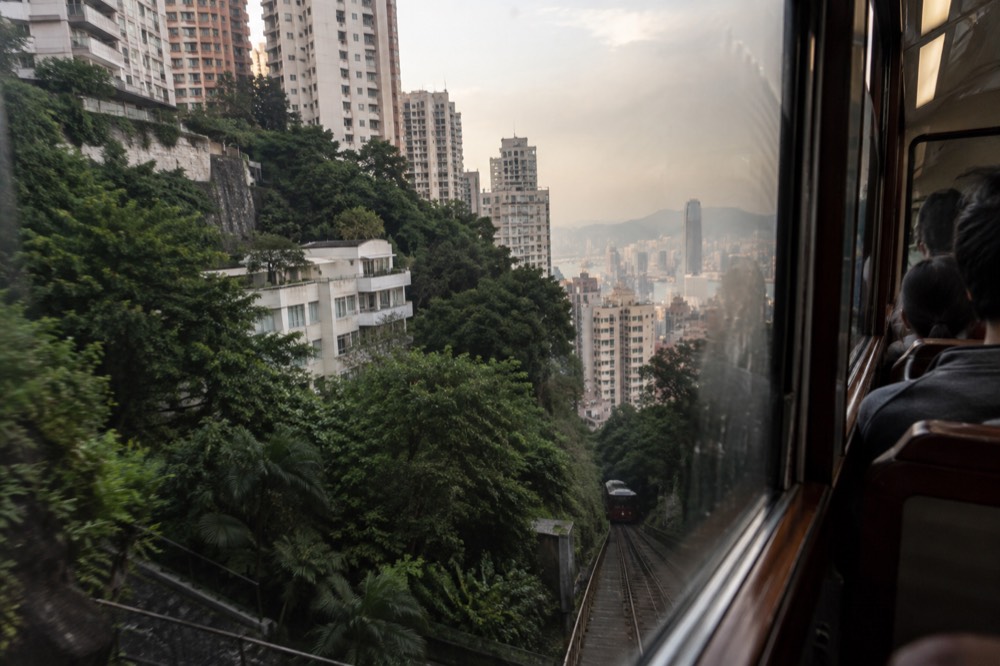
On the uphill ride the right side carries the harbour, Central's towers and the leaning-building illusion, while the left side carries the hillside, close-up greenery and brief framed views over Kennedy Road and the Mid-Levels. The left side is not a wasted seat, it is a different one: quieter, greener, and in some ways better for photographs without glass glare from the opposite side of the car.
The table below is a fair summary of what each side offers on the climb, built from the operator's published track description and the consistent pattern in guest reviews rather than from any official seat map, because no official seat map exists.
| Side going up | What you mainly see | Best for |
|---|---|---|
| Right | Harbour, Central and Wan Chai towers, the leaning-building illusion at the steep section | The classic first-time view, photography of the skyline |
| Left | Hillside, retaining walls, greenery, framed glimpses over Mid-Levels and Kennedy Road | A calmer ride, avoiding the busiest side of the car |
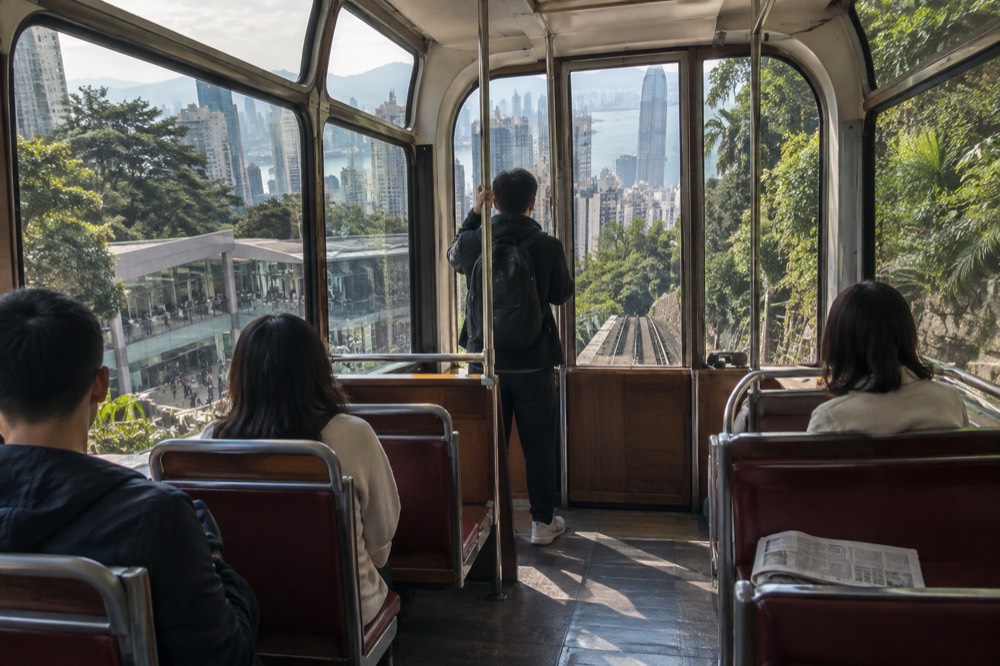
Two things soften that contrast. First, the sixth-generation tramcars that entered service in the August 2022 rebuild have larger panoramic windows than their predecessors, so even the hillside side gets more light and more of the city than the old cars allowed. Second, the floor of the standing area carries a waveform design, and the standing passengers spread along both sides, which means the view is not exclusively a seated privilege. The 210-passenger capacity of the current cars breaks down as 167 seated and 43 standing, a split the operator publishes and almost nobody repeats, and it is exactly the number a reader asking about seat sides is implicitly asking about.
The seating math: 167 seats, 43 standing spots
Each sixth-generation tramcar carries 210 passengers, 167 seated and 43 standing, a split published by the operator after the August 2022 rebuild. Nobody can reserve a seat, seats are taken on a first-come basis at boarding, and the operator states plainly that its tickets do not provide priority boarding, so the side you get depends on where you are in the boarding group.
This is the part of the question no review answers honestly. Choosing the right side is only possible if a right-side seat is free when you board, and boarding order is not something any ticket can fix. The operator's own FAQ, available at the operator's FAQ page, states that timed tickets "do not provide priority boarding" and that queueing time depends on the number of visitors on the day. In the site's own words: buying ahead removes the ticket-counter line, not the boarding line, and no published figure exists for how long either line runs at any hour of any day.
The practical reading of the 167-seat number is that most boarding passengers do get a seat, and the practical reading of the reviews is that the right side fills first. Families and groups who want to sit together should expect to split across the aisle rather than bank on a full row on the harbour side. If the right side is full when you board, the standing area at the ends of the car still has windows, and the panoramic glazing installed in the 2022 rebuild means the view is not lost, only framed differently.
Does the side matter on the way down?
Coming down, the sides swap: the harbour view moves to the left of the car as it faces downhill, and the leaning-building illusion weakens because the study that documented it was conducted on the uphill ride. A round-trip passenger who sits right going up and left going down sees the full picture, which is one quiet argument for buying a return ticket rather than a single.
The downhill ride is the same track, the same six minutes, and the same gradient, but the seating geometry reverses. The towers that leaned toward the Peak on the way up are now below and behind you on the harbour side, and the illusion the University of Hong Kong study recorded is described for the uphill journey specifically. Downhill, the right side faces into the hill and the left side faces the water. A one-way ticket holder walking down instead of riding misses this entirely, and there is a whole separate piece on walking down from the top for anyone weighing that option.
The fare ladder makes the round-trip decision concrete. The operator's published gate fares for the tram alone are HK$116 adult return and HK$82 adult single, with concession rates of HK$75 return and HK$52 single for a child aged 3 to 11, a senior 65 or above, or a holder of the HKSAR Registration Card for people with Disabilities. The booking listing's cheapest option, from $10.59, is the one-way adult tram ride only, with no Sky Terrace 428 admission and no ride back down. Anyone planning to sit right going up and left coming down needs the return, not the single.
When the side genuinely does not matter
On a foggy day, at night, or in the murkiest months of the year, the side choice stops mattering because there is nothing on either side to see. The Hong Kong Observatory's 30-year normals show February and March as the poorest months for visibility, with 1.10 and 1.47 mean days of visibility under 1,000 metres respectively, while October through January are the clearest.
The weather numbers deserve a longer look, because they are the only published basis for judging whether the view from either side will exist at all. The Observatory's monthly normals for 1991 to 2020, recorded at the Observatory's own station and published at the Hong Kong Observatory, are Hong Kong-wide figures rather than Peak-specific measurements, and they say the following about the months visitors actually travel in.
| Month | Sunshine share | Mean cloud | Rain | Fog days (visibility under 1,000 m) |
|---|---|---|---|---|
| October | 55% | 58% | 120.3 mm | 0 |
| November | 52% | 58% | 39.3 mm | 0 |
| December | 48% | 57% | 28.8 mm | 0.03 |
| February | 32% | 72% | 38.9 mm | 1.10 |
| March | 27% | 77% | 75.3 mm | 1.47 |
The pattern is blunt. October, November and December are the clear months, and February and March are the murky ones, and March is the worst of the year for sunshine at 27 per cent of possible bright sunshine. A foggy March morning makes the seat-side debate academic: both sides of the car look at cloud. The operator itself tells visitors to check the Hong Kong Observatory's two Victoria Peak webcams before travelling, one looking east and one looking north-northeast, which is the only live visibility check that exists for this trip. Checking the webcam before choosing a departure time does more for your view than any seat does.
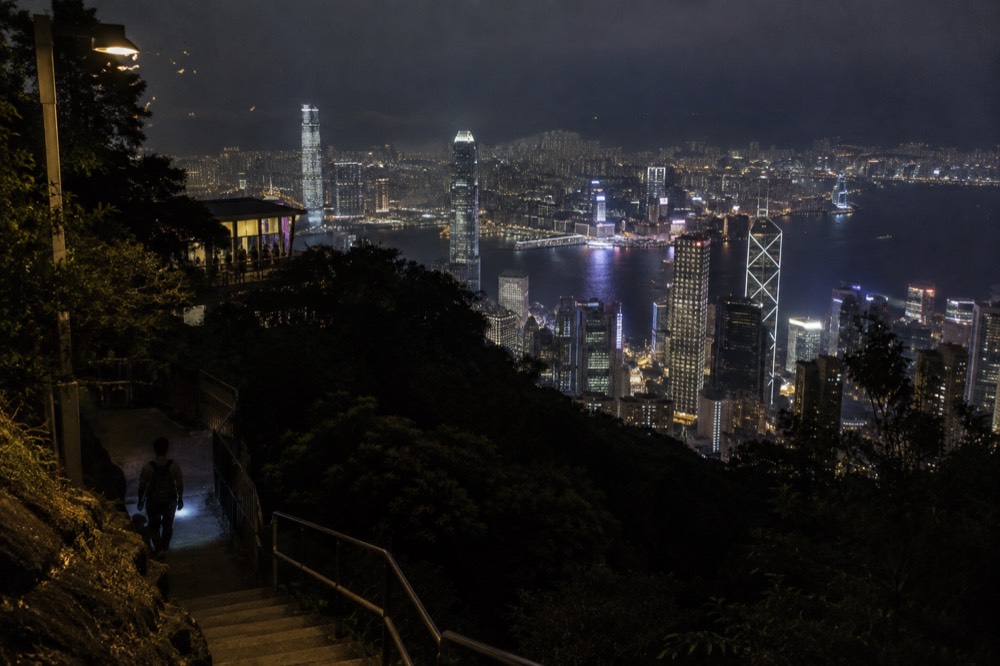
Night is the other great equaliser. After dark the harbour side shows the lit skyline, which is the reason the debate exists at all, but the hillside side shows almost nothing, and the deck at the top, Sky Terrace 428, closes at 10 pm while the tram itself runs until 11 pm. There is a fuller treatment of the evening case in the Peak after dark, including what stays open later than the viewing deck does.
Getting the seat you want in practice
No seat can be reserved, no ticket provides priority boarding, and no published figure exists for how long the boarding line runs, so the only levers are timing and boarding position. The operator's sole published crowd-timing guidance is to purchase tickets in advance and come before 3pm during non-peak hours, and the tram starts at 7:30 am, an hour before Sky Terrace 428 opens.
That single operator sentence, from its own FAQ, is the only official timing advice that exists anywhere, and it is worth reading exactly as written: "During public holidays or festive seasons, crowd control management will be implemented. Visitors are encouraged to purchase tickets in advance and come before 3pm during non-peak hours." Everything else on the subject, every "go early to beat the crowds" line on the open web, is invention. What can be added honestly is the hours trap: the first tram of the day leaves at 7:30 am, but Sky Terrace 428 does not open until 8:30 am, so an early combo ticket cannot be used in full on arrival.
Boarding mechanics are simpler than the forums make them. Pre-purchased ticket holders line up in their own queue and show the e-voucher QR code at the gate, with no separate redemption step. The operator adds a small published detail that helps at the gate: the code may be shown on a phone or on paper, with the screen brightness turned up, and the best scanning distance is about 2 to 3 cm from the sensor. An Octopus card cannot be used for direct entry at the gate, though it can be used to buy a ticket at the counter and to pay on board at the intermediate stations, a three-part answer the operator publishes and the forums routinely get wrong. There is a dedicated piece on using an Octopus card on the Peak Tram for the full version.
One last practical note that no seat-side article usually carries: tripods and lighting equipment are not allowed on the Peak Tram, in The Peak Tower or on Sky Terrace 428, and drones are prohibited on the operator's property without management permission. If the plan was to brace a tripod against the window on the harbour side, the operator's own rules rule it out. Handheld photography from the right side going up remains entirely allowed, and free Wi-Fi is available at both tram termini, in The Peak Tower and on Sky Terrace 428 for uploading the results.
The honest summary on seat sides
Sit on the right going up if the choice exists, because that is where the harbour, the Central towers and the documented leaning-building illusion are, and sit on the left coming down for the same view in reverse. But treat it as a preference, not a promise: seats are first-come, the operator sells no seat reservation and no priority boarding, and on a foggy February or March morning both sides look at the same cloud.
The seat is the smallest variable in a trip that has much larger ones. Whether the tram is running at all on your date, whether the deck at the top is open when you arrive, and whether the air is clear enough to see the harbour from any window all matter more than which side of the car you occupy. The one bookable listing this site features, described in full on the Peak Tram ride guide, spans tram-only and tram plus Sky Terrace 428 options, and the choice between those options changes the day far more than the choice of seat does. The cheapest option, from $10.59, buys a one-way adult tram ride with no deck admission, and the operator's own gate fares put the adult tram-plus-deck combination at HK$146 single and HK$182 return.
For anyone who wants the full picture of Victoria Peak Hong Kong rather than just the ride, the free alternatives at the top are real and worth knowing: the Peak Galleria rooftop viewing deck is free, and so are Lugard Road, Harlech Road and Victoria Peak Garden, which the operator publishes at 554 metres, higher than the paid deck at 428 metres. The seat-side question is a six-minute decision inside a much bigger one.
If the round-trip combination is more ticket than the day needs, the tram-only and single-ride options cover the same climb at the operator's lower gate fares, and the full selection below lays the choices side by side.
Common questions about the Peak Tram seat sides
Which side of the Peak Tram is better?
The consistent answer in guest reviews is the right side going up, which faces the harbour and the Central skyline, with the left side facing the hillside. Coming down, the sides swap and the harbour view is on the left. The operator publishes no official seat-side guidance, so treat it as popular opinion with a physical logic behind it.
Can you reserve a seat on the Peak Tram?
No. Seats are taken on a first-come basis at boarding, and the operator states that its tickets do not provide priority boarding. The current tramcars seat 167 passengers with standing room for 43 more.
Does buying a ticket in advance let you skip the line?
Pre-purchase removes the ticket-counter line, not the boarding line. The operator says queueing time depends on the number of visitors on the day, and no published wait figure exists for any hour or season.
Is the view better going up or coming down?
The view is the same track in reverse, but the documented leaning-building illusion was recorded on the uphill ride, and the harbour sits on the right going up and the left coming down. A round-trip ticket lets you take both sides.
What is the best time of day to get a good seat?
The only official guidance is the operator's own: purchase tickets in advance and come before 3pm during non-peak hours. The tram starts at 7:30 am, while Sky Terrace 428 opens at 8:30 am, so an early combo ticket cannot be used in full on arrival.
Does the seat side matter if the weather is bad?
Not much. The Observatory's 30-year normals mark February and March as the poorest months for visibility, and in fog both sides of the car look at cloud. The operator recommends checking the Hong Kong Observatory's two Victoria Peak webcams before travelling.